Gong Zhaoting, Hu Mengjin, Yang Yuejin, Yin Chunlin
State Key Laboratory of Cardiovascular Disease, Fuwai Hospital, National Center for Cardiovascular Diseases, Chinese Academy of Medical Sciences & Peking Union Medical College, Beijing, China.
Department of Cardiology, Xuanwu Hospital, Capital Medical University, Beijing, China.
Cancer Med. 2024 Mar;13(5):e7067. doi: 10.1002/cam4.7067.
Previous observational studies indicated that atrial fibrillation may increase the risk of breast cancer. Following a breast cancer diagnosis, the chance of developing atrial fibrillation may increase as well. However, it is uncertain whether the link is causal or just due to confounding factors.
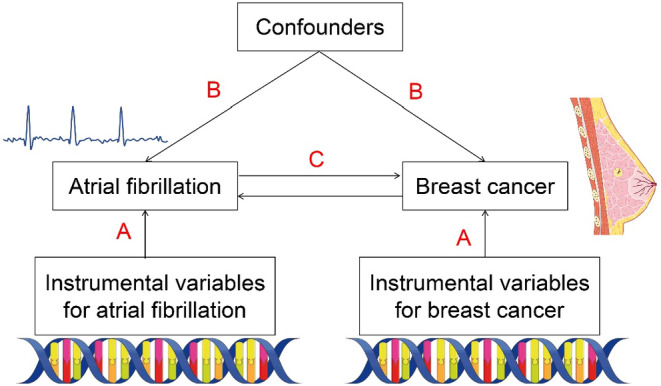
Using bidirectional Mendelian randomization (MR) analysis, we sought to assess the bidirectional causal relationship between atrial fibrillation and breast cancer from a genetic level.
Large genome-wide association studies yielded summary-level data for atrial fibrillation and breast cancer. The preliminary estimate was inverse variance weighted (IVW) under a random model. MR-Egger, weighted median, simple mode, weighted mode, and multivariable MR (adjusting body mass index, smoking, and alcohol drinking) were performed as sensitivity analyses.
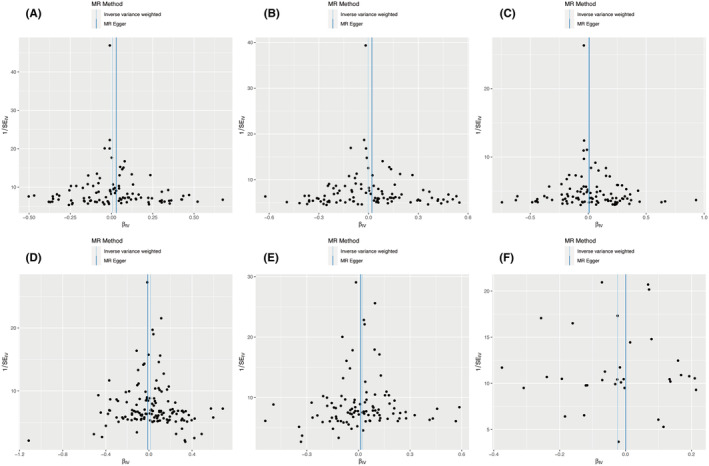
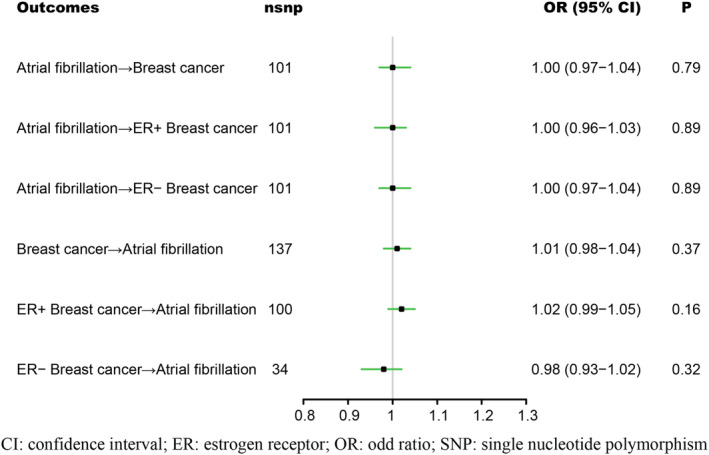
Genetically predicted atrial fibrillation presented no statistically significant association with overall breast cancer (odds ratio [OR] = 1.00; 95% confidence interval [CI]: 0.97-1.04; p = 0.79), estrogen receptor (ER) + (OR = 1.00; 95% CI: 0.96-1.03; p = 0.89) or ER- subtypes (OR = 1.00; 95% CI: 0.97-1.04; p = 0.89). Similarly, genetically predicted overall breast cancer (OR = 1.01; 95% CI: 0.98-1.04; p = 0.37), ER+ (OR = 1.02; 95% CI: 0.99-1.05; p = 0.16) or ER- (OR = 0.98; 95% CI: 0.93-1.02; p = 0.32) subtypes had no causal effect on atrial fibrillation. Sensitivity analyses yielded similar results. Individual single nucleotide polymorphism had little effect on the total estimate. We did not observe any evidence of horizontal pleiotropy.
Our bidirectional MR studies revealed that there may be no causal links between atrial fibrillation and breast cancer.
先前的观察性研究表明,心房颤动可能会增加患乳腺癌的风险。在被诊断出患有乳腺癌后,发生心房颤动的几率也可能会增加。然而,这种联系是因果关系还是仅仅由于混杂因素尚不确定。
我们使用双向孟德尔随机化(MR)分析,试图从基因水平评估心房颤动与乳腺癌之间的双向因果关系。
大型全基因组关联研究产生了心房颤动和乳腺癌的汇总数据。在随机模型下,初步估计采用逆方差加权(IVW)法。进行MR-Egger、加权中位数、简单模式、加权模式和多变量MR(调整体重指数、吸烟和饮酒情况)作为敏感性分析。
基因预测的心房颤动与总体乳腺癌(优势比[OR]=1.00;95%置信区间[CI]:0.97-1.04;p=0.79)、雌激素受体(ER)阳性(OR=1.00;95%CI:0.96-1.03;p=0.89)或ER阴性亚型(OR=1.00;95%CI:0.97-1.04;p=0.89)之间无统计学显著关联。同样,基因预测的总体乳腺癌(OR=1.01;95%CI:0.98-1.04;p=0.37)、ER阳性(OR=1.02;95%CI:0.99-1.05;p=0.16)或ER阴性(OR=0.98;95%CI:0.93-1.02;p=0.32)亚型对心房颤动无因果效应。敏感性分析得出了类似结果。单个单核苷酸多态性对总体估计影响很小。我们没有观察到任何水平多效性的证据。
我们的双向MR研究表明,心房颤动与乳腺癌之间可能不存在因果联系。