Pérez-Peñate Gregorio Miguel, Juliá-Serdá Gabriel, Galván-Fernández Helena, Alemán-Segura Desireé, León-Marrero Fernando, Garcia-Quintana Antonio, de Larrinoa Iñigo Rúa-Fernández, Ortega-Trujillo José Ramón, Gómez-Sánchez Miguel Ángel
Department of Respiratory Medicine Multidisciplinary Pulmonary Vascular Unit, Hospital Universitario Dr. Negrín Las Palmas de Gran Canaria Spain.
CIBER de Enfermedades Respiratorias, Instituto de Salud Carlos III Madrid Spain.
Pulm Circ. 2024 Mar 10;14(1):e12344. doi: 10.1002/pul2.12344. eCollection 2024 Jan.
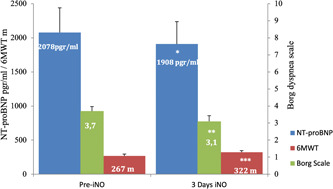
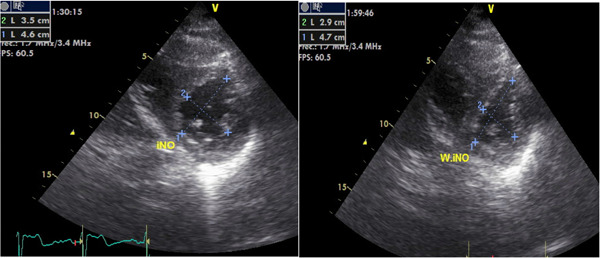
Inhaled nitric oxide (iNO) is a potent and selective pulmonary vasodilator with a safety concern due to rebound pulmonary hypertension (PH) associated with its withdrawal. We report short-term pulsed iNO in patients with severe pulmonary arterial hypertension (PAH) and nonoperable chronic thromboembolic PH (nCTEPH). This is a retrospective analysis of 33 patients: 22 with PAH and 11 with nCTEPH. We assessed hemodynamic, echocardiographic, and other noninvasive variables to evaluate safety and efficacy of iNO. We performed an iNO withdrawal test during right heart catheterization and after 3 days of iNO treatment. iNO significantly improved all variables examined in 22 patients with PAH and 11 with nCTEPH. Two patterns of response were observed after sudden iNO withdrawal. Twenty-nine patients (88%) showed minimal hemodynamic, oxygenation and clinical changes. Four patients (12%) had a reduction in cardiac index ≥20% and PaO ≥ 5%, three patients did not show clinical deterioration, and one patient developed hemodynamic collapse that needed iNO administration. This retrospective study suggests that short-term iNO improves hemodynamics and clinical conditions in some patients with PAH an nCTPEH. However, pulsed iNO withdrawal PH rebound could be a serious concern in these patients. Given the lack of evidence, we do not recommend the use of pulsed iNO in the treatment of patients with chronic PH.
吸入一氧化氮(iNO)是一种强效且具有选择性的肺血管扩张剂,但因其撤药后会引发肺高压反弹(PH)而存在安全隐患。我们报告了重度肺动脉高压(PAH)和无法手术的慢性血栓栓塞性肺高压(nCTEPH)患者短期脉冲式吸入一氧化氮的情况。这是一项对33例患者的回顾性分析:22例PAH患者和11例nCTEPH患者。我们评估了血流动力学、超声心动图及其他非侵入性变量,以评估iNO的安全性和有效性。我们在右心导管检查期间及iNO治疗3天后进行了iNO撤药试验。iNO显著改善了22例PAH患者和11例nCTEPH患者所检测的所有变量。突然撤药iNO后观察到两种反应模式。29例患者(88%)血流动力学、氧合及临床变化极小。4例患者(12%)心指数降低≥20%且动脉血氧分压(PaO)≥5%,3例患者未出现临床恶化,1例患者发生血流动力学崩溃,需要重新给予iNO。这项回顾性研究表明,短期iNO可改善部分PAH和nCTPEH患者的血流动力学及临床状况。然而,脉冲式iNO撤药引发的肺高压反弹可能是这些患者的一个严重问题。鉴于缺乏证据,我们不建议在慢性肺高压患者的治疗中使用脉冲式iNO。