Oved Joseph H, Gibson Nora M, Venella Kimberly, Elgarten Caitlin W, Wray Lisa, Warren Julia T, Olson Timothy S
Division of Pediatric Transplantation & Cellular Therapies, Memorial Sloan Kettering Cancer Center, New York, NY, United States.
Division of Oncology, Department of Pediatrics, Children's Hospital of Philadelphia, Philadelphia, PA, United States.
Front Immunol. 2024 Feb 26;15:1369243. doi: 10.3389/fimmu.2024.1369243. eCollection 2024.
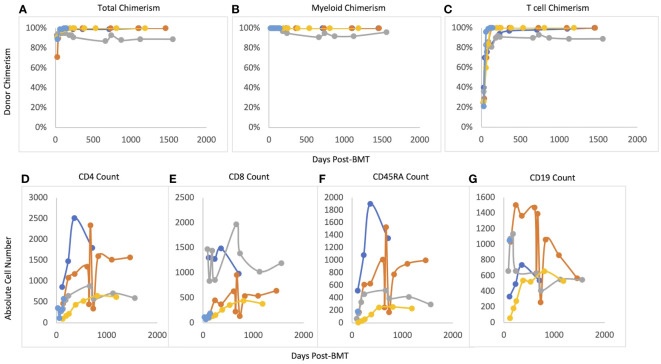
Severe congenital neutropenia (SCN) is caused by germline mutations, most commonly in , impacting neutrophil maturation and leading to high risk of life-threatening infections. Most patients with mutant SCN can achieve safe neutrophil counts with chronic Granulocyte-Colony Stimulating Factor (G-CSF). However, up to 10% of patients have neutropenia refractory to G-CSF and require allogeneic stem cell transplant. Traditional conditioning for these patients includes busulfan and cyclophosphamide which is associated with significant toxicities. We present five patients with SCN without myeloid malignancy transplanted using a reduced toxicity regimen of busulfan, fludarabine and thymoglobulin. 5 pediatric patients with SCN underwent matched sibling donor bone marrow transplant (MSD-BMT) between 2014-2022 on or per CHP14BT057 (NCT02928991), a prospective, single center trial testing elimination of cyclophosphamide from conditioning in pediatric patients with single lineage inherited BMF syndromes. All patients had MSDs and no evidence of MDS. Conditioning consisted of PK-adjusted busulfan, fludarabine, and thymoglobulin, with calcineurin inhibitor and mycophenolate mofetil GVHD prophylaxis. With median follow-up of 48.4 months, overall and event-free survival were 100%. There was no acute GVHD and one instance of chronic limited GVHD. Patients exhibited >95% donor myeloid chimerism at 5 years post-BMT. Two patients experienced CMV reactivation without end-organ disease, and no other viral reactivation or significant infections occurred. MSD-BMT with reduced toxicity myeloablation for SCN provides excellent outcomes while minimizing toxicity. These data suggest that busulfan, fludarabine, and ATG can be considered an efficacious, low-toxicity standard of care regimen for patients with SCN undergoing MSD-BMT.
严重先天性中性粒细胞减少症(SCN)由种系突变引起,最常见于 ,影响中性粒细胞成熟并导致危及生命感染的高风险。大多数突变型SCN患者使用慢性粒细胞集落刺激因子(G-CSF)可实现安全的中性粒细胞计数。然而,高达10%的患者对G-CSF难治性中性粒细胞减少症,需要进行异基因干细胞移植。这些患者的传统预处理包括白消安和环磷酰胺,这与显著的毒性相关。我们报告了5例无髓系恶性肿瘤的SCN患者,采用白消安、氟达拉滨和抗胸腺细胞球蛋白的低毒性方案进行移植。5例SCN儿科患者于2014年至2022年期间接受了匹配同胞供体骨髓移植(MSD-BMT),依据CHP14BT057(NCT02928991)进行,这是一项前瞻性单中心试验,测试在单谱系遗传性骨髓衰竭综合征儿科患者的预处理中消除环磷酰胺。所有患者均有匹配的同胞供体且无骨髓增生异常综合征证据。预处理包括根据药代动力学调整的白消安、氟达拉滨和抗胸腺细胞球蛋白,并使用钙调神经磷酸酶抑制剂和霉酚酸酯预防移植物抗宿主病(GVHD)。中位随访48.4个月,总生存率和无事件生存率均为100%。无急性GVHD,有1例慢性局限性GVHD。患者在BMT后5年表现出>95%的供体髓系嵌合。2例患者出现巨细胞病毒再激活但无终末器官疾病,未发生其他病毒再激活或严重感染。采用低毒性清髓性预处理的MSD-BMT治疗SCN可提供优异的疗效,同时将毒性降至最低。这些数据表明,白消安、氟达拉滨和抗胸腺细胞球蛋白可被视为接受MSD-BMT的SCN患者的一种有效、低毒性的标准治疗方案。