Mehnert Anne, Bershan Sivan, Kollmus-Heege Jil, Gerischer Lea, Herdick Meret Luise, Hoffmann Sarah, Lehnerer Sophie, Scheibe Franziska, Stascheit Frauke, Stein Maike, Buchan Alastair M, Meisel Andreas, Aigner Annette, Mergenthaler Philipp
Charité - Universitätsmedizin Berlin, Department of Neurology with Experimental Neurology, Berlin, Germany.
Charité - Universitätsmedizin Berlin, Center for Stroke Research Berlin, Berlin, Germany.
Front Neurol. 2024 Feb 26;15:1297997. doi: 10.3389/fneur.2024.1297997. eCollection 2024.
Myasthenia gravis (MG) is a rare autoimmune disease characterized by fatigable weakness of the voluntary muscles and can exacerbate to life-threatening myasthenic crisis (MC), requiring intensive care treatment. Routine laboratory parameters are a cost-effective and widely available method for estimating the clinical outcomes of several diseases, but so far, such parameters have not been established to detect disease progression in MG.
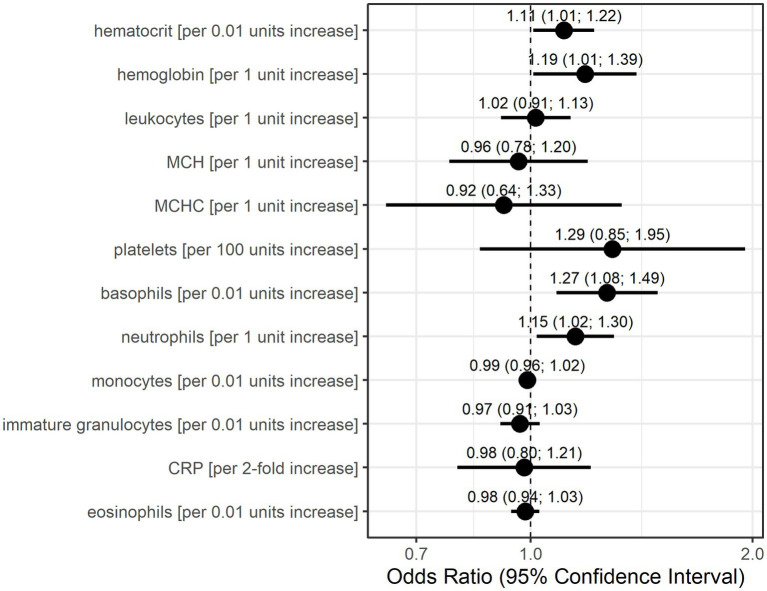
We conducted a retrospective analysis of selected laboratory parameters related to inflammation and hemogram for MG patients with MC compared to MG patients without MC. To identify potential risk factors for MC, we applied time-varying Cox regression for time to MC and, as a sensitivity analysis, generalized estimating equations logistic regression for the occurrence of MC at the next patient visit.
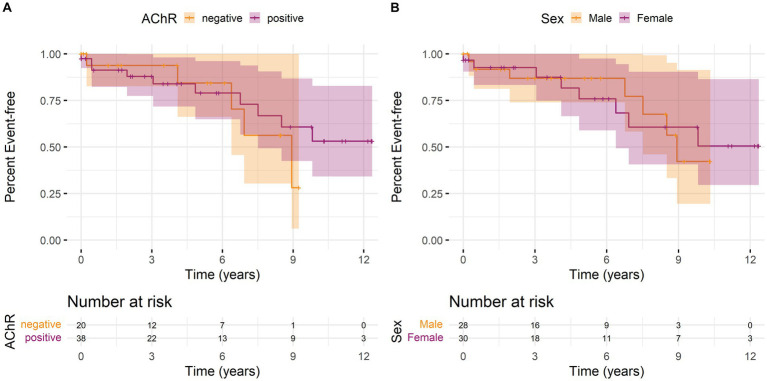
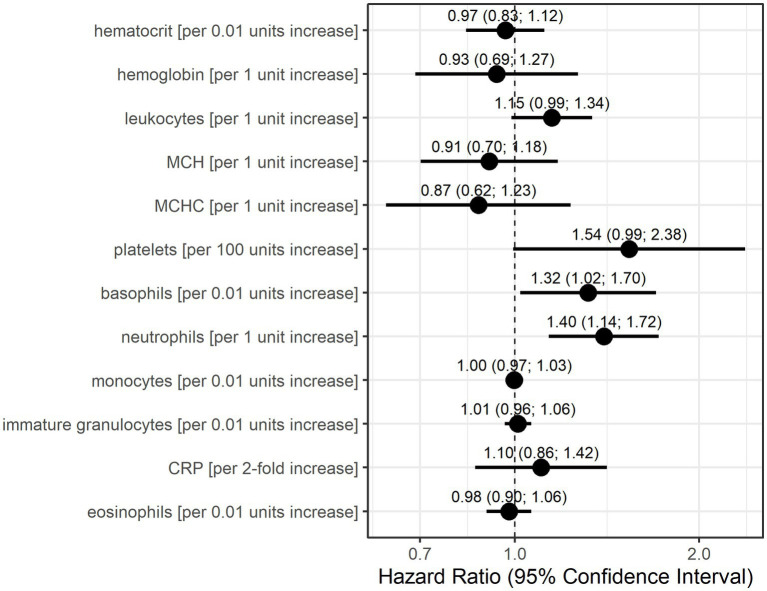
15 of the 58 examined MG patients suffered at least one MC. There was no notable difference in the occurrence of MC by antibody status or sex. Both regression models showed that higher counts of basophils (per 0.01 unit increase: HR = 1.32, 95% CI = 1.02-1.70), neutrophils (per 1 unit increase: HR = 1.40, 95% CI = 1.14-1.72), potentially leukocytes (per 1 unit increase: HR = 1.15, 95% CI = 0.99-1.34), and platelets (per 100 units increase: HR = 1.54, 95% CI = 0.99-2.38) may indicate increased risk for a myasthenic crisis.
This pilot study provides proof of the concept that increased counts of basophils, neutrophils, leukocytes, and platelets may be associated with a higher risk of developing MC in patients with MG.
重症肌无力(MG)是一种罕见的自身免疫性疾病,其特征为随意肌出现易疲劳性肌无力,可恶化为危及生命的重症肌无力危象(MC),需要重症监护治疗。常规实验室参数是评估多种疾病临床结局的一种经济高效且广泛可用的方法,但迄今为止,尚未确定此类参数用于检测MG疾病进展情况。
我们对伴有MC的MG患者与不伴有MC的MG患者的炎症和血常规相关选定实验室参数进行了回顾性分析。为确定MC的潜在危险因素,我们对发生MC的时间应用了时变Cox回归,并作为敏感性分析,对下一次患者就诊时MC的发生情况应用了广义估计方程逻辑回归。
58例接受检查的MG患者中有15例至少发生过一次MC。MC的发生在抗体状态或性别方面无显著差异。两种回归模型均显示,嗜碱性粒细胞计数较高(每增加0.01单位:风险比[HR]=1.32,95%置信区间[CI]=1.02 - 1.70)、中性粒细胞计数较高(每增加1单位:HR = 1.40,95% CI = 1.14 - 1.72)、潜在白细胞计数较高(每增加1单位:HR = 1.15,95% CI = 0.99 - 1.34)以及血小板计数较高(每增加100单位:HR = 1.54,95% CI = 0.99 - 2.38)可能表明重症肌无力危象风险增加。
这项初步研究提供了概念验证,即嗜碱性粒细胞、中性粒细胞、白细胞和血小板计数增加可能与MG患者发生MC的较高风险相关。