Xu Liping, Dai Qiaoding, Zhang Yan, Lin Na, Ji Lina, Song Xinwei
Department of Rheumatology and Immunology, The First Affiliated Hospital of Zhejiang Chinese Medical University (Zhejiang Provincial Hospital of Chinese Medicine), Hangzhou, China.
Department of Rheumatology and Immunology, Wenzhou Hospital of Integrated Traditional Chinese and Western Medicine affiliated to Zhejiang Chinese Medicine University, Wenzhou, Zhejiang, China.
Cell Transplant. 2024 Jan-Dec;33:9636897241236586. doi: 10.1177/09636897241236586.
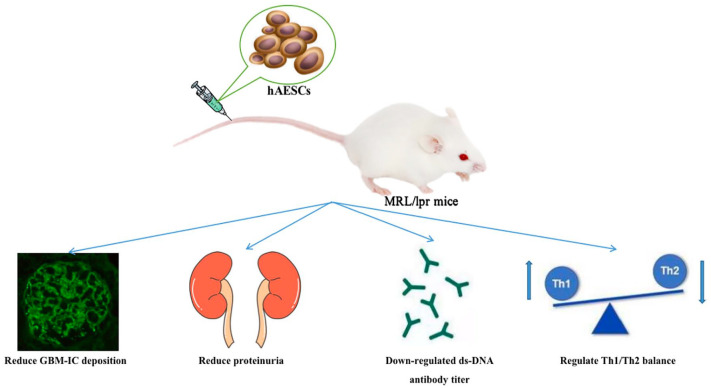
Systemic lupus erythematosus (SLE) is a multi-organ and systemic autoimmune disease characterized by an imbalance of humoral and cellular immunity. The efficacy and side effects of traditional glucocorticoid and immunosuppressant therapy remain controversial. Recent studies have revealed abnormalities in mesenchymal stem cells (MSCs) in SLE, leading to the application of bone marrow-derived MSCs (BM-MSCs) transplantation technique for SLE treatment. However, autologous transplantation using BM-MSCs from SLE patients has shown suboptimal efficacy due to their dysfunction, while allogeneic mesenchymal stem cell transplantation (MSCT) still faces challenges, such as donor degeneration, genetic instability, and immune rejection. Therefore, exploring new sources of stem cells is crucial for overcoming these limitations in clinical applications. Human amniotic epithelial stem cells (hAESCs), derived from the eighth-day blastocyst, possess strong characteristics including good differentiation potential, immune tolerance with low antigen-presenting ability, and unique immune properties. Hence, hAESCs hold great promise for the treatment of not only SLE but also other autoimmune diseases.
系统性红斑狼疮(SLE)是一种多器官、全身性自身免疫性疾病,其特征为体液免疫和细胞免疫失衡。传统糖皮质激素和免疫抑制剂治疗的疗效及副作用仍存在争议。最近的研究揭示了SLE患者间充质干细胞(MSC)存在异常,这促使骨髓源性间充质干细胞(BM-MSC)移植技术应用于SLE治疗。然而,使用SLE患者的BM-MSC进行自体移植,由于其功能障碍,疗效并不理想,而异基因间充质干细胞移植(MSCT)仍面临挑战,如供体退变、基因不稳定和免疫排斥。因此,探索新的干细胞来源对于克服临床应用中的这些局限性至关重要。源自第8天囊胚的人羊膜上皮干细胞(hAESC)具有强大的特性,包括良好的分化潜能、低抗原呈递能力的免疫耐受性和独特的免疫特性。因此,hAESC不仅对SLE的治疗,而且对其他自身免疫性疾病的治疗都具有巨大的潜力。