Ko Dukhan, Choi Yongchul, Lee Kyujin
Department of Sports Science Convergence, Dongguk University, Seoul 04620, Republic of Korea.
Department of Physical Education, Gangneung-Wonju National University, Gangneung 25457, Republic of Korea.
Healthcare (Basel). 2024 Feb 26;12(5):547. doi: 10.3390/healthcare12050547.
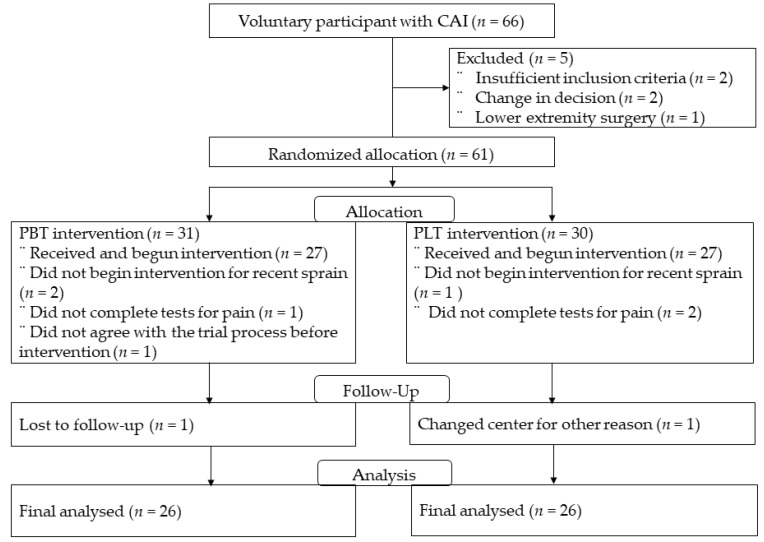
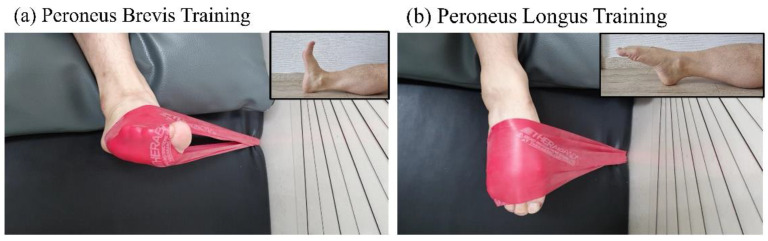
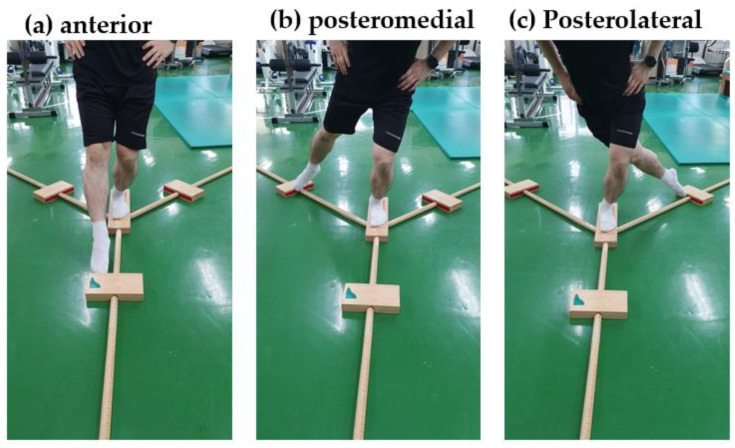
Chronic ankle instability (CAI) is a common injury that can occur in daily life or sporting events. Injuries to the anterior talofibular, posterior talofibular, and calcaneofibular ligaments are common, and the core of rehabilitation training involves strengthening the peroneus muscle. Many studies on rehabilitation training have focused on strengthening the peroneus brevis muscle, and few studies have focused on specific training to strengthen the peroneus longus muscle. Therefore, this study aims to investigate changes in the symptoms and functions of patients by applying training to strengthen the peroneus longus and peroneus brevis muscles. Home-based training and mobile monitoring were utilized for 12 weeks, divided into peroneus brevis training (PBT) and peroneus longus training (PLT), in 52 adult males with CAI. Participation was voluntary, with enrollment done through a bulletin board, and intervention training allocation was randomly assigned and conducted in a double-blind manner. This study was registered as a trial protocol (KCT 0008478). Foot and ankle outcome scores (FAOS), isokinetic ankle strength tests, and Y-balance tests were performed before and after the intervention. Both PLT and PBT significantly improved in FAOS, inversion, and eversion at angular velocities of 30°/s and 120°/s and in the anterior and posterolateral directions of the Y-balance test ( < 0.05). Interaction effects by time and group were not significant for the FAOS ( > 0.05). However, PLT improved eversion muscle strength and muscle power to a greater degree, compared with PBT, in the anterior and posterolateral directions of the Y-balance test ( < 0.05). In conclusion, both PLT and PBT were effective for CAI patients; in addition, PLT had greater potential for improving strength and balance.
慢性踝关节不稳(CAI)是一种常见损伤,可发生于日常生活或体育赛事中。距腓前韧带、距腓后韧带和跟腓韧带损伤较为常见,康复训练的核心在于增强腓骨肌。许多关于康复训练的研究都聚焦于增强腓骨短肌,而针对增强腓骨长肌的特定训练的研究较少。因此,本研究旨在通过应用增强腓骨长肌和腓骨短肌的训练来探究患者症状和功能的变化。对52名患有CAI的成年男性进行了为期12周的居家训练和移动监测,分为腓骨短肌训练(PBT)和腓骨长肌训练(PLT)。参与是自愿的,通过公告栏进行招募,干预训练分配随机且采用双盲方式进行。本研究已注册为试验方案(KCT 0008478)。在干预前后进行了足踝结果评分(FAOS)、等速踝关节力量测试和Y平衡测试。PLT和PBT在FAOS、30°/秒和120°/秒角速度下的内翻和外翻以及Y平衡测试的前后外侧方向上均有显著改善(P<0.05)。FAOS的时间和组间交互效应不显著(P>0.05)。然而,在Y平衡测试的前后外侧方向上,与PBT相比,PLT在更大程度上改善了外翻肌力和肌肉力量(P<0.05)。总之,PLT和PBT对CAI患者均有效;此外,PLT在改善力量和平衡方面具有更大潜力。