Pietrabissa Giada, Castelnuovo Gianluca, Semonella Michelle, Mannarini Stefania, Rossi Alessandro Alberto
Department of Psychology, Catholic University of Milan, 20123 Milan, Italy.
Clinical Psychology Research Laboratory, IRCCS Istituto Auxologico Italiano, 20149 Milan, Italy.
Healthcare (Basel). 2024 Feb 29;12(5):574. doi: 10.3390/healthcare12050574.
Gaining knowledge of the various reasons behind people's consumption of highly processed foods has the potential to enhance obesity prevention initiatives and open avenues to tailor treatment approaches for obesity and binge eating at a more personalized level. This contribution aimed to test the psychometric properties and factor structure of the Palatable Eating Motives Scale (PEMS-IT) in a community sample of Italian adults.
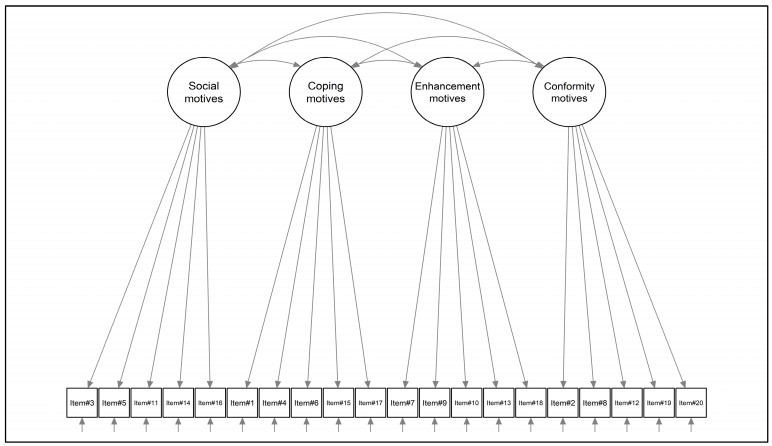
A confirmatory factor analysis was performed to test the factor structure of the Italian version of the PEMS (PEMS-IT) on a total of 616 respondents. Furthermore, the reliability and convergent validity analysis of the tool were evaluated.
The analysis confirmed the four-factor structure of PEMS-IT [(YBχ (164) = 537.901; < 0.001, the CFI = 0.918, RMSEA = 0.072; 90%CI [0.065-0.078]; (RMSEA < 0.05) < 0.001, and SRMR = 0.080] and satisfactory reliability on its subscales (Cronbach's α: 0.745-0.917). Positive correlations were also found with food addiction and binge-eating symptoms, compulsive eating behavior, and uncontrolled and emotional eating.
The PEMS-IT appears to be an instrument with promising psychometric properties and potential applications in clinical settings. However, it also has some limitations, and future studies could focus on improving the semantic content of the elements to increase the overall utility and precision of the instrument.
了解人们食用高加工食品背后的各种原因,有可能加强肥胖预防措施,并为在更个性化层面上定制肥胖和暴饮暴食的治疗方法开辟途径。本研究旨在检验意大利成年人群体样本中美味饮食动机量表(PEMS-IT)的心理测量特性和因子结构。
对总共616名受访者进行验证性因子分析,以检验意大利版PEMS(PEMS-IT)的因子结构。此外,还评估了该工具的信度和收敛效度分析。
分析证实了PEMS-IT的四因子结构[(YBχ(164)=537.901;<0.001,CFI=0.918,RMSEA=0.072;90%CI[0.065-0.078];(RMSEA<0.05)<0.001,SRMR=0.080],且其子量表具有令人满意的信度(Cronbach'sα:0.745-0.917)。还发现与食物成瘾、暴饮暴食症状、强迫性进食行为以及无节制和情绪化进食呈正相关。
PEMS-IT似乎是一种具有良好心理测量特性且在临床环境中有潜在应用价值的工具。然而,它也有一些局限性,未来的研究可以集中在改进条目的语义内容上,以提高该工具的整体效用和精度。