
超导环动态驱动无序系统中的集体神经网络行为。
Collective neural network behavior in a dynamically driven disordered system of superconducting loops.
作者信息
Goteti Uday S, Cybart Shane A, Dynes Robert C
机构信息
Department of Physics, University of California, San Diego, CA 92093.
Department of Electrical and Computer Engineering, University of California, Riverside, CA 92521.
出版信息
Proc Natl Acad Sci U S A. 2024 Mar 19;121(12):e2314995121. doi: 10.1073/pnas.2314995121. Epub 2024 Mar 12.
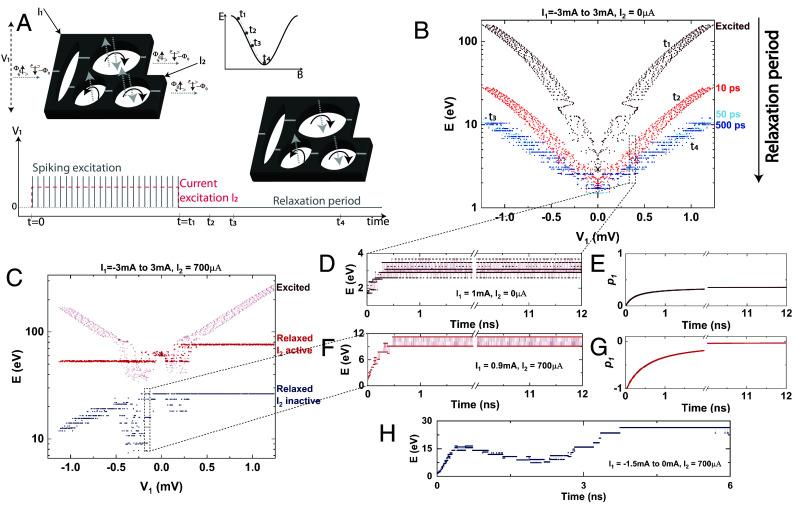
Collective properties of complex systems composed of many interacting components such as neurons in our brain can be modeled by artificial networks based on disordered systems. We show that a disordered neural network of superconducting loops with Josephson junctions can exhibit computational properties like categorization and associative memory in the time evolution of its state in response to information from external excitations. Superconducting loops can trap multiples of fluxons in many discrete memory configurations defined by the local free energy minima in the configuration space of all possible states. A memory state can be updated by exciting the Josephson junctions to fire or allow the movement of fluxons through the network as the current through them surpasses their critical current thresholds. Simulations performed with a lumped element circuit model of a 4-loop network show that information written through excitations is translated into stable states of trapped flux and their time evolution. Experimental implementation on a high-Tc superconductor YBCO-based 4-loop network shows dynamically stable flux flow in each pathway characterized by the correlations between junction firing statistics. Neural network behavior is observed as energy barriers separating state categories in simulations in response to multiple excitations, and experimentally as junction responses characterizing different flux flow patterns in the network. The state categories that produce these patterns have different temporal stabilities relative to each other and the excitations. This provides strong evidence for time-dependent (short-to-long-term) memories, that are dependent on the geometrical and junction parameters of the loops, as described with a network model.
由许多相互作用的组件(如我们大脑中的神经元)组成的复杂系统的集体特性,可以通过基于无序系统的人工网络进行建模。我们表明,具有约瑟夫森结的超导环无序神经网络,在其状态随外部激发信息的时间演化中,能够展现出诸如分类和联想记忆等计算特性。超导环可以在由所有可能状态的配置空间中的局部自由能最小值定义的许多离散记忆配置中捕获磁通子的倍数。当通过约瑟夫森结的电流超过其临界电流阈值时,通过激发约瑟夫森结使其触发或允许磁通子在网络中移动,可以更新记忆状态。用一个4环网络的集总元件电路模型进行的模拟表明,通过激发写入的信息被转化为捕获磁通的稳定状态及其时间演化。在基于高温超导体YBCO的4环网络上的实验实现表明,每个路径中都存在动态稳定的磁通流,其特征在于结触发统计之间的相关性。在模拟中,响应多次激发时,观察到神经网络行为表现为分隔状态类别的能量障碍;在实验中,观察到神经网络行为表现为表征网络中不同磁通流模式的结响应。相对于彼此和激发而言,产生这些模式的状态类别具有不同的时间稳定性。这为依赖于环的几何和结参数的时间相关(短期到长期)记忆提供了有力证据,如用网络模型所描述的那样。




 Zotero 插件