Behavioral Physiology and Sociobiology, Biocentre, University of Würzburg, Würzburg, Germany.
Laboratory of Neurobiology, Department of Biology, Northeastern University, Boston, MA, 02115, USA.
J Comp Physiol A Neuroethol Sens Neural Behav Physiol. 2024 Mar;210(2):189-201. doi: 10.1007/s00359-024-01691-9. Epub 2024 Mar 12.
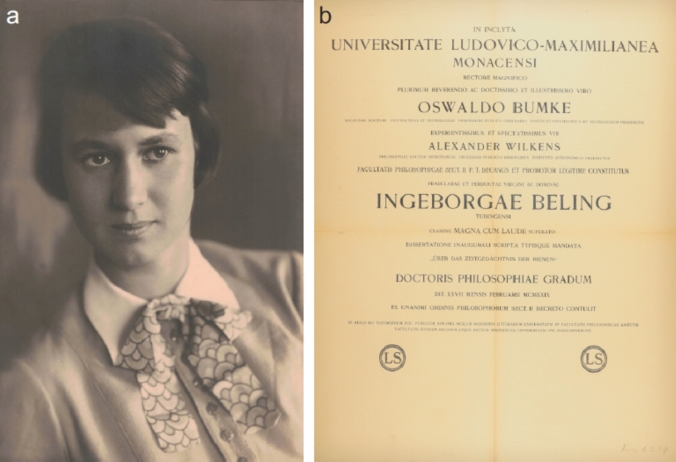
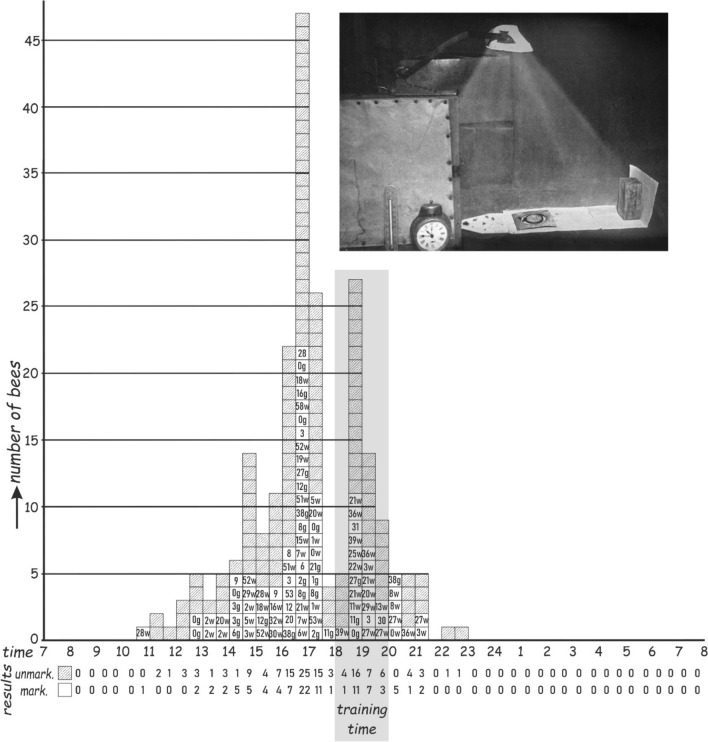
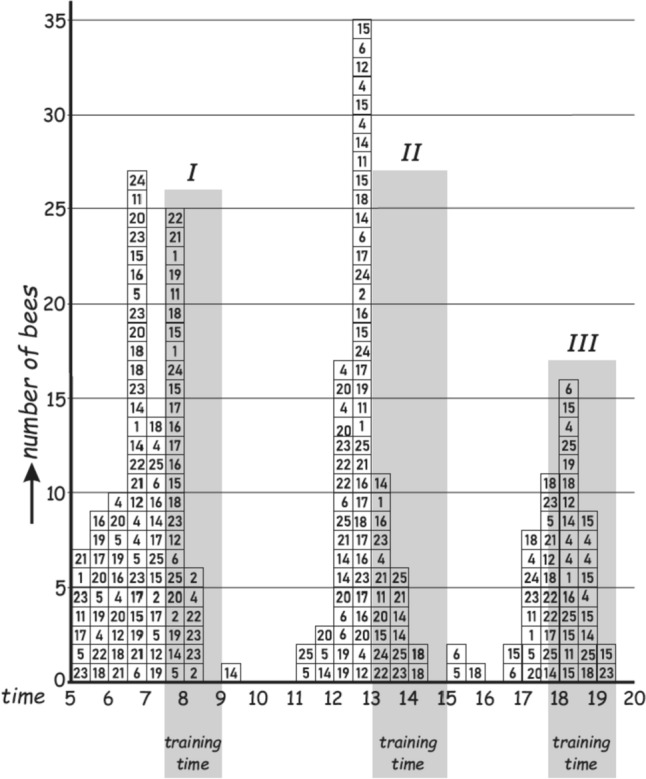
Bees are known for their ability to forage with high efficiency. One of their strategies to avoid unproductive foraging is to be at the food source at the right time of the day. Approximately one hundred years ago, researchers discovered that honeybees have a remarkable time memory, which they use for optimizing foraging. Ingeborg Beling was the first to examine this time memory experimentally. In her doctoral thesis, completed under the mentorship of Karl von Frisch in 1929, she systematically examined the capability of honeybees to remember specific times of the day at which they had been trained to appear at a feeding station. Beling was a pioneer in chronobiology, as she described the basic characteristics of the circadian clock on which the honeybee's time memory is based. Unfortunately, after a few years of extremely productive research, she ended her scientific career, probably due to family reasons or political pressure to reduce the number of women in the workforce. Here, we present a biographical sketch of Ingeborg Beling and review her research on the time memory of honeybees. Furthermore, we discuss the significance of her work, considering what is known about time memory today - nearly 100 years after she conducted her experiments.
蜜蜂以高效觅食而闻名。它们避免无效觅食的策略之一是在一天中的正确时间到达食物源。大约一百年前,研究人员发现蜜蜂具有惊人的时间记忆能力,它们利用这种能力来优化觅食。因伯格·贝林是第一个对此时间记忆进行实验研究的人。1929 年,在卡尔·冯·弗里希的指导下,她完成了博士论文,系统地研究了蜜蜂在特定时间到达喂食站的能力,这些时间是它们经过训练的时间。贝林是生物钟学的先驱,因为她描述了基于蜜蜂时间记忆的昼夜节律钟的基本特征。不幸的是,在几年非常高产的研究之后,她结束了自己的科学生涯,可能是因为家庭原因或减少劳动力中女性数量的政治压力。在这里,我们介绍了因伯格·贝林的生平简介,并回顾了她关于蜜蜂时间记忆的研究。此外,我们还讨论了她的工作的意义,考虑到今天人们对时间记忆的了解——在她进行实验近 100 年后。