Rahman Proton, McInnes Iain B, Deodhar Atul, Schett Georg, Mease Phillip J, Shawi May, Cua Daniel J, Sherlock Jonathan P, Kollmeier Alexa P, Xu Xie L, Sheng Shihong, Ritchlin Christopher T, McGonagle Dennis
Memorial University of Newfoundland, St. Johns, NF, Canada.
University of Glasgow, Glasgow, UK.
Clin Rheumatol. 2024 May;43(5):1591-1604. doi: 10.1007/s10067-024-06921-8. Epub 2024 Mar 12.
To evaluate the association between enthesitis resolution (ER) and dactylitis resolution (DR) and meaningful improvements in patient-reported outcomes (PROs) among biologic-naïve patients with PsA receiving guselkumab in the DISCOVER-2 study.
Enthesitis and dactylitis, characteristic lesions of PsA, were evaluated by independent assessors using the Leeds Enthesitis Index (range, 0-6) and Dactylitis Severity Score (range, 0-60). Proportions of patients with ER or DR (score = 0) among those with score > 0 at baseline were determined at weeks 24, 52, and 100. PROs included: fatigue (Functional Assessment of Chronic Illness Therapy-Fatigue [FACIT-Fatigue]), pain (0-100 visual analog scale), physical function (Health Assessment Questionnaire-Disability Index [HAQ-DI]), and health-related quality of life (36-item Short-Form Health Survey physical/mental component summary [SF-36 PCS/MCS]). Meaningful responses were defined as: improvements of ≥ 4 for FACIT-Fatigue, ≥ 0.35 for HAQ-DI, and ≥ 5 for SF-36 PCS/MCS and absolute scores of ≤ 15 for minimal pain and ≤ 0.5 for normalized HAQ-DI. Associations between ER/DR status and PRO response status were tested using a Chi-square test.
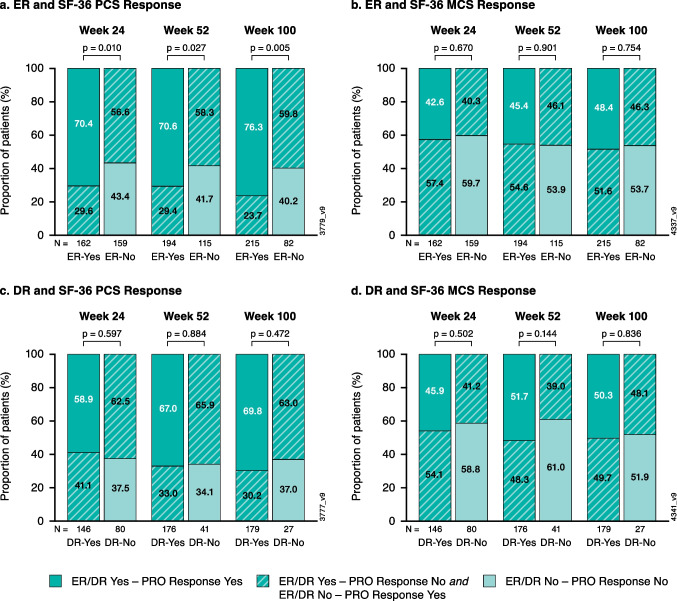
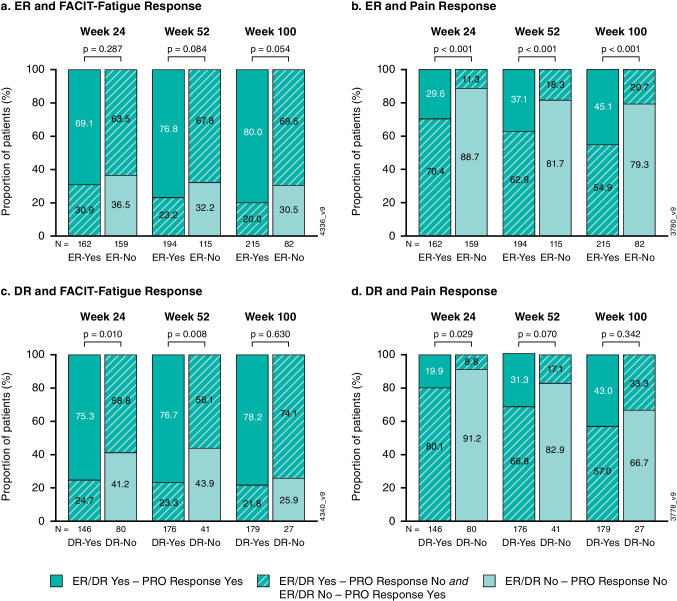
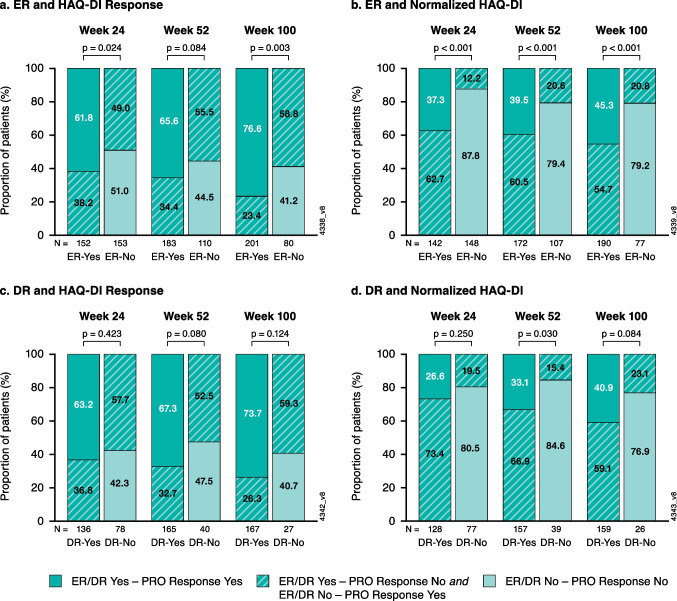
Guselkumab-treated patients with ER were more likely than those without ER to achieve minimal pain (p < 0.001), normalized HAQ-DI (p < 0.001), and PCS response (p < 0.05) at weeks 24, 52, and 100. Patients with DR were more likely than those without DR to achieve FACIT-Fatigue response at week 24 and week 52 (both p ≤ 0.01) and minimal pain at week 24 and normalized HAQ-DI at week 52 (both p ≤ 0.03).
In biologic-naïve patients with active PsA treated with guselkumab, achieving ER or DR was associated with durable improvements in selected PROs, including those of high importance to patients.
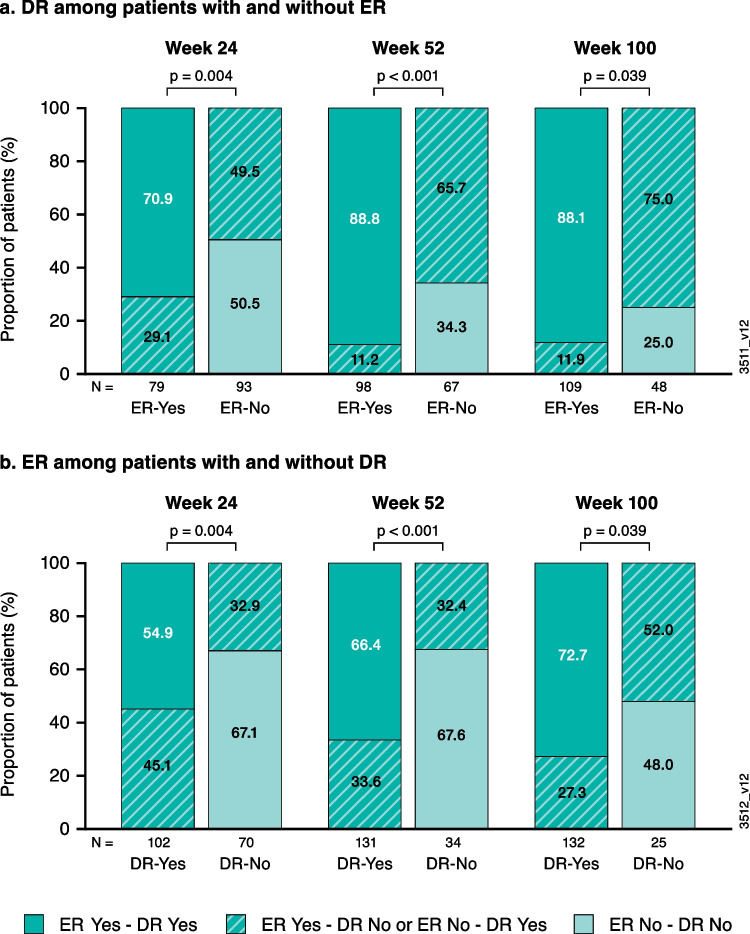
ClinicalTrials.gov ( https://clinicaltrials.gov ) NCT03158285; Registered: May 16, 2017. Key Points • At week 100, 65% and 76% of guselkumab-treated patients achieved enthesitis and dactylitis resolution (ER/DR). • Achieving ER was associated with achieving DR and vice versa through the end of study. • Achieving ER or DR was associated with durable and meaningful improvements in selected patient-reported outcomes.
在DISCOVER - 2研究中,评估初治的银屑病关节炎(PsA)患者接受古塞库单抗治疗时,附着点炎缓解(ER)和指(趾)炎缓解(DR)与患者报告结局(PROs)的有意义改善之间的关联。
PsA的特征性病变——附着点炎和指(趾)炎,由独立评估者使用利兹附着点炎指数(范围为0 - 6)和指(趾)炎严重程度评分(范围为0 - 60)进行评估。在第24、52和100周时,确定基线时评分>0的患者中达到ER或DR(评分 = 0)的患者比例。PROs包括:疲劳(慢性病治疗功能评估 - 疲劳量表[FACIT - 疲劳])、疼痛(0 - 100视觉模拟量表)、身体功能(健康评估问卷 - 残疾指数[HAQ - DI])以及健康相关生活质量(36项简短健康调查问卷身体/心理成分汇总[SF - 36 PCS/MCS])。有意义的反应定义为:FACIT - 疲劳改善≥4分、HAQ - DI改善≥0.35分、SF - 36 PCS/MCS改善≥5分,最小疼痛绝对评分≤15分,标准化HAQ - DI≤0.5分。使用卡方检验来检验ER/DR状态与PRO反应状态之间的关联。
在第24、52和100周时,接受古塞库单抗治疗且达到ER的患者比未达到ER的患者更有可能实现最小疼痛(p < 0.001)、标准化HAQ - DI(p < 0.001)和PCS反应(p < 0.05)。达到DR的患者比未达到DR的患者在第24周和第52周更有可能实现FACIT - 疲劳反应(均p≤0.01),在第24周更有可能实现最小疼痛,在第52周更有可能实现标准化HAQ - DI(均p≤0.03)。
在初治的活动性PsA患者中使用古塞库单抗治疗时,实现ER或DR与特定PROs的持久改善相关,包括对患者非常重要的PROs。
ClinicalTrials.gov(https://clinicaltrials.gov)NCT03158285;注册时间:2017年5月16日。要点 • 在第100周时,接受古塞库单抗治疗的患者中有65%和76%实现了附着点炎和指(趾)炎缓解(ER/DR)。 • 在研究结束时,实现ER与实现DR相关,反之亦然。 • 实现ER或DR与特定患者报告结局的持久且有意义的改善相关。