Ben-David Kfir, Wittels Harrison L, Wishon Michael J, Lee Stephen J, McDonald Samantha M, Howard Wittels S
Department of Surgery, Division of Oncology, Mount Sinai Medical Center, Miami Beach, FL 33140, USA.
Department of Surgery, Wertheim School of Medicine, Florida International University, Miami, FL 33199, USA.
Cancers (Basel). 2024 Feb 27;16(5):962. doi: 10.3390/cancers16050962.
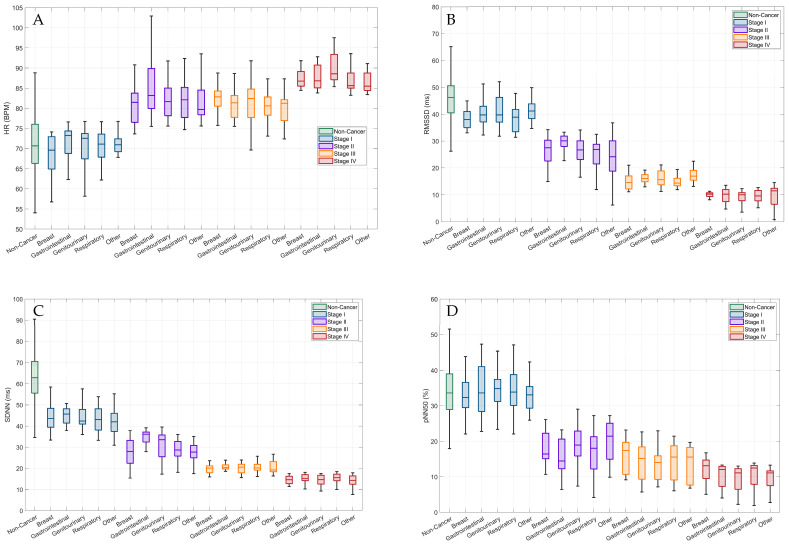
Reduced heart rate variability (HRV) is an autonomic nervous system (ANS) response that may indicate dysfunction in the human body. Consistent evidence shows cancer patients elicit lower HRV; however, only select cancer locations were previously evaluated. Thus, the aim of the current study was to explore HRV patterns in patients diagnosed with and in varying stages of the most prevalent cancers. At a single tertiary academic medical center, 798 patients were recruited. HRV was measured via an armband monitor (Warfighter Monitor, Tiger Tech Solutions, Inc., Miami, FL, USA) equipped with electrocardiographic capabilities and was recorded for 5 to 7 min with patients seated in an upright position. Three time-domain metrics were calculated: SDNN (standard deviation of the NN interval), rMSSD (the root mean square of successive differences of NN intervals), and the percentage of time in which the change in successive NN intervals exceeds 50ms within a measurement (pNN50). Of the 798 patients, 399 were diagnosed with cancer. Cancer diagnoses were obtained via medical records one week following the measurement. Analysis of variance models were performed comparing the HRV patterns between different cancers, cancer stages (I-IV), and demographic strata. A total of 85% of the cancer patients had breast, gastrointestinal, genitourinary, or respiratory cancer. The cancer patients were compared to a control non-cancer patient population with similar patient size and distributions for sex, age, body mass index, and co-morbidities. For all HRV metrics, non-cancer patients exhibited significantly higher rMSSDs (11.1 to 13.9 ms, < 0.0001), SDNNs (22.8 to 27.7 ms, < 0.0001), and pNN50s (6.2 to 8.1%, < 0.0001) compared to stage I or II cancer patients. This significant trend was consistently observed across each cancer location. Similarly, compared to patients with stage III or IV cancer, non-cancer patients possessed lower HRs (-11.8 to -14.0 bpm, < 0.0001) and higher rMSSDs (+31.7 to +32.8 ms, < 0.0001), SDNNs (+45.2 to +45.8 ms), < 0.0001, and pNN50s (19.2 to 21.6%, < 0.0001). The HR and HRV patterns observed did not significantly differ between cancer locations ( = 0.96 to 1.00). The depressed HRVs observed uniformly across the most prevalent cancer locations and stages appeared to occur independent of patients' co-morbidities. This finding highlights the potentially effective use of HRV as a non-invasive tool for determining common cancer locations and their respective stages. More studies are needed to delineate the HRV patterns across different ages, between sexes and race/ethnic groups.
心率变异性(HRV)降低是一种自主神经系统(ANS)反应,可能表明人体功能失调。一致的证据表明癌症患者的HRV较低;然而,以前仅对特定的癌症部位进行了评估。因此,本研究的目的是探索被诊断为最常见癌症且处于不同阶段的患者的HRV模式。在一家单一的三级学术医疗中心,招募了798名患者。通过配备心电图功能的臂带监测器(Warfighter Monitor,Tiger Tech Solutions公司,美国佛罗里达州迈阿密)测量HRV,并在患者直立坐姿下记录5至7分钟。计算了三个时域指标:SDNN(NN间期的标准差)、rMSSD(NN间期连续差值的均方根)以及测量期间连续NN间期变化超过50毫秒的时间百分比(pNN50)。在798名患者中,399名被诊断患有癌症。测量一周后通过病历获取癌症诊断信息。进行方差分析模型以比较不同癌症、癌症阶段(I-IV期)和人口统计学分层之间的HRV模式。共有85%的癌症患者患有乳腺癌、胃肠道癌、泌尿生殖系统癌或呼吸道癌。将癌症患者与具有相似患者规模以及性别、年龄、体重指数和合并症分布的非癌症对照患者群体进行比较。对于所有HRV指标,与I期或II期癌症患者相比,非癌症患者的rMSSD(11.1至13.9毫秒,<0.0001)、SDNN(22.8至27.7毫秒,<0.0001)和pNN50(6.2至8.1%,<0.0001)显著更高。在每个癌症部位均一致观察到这一显著趋势。同样,与III期或IV期癌症患者相比,非癌症患者的心率较低(-11.8至-14.0次/分钟,<0.0001),rMSSD较高(+31.7至+32.8毫秒,<0.0001)、SDNN(+45.2至+45.8毫秒,<0.0001)和pNN50(19.2至21.6%,<0.0001)。观察到的心率和HRV模式在不同癌症部位之间没有显著差异(=0.96至1.00)。在最常见的癌症部位和阶段中均观察到的HRV降低似乎与患者的合并症无关。这一发现突出了HRV作为一种用于确定常见癌症部位及其各自阶段的非侵入性工具的潜在有效用途。需要更多研究来描绘不同年龄、性别和种族/族裔群体之间的HRV模式。