Kitawi Rose, Ledger Scott, Kelleher Anthony D, Ahlenstiel Chantelle L
Kirby Institute, University of New South Wales, Kensington, NSW 2052, Australia.
St. Vincent's Hospital, Darlinghurst, NSW 2010, Australia.
Int J Mol Sci. 2024 Feb 28;25(5):2771. doi: 10.3390/ijms25052771.
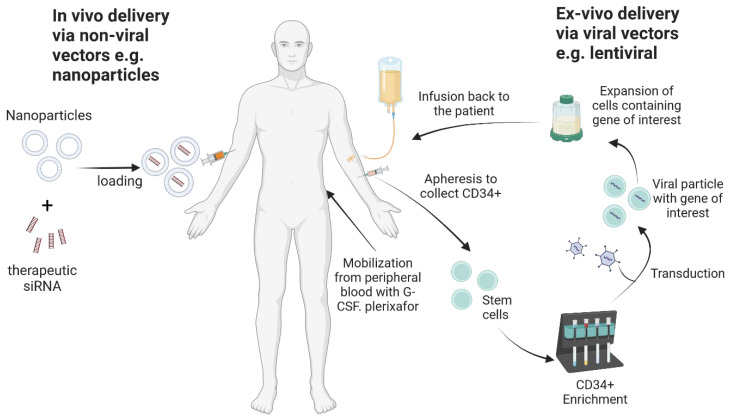
Early gene therapy studies held great promise for the cure of heritable diseases, but the occurrence of various genotoxic events led to a pause in clinical trials and a more guarded approach to progress. Recent advances in genetic engineering technologies have reignited interest, leading to the approval of the first gene therapy product targeting genetic mutations in 2017. Gene therapy (GT) can be delivered either in vivo or ex vivo. An ex vivo approach to gene therapy is advantageous, as it allows for the characterization of the gene-modified cells and the selection of desired properties before patient administration. Autologous cells can also be used during this process which eliminates the possibility of immune rejection. This review highlights the various stages of ex vivo gene therapy, current research developments that have increased the efficiency and safety of this process, and a comprehensive summary of Human Immunodeficiency Virus (HIV) gene therapy studies, the majority of which have employed the ex vivo approach.
早期的基因治疗研究为遗传性疾病的治愈带来了巨大希望,但各种基因毒性事件的发生导致临床试验暂停,并采取了更为谨慎的推进方式。基因工程技术的最新进展重新点燃了人们的兴趣,促成了2017年首个针对基因突变的基因治疗产品获批。基因治疗(GT)可以在体内或体外进行。体外基因治疗方法具有优势,因为它允许在将基因修饰细胞给予患者之前对其进行表征,并选择所需特性。在此过程中也可以使用自体细胞,这消除了免疫排斥的可能性。本综述重点介绍了体外基因治疗的各个阶段、提高该过程效率和安全性的当前研究进展,以及对人类免疫缺陷病毒(HIV)基因治疗研究的全面总结,其中大多数研究采用了体外方法。