Zong Chunmei, Zhao Jinming, Wang Yanping, Wang Lei, Chen Zaoye, Qi Yuxin, Bai Yanfeng, Li Wen, Wang Wubin, Ren Haixiang, Du Weiguang, Gai Junyi
Soybean Research Institute & MARA National Center for Soybean Improvement & MARA Key Laboratory of Biology and Genetic Improvement of Soybean (General) & State Key Laboratory for Crop Genetics and Germplasm Enhancement & State Innovation Platform for Integrated Production and Education in Soybean Bio-Breeding & Jiangsu Collaborative Innovation Center for Modern Crop Production, Nanjing Agricultural University, Nanjing 210095, China.
Mudanjiang Soybean Research and Development Center, Mudanjiang Branch of Heilongjiang Academy of Agricultural Sciences, Mudanjiang 157041, China.
Int J Mol Sci. 2024 Mar 4;25(5):2963. doi: 10.3390/ijms25052963.
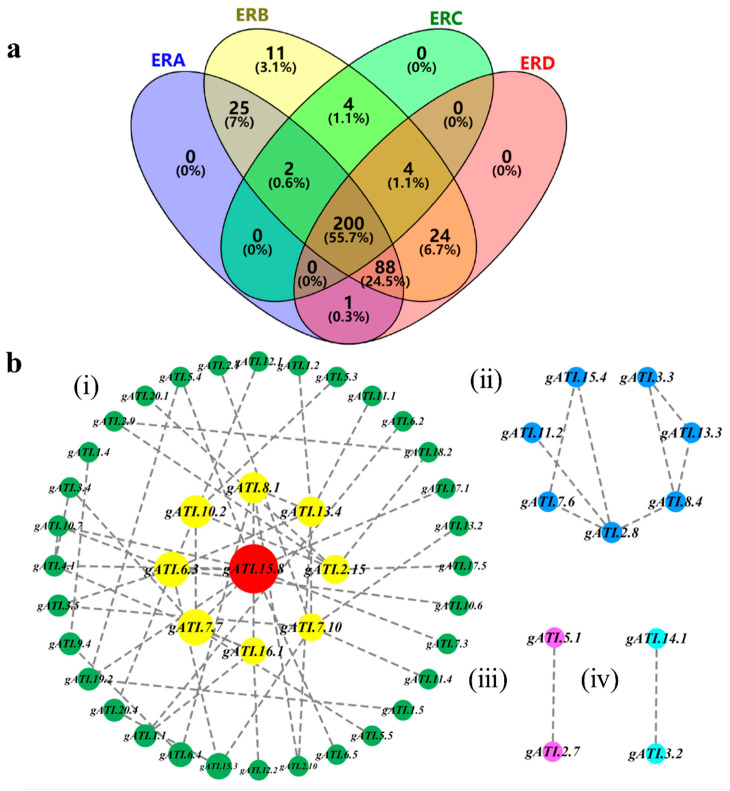
Salinization of cultivated soils may result in either high salt levels or alkaline conditions, both of which stress crops and reduce performance. We sampled genotypes included in the Northeast China soybean germplasm population (NECSGP) to identify possible genes that affect tolerance to alkaline soil conditions. In this study, 361 soybean accessions collected in Northeast China were tested under 220 mM NaHCO:NaCO = 9:1 (pH = 9.8) to evaluate the alkali-tolerance (ATI) at the seedling stage in Mudanjiang, Heilongjiang, China. The restricted two-stage multi-locus model genome-wide association study (RTM-GWAS) with gene-allele sequences as markers (6503 GASMs) based on simplified genome resequencing (RAD-sequencing) was accomplished. From this analysis, 132 main effect candidate genes with 359 alleles and 35 Gene × Environment genes with 103 alleles were identified, explaining 90.93% and 2.80% of the seedling alkali-tolerance phenotypic variation, respectively. Genetic variability of ATI in NECSGP was observed primarily within subpopulations, especially in ecoregion B, from which 80% of ATI-tolerant accessions were screened out. The biological functions of 132 candidate genes were classified into eight functional categories (defense response, substance transport, regulation, metabolism-related, substance synthesis, biological process, plant development, and unknown function). From the ATI gene-allele system, six key genes-alleles were identified as starting points for further study on understanding the ATI gene network.
耕地盐碱化可能导致土壤盐分过高或呈碱性,这两种情况都会给作物带来压力并降低其生长性能。我们对中国东北大豆种质资源群体(NECSGP)中的基因型进行了采样,以确定可能影响碱性土壤耐受性的基因。在本研究中,对在中国东北收集的361份大豆种质在220 mM NaHCO₃:Na₂CO₃ = 9:1(pH = 9.8)条件下进行测试,以评估其在黑龙江牡丹江苗期的耐碱性(ATI)。基于简化基因组重测序(RAD测序),完成了以基因等位序列为标记(6503个基因等位序列标记,GASMs)的受限两阶段多位点模型全基因组关联研究(RTM - GWAS)。通过该分析,鉴定出132个具有359个等位基因的主效候选基因和35个具有103个等位基因的基因×环境基因,分别解释了苗期耐碱性表型变异的90.93%和2.80%。观察到NECSGP中ATI的遗传变异主要存在于亚群体内,尤其是在生态区域B中,从该区域筛选出了80%的耐ATI种质。132个候选基因的生物学功能被分为八个功能类别(防御反应、物质运输、调控、代谢相关、物质合成、生物学过程、植物发育和未知功能)。从ATI基因等位系统中,鉴定出六个关键基因等位基因作为进一步研究理解ATI基因网络的起点。