Callan Andrew, Jha Sonal, Valdez Laura, Baldado Lois, Tsin Andrew
School of Medicine, The University of Texas Rio Grande Valley, Edinburg, TX 78539, USA.
Int J Mol Sci. 2024 Mar 6;25(5):3052. doi: 10.3390/ijms25053052.
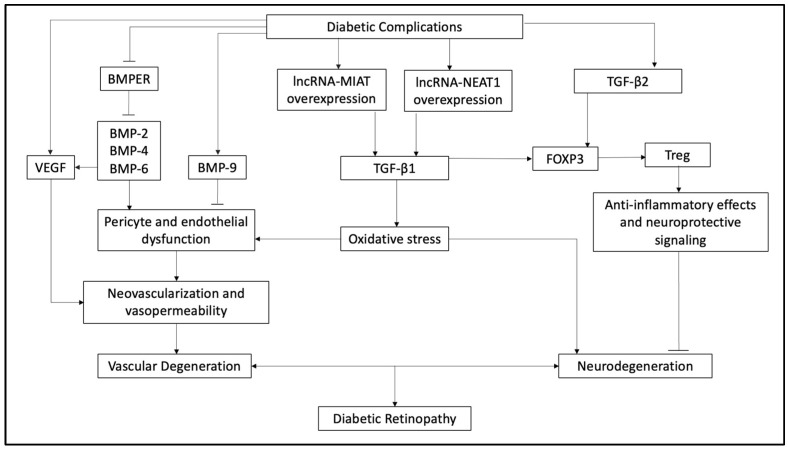
Diabetic retinopathy (DR), a prevalent complication of diabetes mellitus affecting a significant portion of the global population, has long been viewed primarily as a microvascular disorder. However, emerging evidence suggests that it should be redefined as a neurovascular disease with multifaceted pathogenesis rooted in oxidative stress and advanced glycation end products. The transforming growth factor-β (TGF-β) signaling family has emerged as a major contributor to DR pathogenesis due to its pivotal role in retinal vascular homeostasis, endothelial cell barrier function, and pericyte differentiation. However, the precise roles of TGF-β signaling in DR remain incompletely understood, with conflicting reports on its impact in different stages of the disease. Additionally, the BMP subfamily within the TGF-β superfamily introduces further complexity, with BMPs exhibiting both pro- and anti-angiogenic properties. Furthermore, TGF-β signaling extends beyond the vascular realm, encompassing immune regulation, neuronal survival, and maintenance. The intricate interactions between TGF-β and reactive oxygen species (ROS), non-coding RNAs, and inflammatory mediators have been implicated in the pathogenesis of DR. This review delves into the complex web of signaling pathways orchestrated by the TGF-β superfamily and their involvement in DR. A comprehensive understanding of these pathways may hold the key to developing targeted therapies to halt or mitigate the progression of DR and its devastating consequences.
糖尿病视网膜病变(DR)是糖尿病常见的并发症,影响着全球相当一部分人口,长期以来主要被视为一种微血管疾病。然而,新出现的证据表明,它应被重新定义为一种神经血管疾病,其发病机制具有多方面特点,根源在于氧化应激和晚期糖基化终产物。转化生长因子-β(TGF-β)信号家族已成为DR发病机制的主要促成因素,因为它在视网膜血管稳态、内皮细胞屏障功能和周细胞分化中起关键作用。然而,TGF-β信号在DR中的具体作用仍不完全清楚,关于其在疾病不同阶段的影响存在相互矛盾的报道。此外,TGF-β超家族中的骨形态发生蛋白(BMP)亚家族进一步增加了复杂性,BMPs兼具促血管生成和抗血管生成特性。此外,TGF-β信号不仅限于血管领域,还涉及免疫调节、神经元存活和维持。TGF-β与活性氧(ROS)、非编码RNA和炎症介质之间的复杂相互作用与DR的发病机制有关。本综述深入探讨了由TGF-β超家族精心编排的复杂信号通路网络及其在DR中的作用。全面了解这些通路可能是开发靶向治疗以阻止或减轻DR进展及其严重后果的关键。