Pavalur Rajitha, Nattala Prasanthi, Kandasamy Arun, Shukla Dhaval P
Department of Nursing, National Institute of Mental Health and Neuro Sciences, Bengaluru, Karnataka, India.
Department of Psychiatry, National Institute of Mental Health and Neuro Sciences, Bengaluru, Karnataka, India.
J Neurosci Rural Pract. 2024 Jan-Mar;15(1):103-110. doi: 10.25259/JNRP_381_2023. Epub 2024 Jan 18.
Driving under the influence of alcohol is one of the leading causes of road traffic accidents in India. Individuals with acute injuries often present to emergency hospital services. Carrying out brief interventions in the emergency can prevent further injury and even progression to severe patterns of drinking. However, there are no known studies from India examining the effectiveness of such interventions in emergency settings. Against this background, the objective of this randomized controlled trial was to evaluate the effectiveness of a nurse-led Brief Focused Intervention (BFI) in comparison with the minimal intervention for patients with mild Traumatic Brain Injury (TBI) reporting to the emergency and casualty services of a tertiary hospital in Bengaluru, South India, who screened positive for alcohol use.
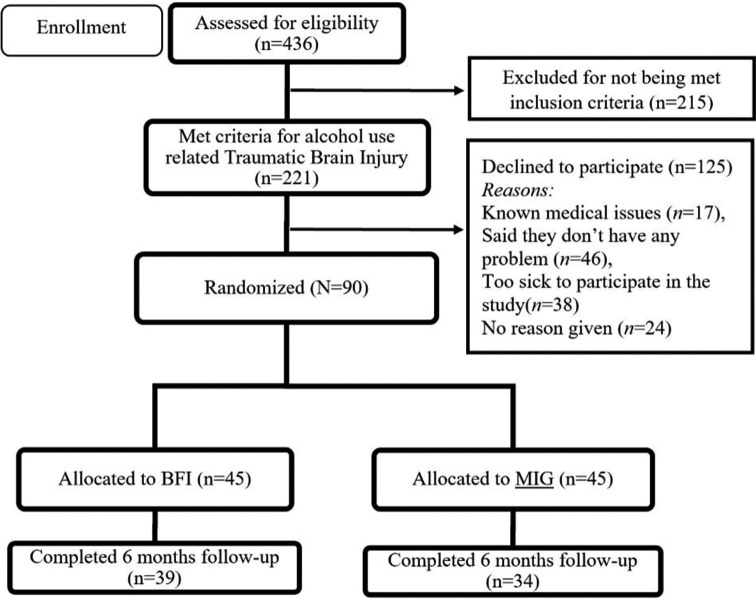
The BFI comprised a video portraying the effects of alcohol on the brain and muscles and brief advice on how to reduce or avoid alcohol use. Subjects ( = 90) were randomly allocated to two groups: BFI ( = 45) or Minimal Intervention Group (MIG) ( = 45). Standardized tools were used to assess both groups on specific outcomes for up to six months following discharge from the emergency and casualty services. At the end of six months, complete data wasavailable for 73 patients.
Participants' ( = 73) mean age was 35 years (standard deviation [SD]-11). Over the six-month follow-up, the BFI group reported significantly lesser quantity of alcohol consumption (Alcohol Use Disorder Identification Test [AUDIT] Score - 5.03, SD 4.09, 95% confidence interval [CI] = 3.70, 6.35) compared to MIG (AUDIT Score - 9.76, SD 2.96, 95% CI = 8.73, 10.80), and fewer alcohol use-related problems in BFI group (Mean - 4.18, SD 3.21, 95% CI = 3.14, 5.22) compared to MIG (Mean - 5.88, SD 2.59, 95% CI = 4.98, 6.79). Results of logistic regression showed that being in MIG as well as baseline hazardous use of alcohol were associated with unfavorable outcomes at the end of six months follow-up.
Findings provide the first known evidence from India for the effectiveness of nurse-led BFI in the emergency and casualty services in improving post-discharge outcomes for patients with alcohol use-related mild TBI. While the findings of the study are statistically significant, these findings also have significant clinical relevance, as they have shown that the BFI improved clinical outcomes. Thus, brief interventions should be implemented for these patients whenever possible in the Emergency setting.
在印度,酒后驾车是道路交通事故的主要原因之一。急性受伤的患者常前往急诊医院就诊。在急诊时进行简短干预可预防进一步受伤,甚至防止饮酒行为发展为严重模式。然而,印度尚无研究考察此类干预措施在急诊环境中的效果。在此背景下,本随机对照试验的目的是评估由护士主导的简短聚焦干预(BFI)与最小干预相比,对在印度南部班加罗尔一家三级医院急诊和伤病服务部门就诊、酒精使用筛查呈阳性的轻度创伤性脑损伤(TBI)患者的有效性。
BFI包括一段描绘酒精对大脑和肌肉影响的视频以及关于如何减少或避免饮酒的简短建议。受试者(n = 90)被随机分为两组:BFI组(n = 45)或最小干预组(MIG,n = 45)。使用标准化工具在急诊和伤病服务部门出院后的长达六个月内评估两组的特定结局。六个月结束时,有73例患者的完整数据。
参与者(n = 73)的平均年龄为35岁(标准差[SD] = 11)。在六个月的随访中,与MIG组(酒精使用障碍识别测试[AUDIT]评分 - 9.76,SD = 2.96,95%置信区间[CI] = 8.73,10.80)相比,BFI组报告的酒精消费量显著较少(AUDIT评分 - 5.03,SD = 4.09,95%CI = 3.70,6.35),且BFI组与酒精使用相关的问题较少(均值 - 4.18,SD = 3.21,95%CI = 3.14,5.22),而MIG组为(均值 - 5.88,SD = 2.59,95%CI = 4.98,6.79)。逻辑回归结果显示,处于MIG组以及基线时危险饮酒与六个月随访结束时的不良结局相关。
研究结果为印度提供了首个已知证据,证明由护士主导的BFI在急诊和伤病服务部门对改善与酒精使用相关的轻度TBI患者出院后的结局有效。虽然该研究结果具有统计学意义,但这些结果也具有显著的临床相关性,因为它们表明BFI改善了临床结局。因此,在急诊环境中应尽可能对这些患者实施简短干预。