López-Otín Carlos, Kroemer Guido
Centre de Recherche des Cordeliers, Equipe labellisée par la Ligue contre le cancer, Université Paris Cité, Sorbonne Université, Inserm U1138, Institut Universitaire de France, Paris, France.
Facultad de Ciencias de la Vida y la Naturaleza, Universidad Nebrija, Madrid, Spain.
Cell Stress. 2024 Mar 12;8:21-50. doi: 10.15698/cst2024.03.294. eCollection 2024.
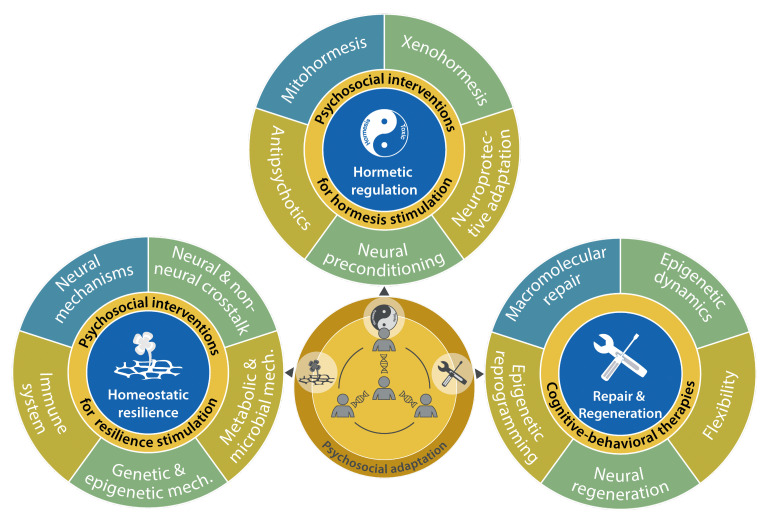
The eight biological hallmarks of health that we initially postulated (. 2021 Jan 7;184(1):33-63) include features of spatial compartmentalization (integrity of barriers, containment of local perturbations), maintenance of homeostasis over time (recycling & turnover, integration of circuitries, rhythmic oscillations) and an array of adequate responses to stress (homeostatic resilience, hormetic regulation, repair & regeneration). These hallmarks affect all eight somatic strata of the human body (molecules, organelles, cells, supracellular units, organs, organ systems, systemic circuitries and meta-organism). Here we postulate that mental and socioeconomic factors must be added to this 8×8 matrix as an additional hallmark of health ("psychosocial adaptation") and as an additional stratum ("psychosocial interactions"), hence building a 9×9 matrix. Potentially, perturbation of each of the somatic hallmarks and strata affects psychosocial factors and vice versa. Finally, we discuss the (patho)physiological bases of these interactions and their implications for mental health improvement.
我们最初提出的八个健康生物学标志(2021年1月7日;184(1):33 - 63)包括空间分隔特征(屏障完整性、局部扰动的遏制)、随时间维持内稳态(循环与周转、回路整合、节律振荡)以及一系列对应激的充分反应(内稳态弹性、适应性调节、修复与再生)。这些标志影响人体的所有八个躯体层次(分子、细胞器、细胞、超细胞单位、器官、器官系统、全身回路和超生物体)。在此我们提出,必须将心理和社会经济因素作为健康的额外标志(“心理社会适应”)以及额外层次(“心理社会相互作用”)添加到这个8×8矩阵中,从而构建一个9×9矩阵。每个躯体标志和层次的扰动都可能影响心理社会因素,反之亦然。最后,我们讨论这些相互作用的(病理)生理基础及其对改善心理健康的意义。