Department of Microbiology and Molecular Genetics, University of Pittsburgh School of Medicine, Pittsburgh, Pennsylvania, USA.
Department of Microbiology and Immunology, Emory University School of Medicine, Emory Antibiotic Resistance Center, Atlanta, Georgia, USA.
mBio. 2024 Apr 10;15(4):e0224823. doi: 10.1128/mbio.02248-23. Epub 2024 Mar 13.
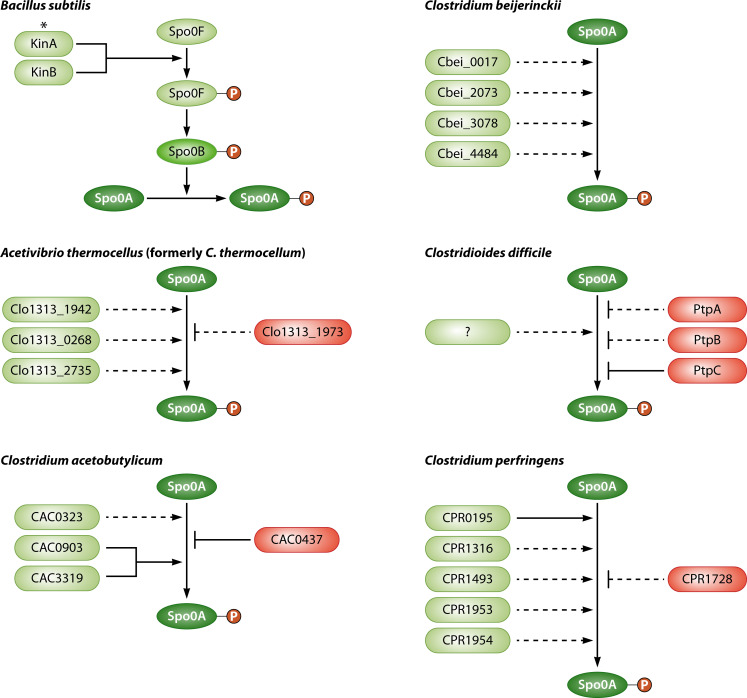
Sporulation is an important feature of the clostridial life cycle, facilitating survival of these bacteria in harsh environments, contributing to disease transmission for pathogenic species, and sharing common early steps that are also involved in regulating industrially important solvent production by some non-pathogenic species. Initial genomics studies suggested that Clostridia lack the classical phosphorelay that phosphorylates Spo0A and initiates sporulation in , leading to the hypothesis that sporulation in Clostridia universally begins when Spo0A is phosphorylated by orphan histidine kinases (OHKs). However, components of the classical phosphorelay were recently identified in some Clostridia. Similar phosphorelay components have not yet been found in the pathogenic Clostridia or the solventogenic Clostridia of industrial importance. For some of those Clostridia lacking a classical phosphorelay, the involvement of OHKs in sporulation initiation has received support from genetic studies demonstrating the involvement of several apparent OHKs in their sporulation. In addition, several clostridial OHKs directly phosphorylate Spo0A . Interestingly, there is considerable protein domain diversity among the sporulation-associated OHKs in Clostridia. Further adding to the emergent complexity of sporulation initiation in Clostridia, several candidate OHK phosphotransfer proteins that were OHK candidates were shown to function as phosphatases that reduce sporulation in some Clostridia. The mounting evidence indicates that no single pathway explains sporulation initiation in all Clostridia and supports the need for further study to fully understand the unexpected and biologically fascinating mechanistic diversity of this important process among these medically and industrially important bacteria.
孢子形成是梭菌生命周期的一个重要特征,有助于这些细菌在恶劣环境中生存,有助于病原性物种的疾病传播,并共享共同的早期步骤,这些步骤也参与调节一些非病原性物种的工业上重要的溶剂生产。最初的基因组学研究表明,梭菌缺乏经典的磷酸接力系统,该系统磷酸化 Spo0A 并启动 ,导致假设梭菌中的孢子形成普遍开始于 Spo0A 被孤儿组氨酸激酶 (OHK) 磷酸化。然而,经典磷酸接力系统的成分最近在一些梭菌中被鉴定出来。类似的磷酸接力成分尚未在病原性梭菌或工业上重要的溶剂生成梭菌中发现。对于一些缺乏经典磷酸接力系统的梭菌,OHK 在孢子形成起始中的作用得到了遗传研究的支持,这些研究表明,几个明显的 OHK 参与了它们的孢子形成。此外,几种梭菌 OHK 直接磷酸化 Spo0A 。有趣的是,梭菌中与孢子形成相关的 OHK 之间存在相当大的蛋白质结构域多样性。进一步增加了梭菌孢子形成起始的复杂性,一些候选 OHK 磷酸转移蛋白被证明是 OHK 候选物,它们在一些梭菌中作为磷酸酶发挥作用,降低了孢子形成。越来越多的证据表明,没有单一的途径可以解释所有梭菌的孢子形成起始,并支持进一步研究,以充分了解这一重要过程在这些医学和工业上重要的细菌中出乎意料的和生物学上迷人的机制多样性。