Amirault K, Wright R, Sujani S, Dos Reis B R, Osorio J, Fernandes T, White R R
School of Animal Sciences, Virginia Tech, Blacksburg, VA 24073.
JDS Commun. 2023 Nov 17;5(2):91-95. doi: 10.3168/jdsc.2023-0409. eCollection 2024 Mar.
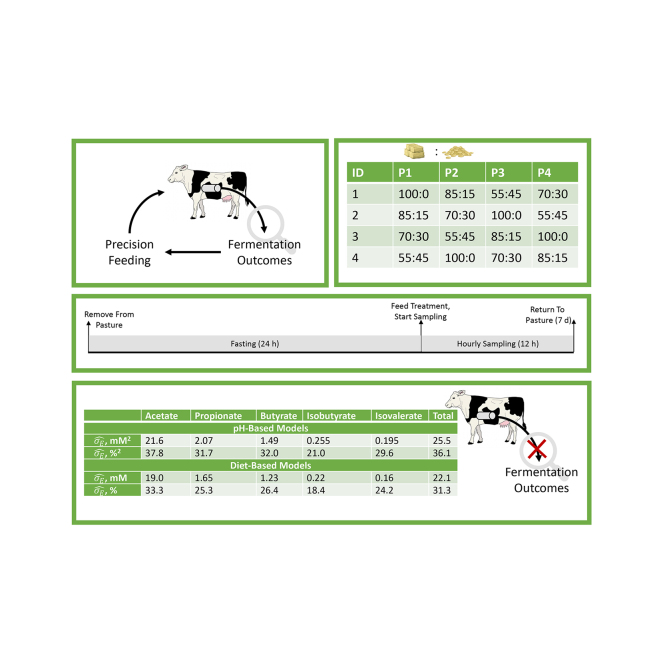
The purpose of this study was to investigate the potential of using ruminal pH measurements to track time-series ruminal volatile fatty acid (VFA) concentrations occurring in response to short-term dietary disruption. Four ruminally cannulated dry Holstein dairy cows were individually housed and assigned to 4 treatments in a Latin square design. Treatments differing in forage-to-concentrate (F:C) ratio (100:0 to 55:45) were used because they were expected to result in large differences in VFA concentration, over which the relationships between pH and VFA could be robustly evaluated. Each sampling period lasted 36 h. Animals were removed from pasture and fasted for 24 h, after which time they were fed their treatment ration for 2 h and sampled for rumen fluid hourly for 12 h. Rumen fluid samples were analyzed immediately for pH, frozen, and subsequently analyzed for VFA concentrations using gas chromatography. Animals were returned to pasture for 7 d between sampling periods. To confirm that the short-term dietary disruptions resulted in expected variation in VFA concentrations, mean VFA concentrations during each animal period (n = 16) were analyzed using a linear mixed effects model with fixed (linear and quadratic) effects for F:C ratio and random effects for animal and period. Results indicated significant changes in VFA concentration across F:C ratio, but no significant shifts in VFA molar proportions, perhaps due to the short-term nature of the feeding protocol. To explore opportunity to use pH measurements to explain variability in VFA concentrations in real time across dietary conditions, a linear mixed-effect model was used to link the time-series measurements (n = 207). The VFA concentrations were analyzed with linear mixed effect models using linear and quadratic terms for pH, and random effects for animal and period. These models had poor accuracy, with residual error variance ranging from 21% to 38%, and residuals patterning significantly with F:C ratio. The data suggest that pH may lack reliability for VFA prediction in short-term feeding scenarios differing considerably in F:C ratio.
本研究的目的是调查利用瘤胃液pH值测量来追踪因短期饮食干扰而出现的瘤胃挥发性脂肪酸(VFA)浓度时间序列的潜力。选用4头装有瘤胃瘘管的干奶期荷斯坦奶牛,单独饲养,并按照拉丁方设计分配到4种处理中。采用不同饲草与精料(F:C)比例(100:0至55:45)的处理,因为预计它们会导致VFA浓度出现较大差异,从而能够有力地评估pH值与VFA之间的关系。每个采样期持续36小时。将动物从牧场移走并禁食24小时,之后给它们喂食处理日粮2小时,并在12小时内每小时采集瘤胃液样本。立即分析瘤胃液样本的pH值,冷冻后,随后使用气相色谱法分析VFA浓度。在采样期之间,将动物放回牧场7天。为了确认短期饮食干扰导致了VFA浓度的预期变化,使用线性混合效应模型分析每个动物周期(n = 16)期间的平均VFA浓度,该模型具有F:C比例的固定(线性和二次)效应以及动物和周期的随机效应。结果表明,VFA浓度随F:C比例有显著变化,但VFA摩尔比例没有显著变化,这可能是由于饲养方案的短期性质所致。为了探索利用pH值测量实时解释不同饮食条件下VFA浓度变异性的机会,使用线性混合效应模型来关联时间序列测量值(n = 207)。使用pH值的线性和二次项以及动物和周期的随机效应,通过线性混合效应模型分析VFA浓度。这些模型的准确性较差,残差误差方差范围为21%至38%,并且残差与F:C比例有显著的模式关系。数据表明,在F:C比例差异很大的短期饲养场景中,pH值可能缺乏预测VFA的可靠性。