Department of Management, Policy & Community Health, School of Public Health, The University of Texas Health Science Center at Houston.
Department of Medicine, Baylor College of Medicine, Houston, Texas.
JAMA Netw Open. 2024 Mar 4;7(3):e240087. doi: 10.1001/jamanetworkopen.2024.0087.
Lack of timely follow-up of cancer-related abnormal test results can lead to delayed or missed diagnoses, adverse cancer outcomes, and substantial cost burden for patients. Care delivery models, such as the Veterans Affairs' (VA) Patient-Aligned Care Team (PACT), which aim to improve patient-centered care coordination, could potentially also improve timely follow-up of abnormal test results. PACT was implemented nationally in the VA between 2010 and 2012.
To evaluate the long-term association between PACT implementation and timely follow-up of abnormal test results related to the diagnosis of 5 different cancers.
DESIGN, SETTING, AND PARTICIPANTS: This multiyear retrospective cohort study used 14 years of VA data (2006-2019), which were analyzed using panel data-based random-effects linear regressions. The setting included all VA clinics and facilities. The participants were adult patients who underwent diagnostic testing related to 5 different cancers and had abnormal test results. Data extraction and statistical analyses were performed from September 2021 to December 2023.
Calendar years denoting preperiods and postperiods of PACT implementation, and the PACT Implementation Progress Index Score denoting the extent of implementation in each VA clinic and facility.
Percentage of potentially missed timely follow-ups of abnormal test results.
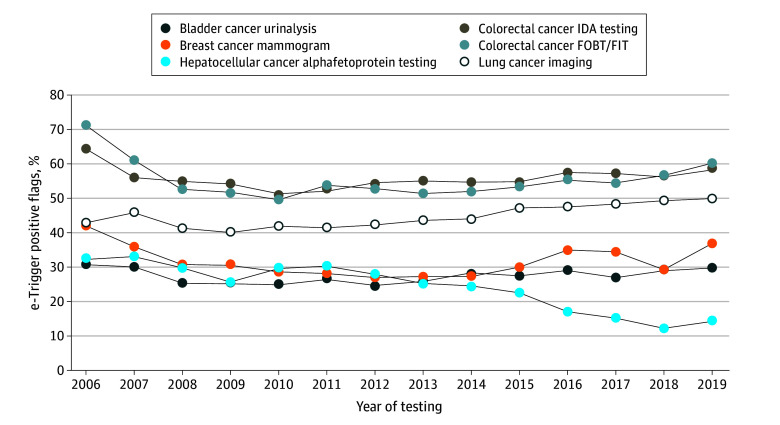
This study analyzed 6 data sets representing 5 different types of cancers. During the initial years of PACT implementation (2010 to 2013), percentage of potentially missed timely follow-ups decreased between 3 to 7 percentage points for urinalysis suggestive of bladder cancer, 12 to 14 percentage points for mammograms suggestive of breast cancer, 19 to 22 percentage points for fecal tests suggestive of colorectal cancer, and 6 to 13 percentage points for iron deficiency anemia laboratory tests suggestive of colorectal cancer, with no statistically significant changes for α-fetoprotien tests and lung cancer imaging. However, these beneficial reductions were not sustained over time. Better PACT implementation scores were associated with a decrease in potentially missed timely follow-up percentages for urinalysis (0.3-percentage point reduction [95% CI, -0.6 to -0.1] with 1-point increase in the score), and laboratory tests suggestive of iron deficiency anemia (0.5-percentage point reduction [95% CI,-0.8 to -0.2] with 1-point increase in the score).
This cohort study found that implementation of PACT in the VA was associated with a potential short-term improvement in the quality of follow-up for certain test results. Additional multifaceted sustained interventions to reduce missed test results are required to prevent care delays.
癌症相关异常检测结果未能及时跟进可能导致诊断延误或漏诊,对患者产生不利的癌症结局和巨大的经济负担。旨在改善以患者为中心的护理协调的护理交付模式,如退伍军人事务部(VA)的患者一致护理团队(PACT),可能也有助于改善异常检测结果的及时跟进。PACT 于 2010 年至 2012 年在 VA 全国范围内实施。
评估 PACT 实施与 5 种不同癌症诊断相关的异常检测结果及时跟进之间的长期关联。
设计、设置和参与者:这项多年回顾性队列研究使用了 14 年的 VA 数据(2006-2019 年),并使用面板数据基于随机效应线性回归进行了分析。该设置包括所有 VA 诊所和设施。参与者为接受与 5 种不同癌症相关的诊断性检测且检测结果异常的成年患者。数据提取和统计分析于 2021 年 9 月至 2023 年 12 月进行。
表示 PACT 实施前期和后期的历年以及表示每个 VA 诊所和设施实施程度的 PACT 实施进展指数得分。
异常检测结果潜在错过及时跟进的百分比。
本研究分析了代表 5 种不同类型癌症的 6 个数据集。在 PACT 实施的最初几年(2010 年至 2013 年),膀胱癌尿液分析结果提示的潜在错过及时跟进的百分比下降了 3 到 7 个百分点,乳腺癌乳房 X 光检查结果提示的百分比下降了 12 到 14 个百分点,结直肠癌粪便检查结果提示的百分比下降了 19 到 22 个百分点,结直肠癌铁缺乏性贫血实验室检查结果提示的百分比下降了 6 到 13 个百分点,而 α-胎蛋白检测和肺癌影像学检查结果则没有统计学意义的变化。然而,这些有益的减少并没有持续下去。更好的 PACT 实施评分与潜在错过及时跟进的百分比降低相关,尿液分析(评分增加 1 分,减少 0.3 个百分点[95%CI,-0.6 至 -0.1])和铁缺乏性贫血实验室检测(评分增加 1 分,减少 0.5 个百分点[95%CI,-0.8 至 -0.2])。
这项队列研究发现,VA 中 PACT 的实施与某些检测结果的随访质量的潜在短期改善相关。需要采取更多多方面的持续干预措施来减少漏检结果,以防止治疗延误。
