Xu Dandan, Hu Chang, Xiong Jie, Huang Haiyan, Wang Shasha, Ding Xinbo, Zhou Junying, Deng Juan, Guo Chunling, Li Miqi, You Ting, Cheng Wei, Li Bo, Tang Xiaoqin, Li Xiaohong, Li Hongmei, Li Jin, Ma Jing, Xiao Meng, Fu Xing, Li Huilin, Peng Zhiyong, Hu Bo, Hu Fen
Department of Critical Care Medicine, Zhongnan Hospital of Wuhan University, Wuhan, 430071, Hubei, China.
Department of Critical Care Medicine, Tongji Hospital, Tongji Medical College, Huazhong University of Science and Technology, Wuhan, 430030, Hubei, China.
Infect Dis Ther. 2024 Apr;13(4):941-951. doi: 10.1007/s40121-024-00953-y. Epub 2024 Mar 14.
The replacement intervals for infusion sets may differ among healthcare institutions, which may have an impact on the occurrence of central line-associated bloodstream infections (CLABSI). Nevertheless, there exists a limited amount of high-quality evidence available to assist clinicians in determining the most suitable replacement intervals for infusion sets. Therefore, the objective of this trial is to compare the efficacy of 24-h and 96-h replacement intervals for infusion sets on CLABSI among critically ill adults who have central venous access devices.
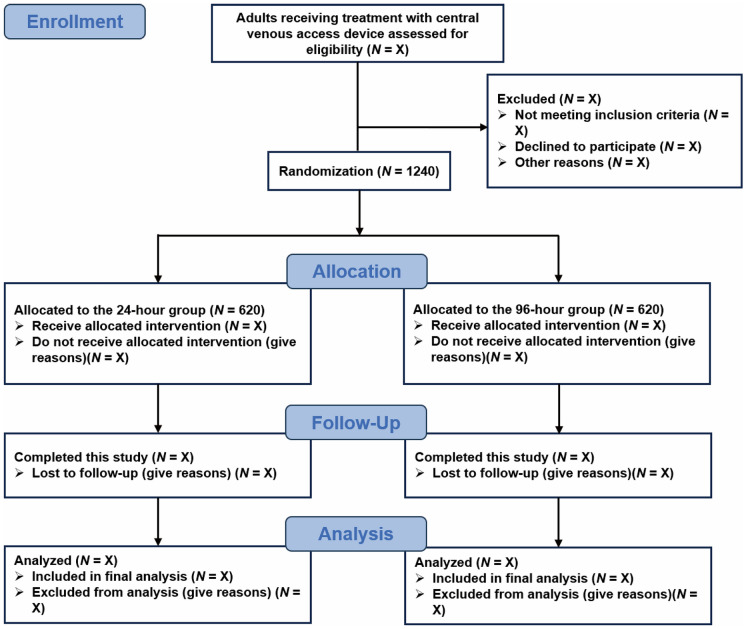
This is a multicenter, parallel-group randomized controlled trial that will investigate the effect of infusion set replacement intervals on CLABSI in adult patients admitted to intensive care units (ICUs). The study will enroll 1240 participants who meet the inclusion criteria, which includes being 18 years or older, expected to stay in the ICU for longer than 96 h, and in need of central venous access. Participants will be randomly assigned to either a control group receiving a 96-h replacement interval or a treatment group receiving a 24-h replacement interval.
The primary outcome of this trial is the rate of CLABSI within 28 days after randomization.
This is the first randomized controlled trial to investigate the effects of infusion set replacement at 24-h and 96-h intervals on CLABSI in ICU patients.
ClinicalTrials.gov identifier, NCT05359601.
各医疗机构输液器的更换间隔可能不同,这可能会影响中心静脉导管相关血流感染(CLABSI)的发生。然而,目前可用于帮助临床医生确定最合适输液器更换间隔的高质量证据有限。因此,本试验的目的是比较在有中心静脉通路装置的成年重症患者中,输液器24小时和96小时更换间隔对CLABSI的疗效。
这是一项多中心、平行组随机对照试验,将调查输液器更换间隔对入住重症监护病房(ICU)成年患者CLABSI的影响。该研究将招募1240名符合纳入标准的参与者,包括年龄在18岁及以上、预计在ICU停留超过96小时且需要中心静脉通路。参与者将被随机分配到接受96小时更换间隔的对照组或接受24小时更换间隔的治疗组。
本试验的主要结果是随机分组后28天内的CLABSI发生率。
这是第一项调查24小时和96小时间隔更换输液器对ICU患者CLABSI影响的随机对照试验。
ClinicalTrials.gov标识符,NCT05359601。