State Key Laboratory of Respiratory Disease, National Clinical Research Center for Respiratory Disease, National Center for Respiratory Medicine, Department of Organ transplantation, Guangzhou Institute of Respiratory Health, the First Affiliated Hospital of Guangzhou Medical University, 510120, Guangzhou, Guangdong, P.R. China.
Vision Medicals Co., Ltd, 510700, Guangzhou, Guangdong, P.R. China.
Respir Res. 2024 Mar 14;25(1):125. doi: 10.1186/s12931-024-02755-9.
Increasing evidence revealed that lung microbiota dysbiosis was associated with pulmonary infection in lung transplant recipients (LTRs). Pneumocystis jirovecii (P. jirovecii) is an opportunistic fungal pathogen that frequently causes lethal pneumonia in LTRs. However, the lung microbiota in LTRs with P. jirovecii pneumonia (PJP) remains unknow.
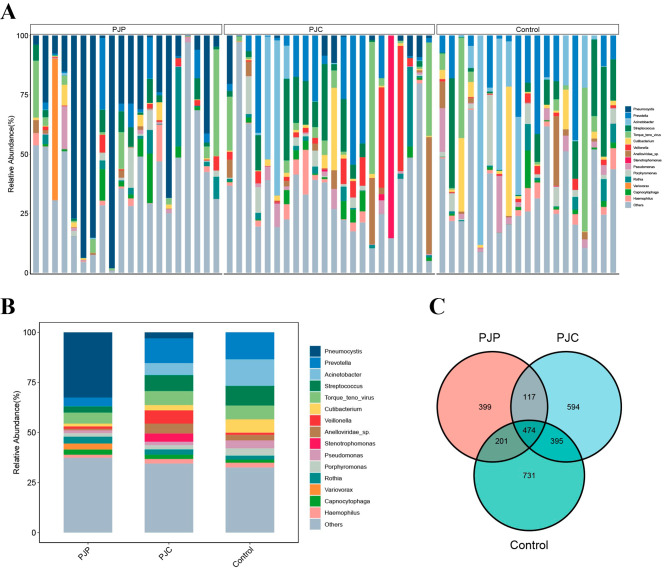
In this prospective observational study, we performed metagenomic next-generation sequencing (mNGS) on 72 bronchoalveolar lavage fluid (BALF) samples from 61 LTRs (20 with PJP, 22 with PJC, 19 time-matched stable LTRs, and 11 from LTRs after PJP recovery). We compared the lung microbiota composition of LTRs with and without P. jirovecii, and analyzed the related clinical variables.
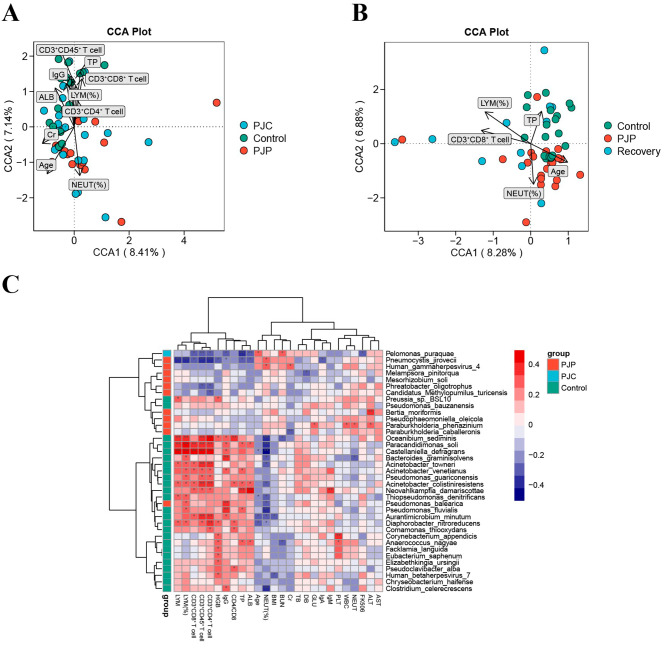
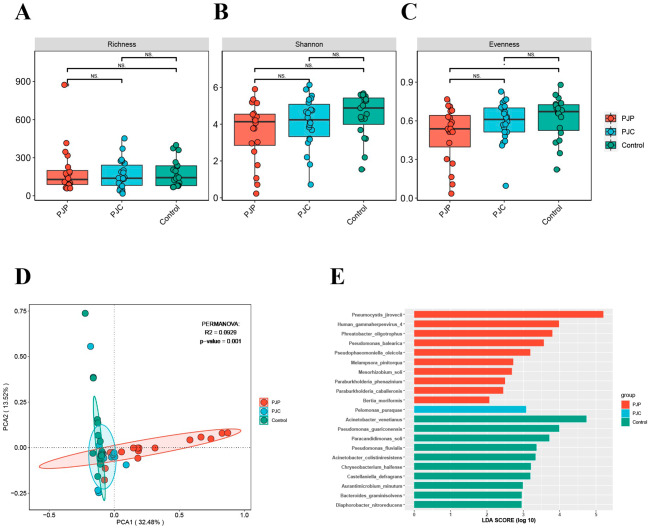
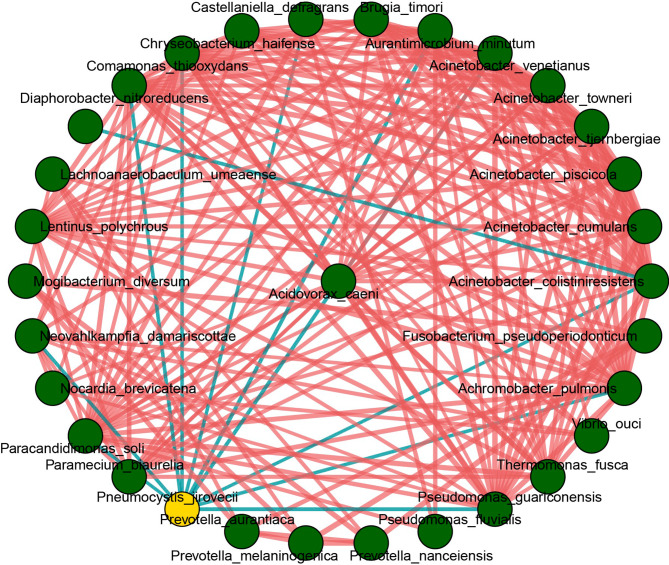
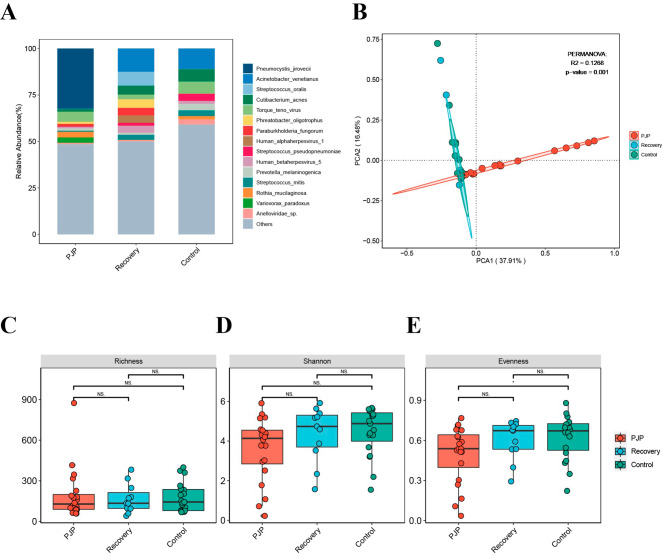
BALFs collected at the episode of PJP showed a more discrete distribution with a lower species diversity, and microbiota composition differed significantly compared to P. jirovecii colonization (PJC) and control group. Human gammaherpesvirus 4, Phreatobacter oligotrophus, and Pseudomonas balearica were the differential microbiota species between the PJP and the other two groups. The network analysis revealed that most species had a positive correlation, while P. jirovecii was correlated negatively with 10 species including Acinetobacter venetianus, Pseudomonas guariconensis, Paracandidimonas soli, Acinetobacter colistiniresistens, and Castellaniella defragrans, which were enriched in the control group. The microbiota composition and diversity of BALF after PJP recovery were also different from the PJP and control groups, while the main components of the PJP recovery similar to control group. Clinical variables including age, creatinine, total protein, albumin, IgG, neutrophil, lymphocyte, CD3CD45, CD3CD4 and CD3CD8 T cells were deeply implicated in the alterations of lung microbiota in LTRs.
This study suggests that LTRs with PJP had altered lung microbiota compared to PJC, control, and after recovery groups. Furthermore, lung microbiota is related to age, renal function, nutritional and immune status in LTRs.
越来越多的证据表明,肺微生物失调与肺移植受者(LTR)的肺部感染有关。卡氏肺孢子虫(P. jirovecii)是一种机会性真菌病原体,常导致 LTR 致命性肺炎。然而,LTR 中 P. jirovecii 肺炎(PJP)的肺微生物组仍不清楚。
在这项前瞻性观察研究中,我们对 61 名 LTR 的 72 份支气管肺泡灌洗液(BALF)样本进行了宏基因组下一代测序(mNGS)(20 名患有 PJP,22 名患有 PJC,19 名时间匹配的稳定 LTR,和 11 名 PJP 恢复后的 LTR)。我们比较了 LTR 中有无卡氏肺孢子虫的肺微生物组组成,并分析了相关的临床变量。
PJP 发作时采集的 BALF 显示出更离散的分布,物种多样性较低,与卡氏肺孢子虫定植(PJC)和对照组相比,微生物组成差异显著。人类γ疱疹病毒 4、Phreatobacter oligotrophus 和 Pseudomonas balearica 是 PJP 与其他两组之间的差异微生物种。网络分析显示,大多数物种呈正相关,而卡氏肺孢子虫与包括 Acinetobacter venetianus、Pseudomonas guariconensis、Paracandidimonas soli、Acinetobacter colistiniresistens 和 Castellaniella defragrans 在内的 10 个物种呈负相关,这些物种在对照组中丰富。PJP 恢复后的 BALF 微生物组组成和多样性也与 PJP 和对照组不同,而 PJP 恢复后的主要成分与对照组相似。包括年龄、肌酐、总蛋白、白蛋白、IgG、中性粒细胞、淋巴细胞、CD3CD45、CD3CD4 和 CD3CD8 T 细胞在内的临床变量均深入涉及 LTR 中肺微生物组的改变。
本研究表明,与 PJC、对照组和恢复组相比,PJP 的 LTR 肺微生物组发生了改变。此外,肺微生物组与 LTR 的年龄、肾功能、营养和免疫状态有关。