Department of Clinical Sciences Lund, Division of Infection Medicine, Lund University, BMC B14, 221 84, Lund, Sweden.
Division of Infectious Diseases, Skåne University Hospital Lund, Lund, Sweden.
Respir Res. 2021 Apr 23;22(1):118. doi: 10.1186/s12931-021-01724-w.
Lung transplant (LTx) recipients are at increased risk for airway infections, but the cause of infection is often difficult to establish with traditional culture-based techniques. The objectives of the study was to compare the airway microbiome in LTx patients with and without ongoing airway infection and identify differences in their microbiome composition.
LTx recipients were prospectively followed with bronchoalveolar lavage (BAL) during the first year after transplantation. The likelihood of airway infection at the time of sampling was graded based on clinical criteria and BAL cultures, and BAL fluid levels of the inflammatory markers heparin-binding protein (HBP), IL-1β and IL-8 were determined with ELISA. The bacterial microbiome of the samples were analysed with 16S rDNA sequencing and characterized based on richness and evenness. The distance in microbiome composition between samples were determined using Bray-Curtis and weighted and unweighted UniFrac.
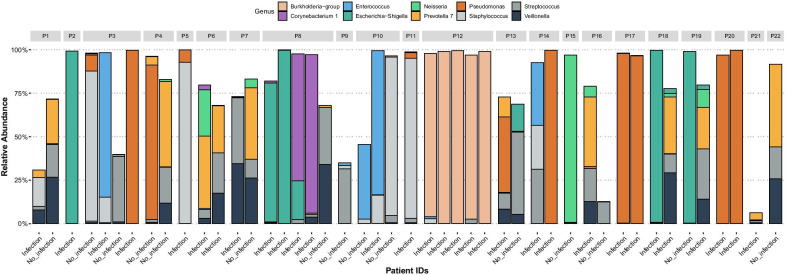
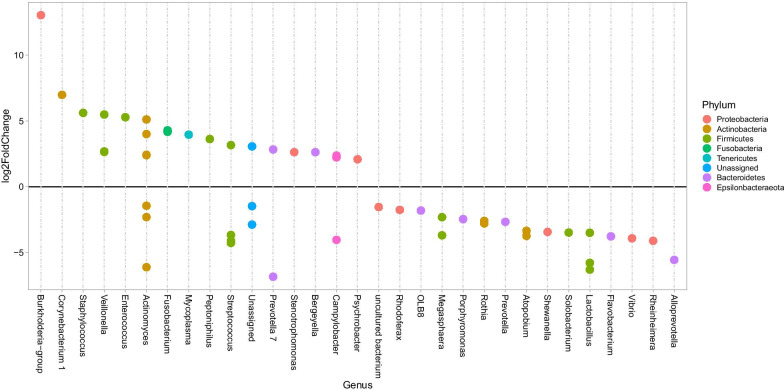
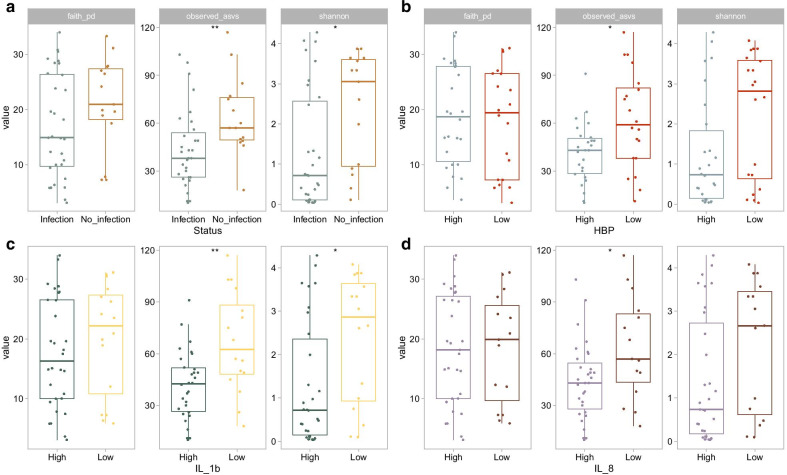
A total of 46 samples from 22 patients were included in the study. Samples collected during infection and samples with high levels of inflammation were characterized by loss of bacterial diversity and a significantly different species composition. Burkholderia, Corynebacterium and Staphylococcus were enriched during infection and inflammation, whereas anaerobes and normal oropharyngeal flora were less abundant. The most common findings in BAL cultures, including Pseudomonas aeruginosa, were not enriched during infection.
This study gives important insights into the dynamics of the airway microbiome of LTx recipients, and suggests that lung infections are associated with a disruption in the homeostasis of the microbiome.
肺移植(LTx)受者发生气道感染的风险增加,但传统的基于培养的技术往往难以确定感染的原因。本研究的目的是比较 LTx 受者中持续气道感染和无持续气道感染患者的气道微生物组,并确定其微生物组组成的差异。
前瞻性地对 LTx 受者进行随访,在移植后第一年进行支气管肺泡灌洗(BAL)。根据临床标准和 BAL 培养物对采样时发生气道感染的可能性进行分级,并通过 ELISA 测定 BAL 液中肝素结合蛋白(HBP)、IL-1β和 IL-8 的炎症标志物水平。使用 16S rDNA 测序分析样本的细菌微生物组,并基于丰富度和均匀度进行特征描述。使用 Bray-Curtis 和加权和非加权 UniFrac 确定样本之间微生物组组成的距离。
共纳入 22 例患者的 46 个样本。感染期间采集的样本和炎症水平较高的样本表现为细菌多样性丧失和明显不同的物种组成。感染和炎症期间 Burkholderia、Corynebacterium 和 Staphylococcus 富集,而厌氧菌和正常口咽菌群较少。BAL 培养中最常见的发现,包括铜绿假单胞菌,在感染期间并未富集。
本研究深入了解了 LTx 受者气道微生物组的动态变化,并提示肺部感染与微生物组的平衡失调有关。