Lin Cheng, Li Meifang, Lin Yingying, Zhang Yu, Xu Hanchuan, Chen Bijuan, Yan Xia, Xu Yun
Department of Radiation Oncology, Clinical Oncology School of Fujian Medical University, Fujian Cancer Hospital, Fuzhou, Fujian Province, China.
Interdisciplinary College of Medicine and Engineering, Fuzhou University, Fuzhou, Fujian, China.
Infect Agent Cancer. 2024 Mar 14;19(1):8. doi: 10.1186/s13027-024-00570-x.
Nasopharyngeal carcinoma (NPC) is prevalent in southern China. EBV DNA is the most useful biomarker in NPC. However, the value of EBV DNA in posttreatment NPC patients infected with severe acute respiratory syndrome coronavirus 2 (SARS-CoV-2) remains unclear.
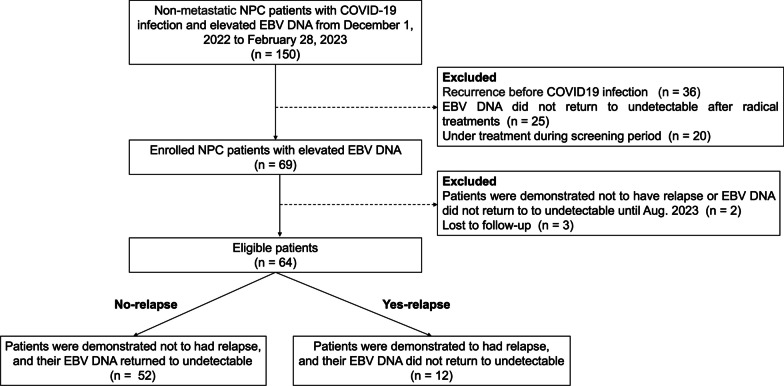
Sixty-four eligible NPC patients were enrolled between December 2022 and February 2023. Patients who met the following criteria were included: had non-metastatic NPC, completed radical treatment, were first firstly infected with SARS-CoV-2 and their EBV DNA changed from undetectable to detectable.
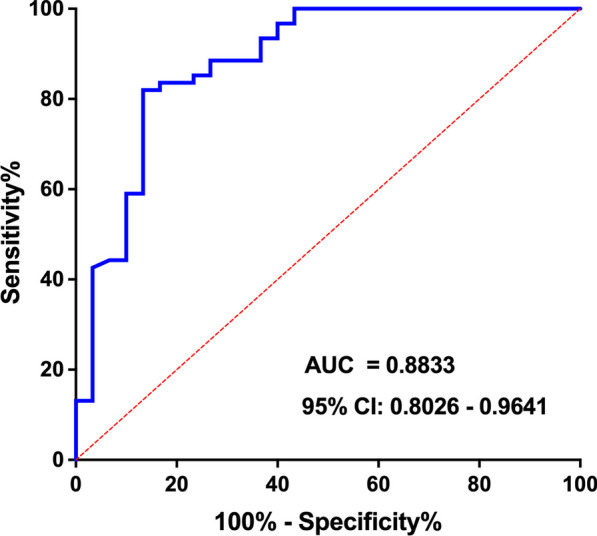
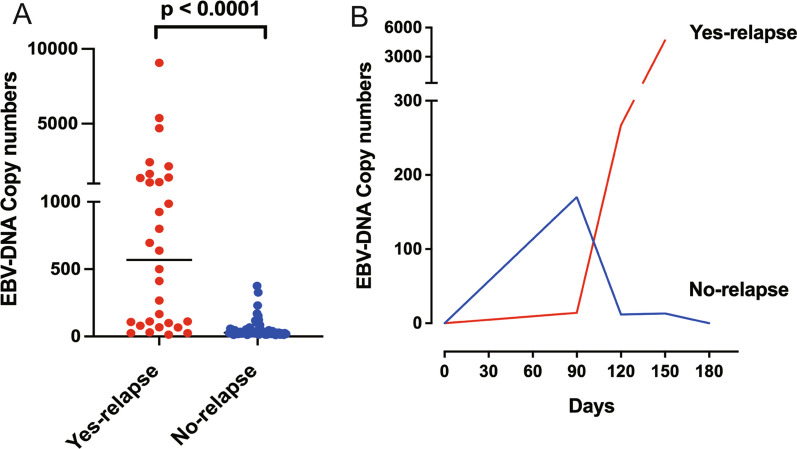
At the end of follow-up, 81.25% (52/64) of patients were confirmed not to relapse with undetectable EBV DNA (no-relapse). In addition, 18.75% (12/64) of patients experienced relapse with consistent detection of EBV DNA (yes-relapse). For all 64 patients, the average time from diagnosis of coronavirus disease 2019 (COVID-19) to detection of detectable EBV DNA was 35.41 days (2 to 139 days). For 52 no-relapse patients, the average time from EBV DNA changing from detectable to undetectable was 63.12 days (6 to 147 days). The levels of EBV DNA were greater in yes-relapse patients than that in no-relapse patients, and the average of EBV DNA levels were 1216 copies/ml and 53.18 copies/ml, respectively. Using 62.3 copies/mL as the threshold, the area under the curve for EBV DNA was 0.88 for distinguishing yes-relapse patients from no-relapse patients. The sensitivity and specificity were 81.97% (95% CI 0.71-0.95) and 86.67% (95% CI 0.70-0.95), respectively.
For NPC patients infected with SARS-CoV-2, EBV DNA alone is insufficient for monitoring relapse after radical therapy. Long-term follow-up and underlying mechanistic investigations of EBV DNA changes are urgently needed.
鼻咽癌(NPC)在中国南方地区较为常见。EBV DNA是鼻咽癌中最有用的生物标志物。然而,EBV DNA在感染严重急性呼吸综合征冠状病毒2(SARS-CoV-2)的鼻咽癌患者治疗后的价值仍不明确。
2022年12月至2023年2月期间纳入了64例符合条件的鼻咽癌患者。纳入符合以下标准的患者:患有非转移性鼻咽癌,完成根治性治疗,首次感染SARS-CoV-2且其EBV DNA从不可检测变为可检测。
随访结束时,81.25%(52/64)的患者经确认未复发,EBV DNA不可检测(无复发)。此外,18.�5%(12/64)的患者出现复发,EBV DNA持续可检测(有复发)。对于所有64例患者,从诊断新型冠状病毒肺炎(COVID-19)到检测到可检测的EBV DNA的平均时间为35.41天(2至139天)。对于52例无复发患者,EBV DNA从可检测变为不可检测的平均时间为63.12天(6至147天)。有复发患者的EBV DNA水平高于无复发患者,EBV DNA水平平均值分别为1216拷贝/毫升和53.18拷贝/毫升。以62.3拷贝/毫升作为阈值,EBV DNA区分有复发患者和无复发患者的曲线下面积为0.88。敏感性和特异性分别为81.97%(95%CI 0.71 - 0.95)和86.67%(95%CI 0.70 - 0.95)。
对于感染SARS-CoV-2的鼻咽癌患者,仅EBV DNA不足以监测根治性治疗后的复发情况。迫切需要对EBV DNA变化进行长期随访和深入的机制研究。