Park Jisu, Kim Doo Sup, Huh Hyungkyu, Cho Won Gil, Kim HyunWoo, Lee Dong-Woo
Department of Orthopedic Surgery, Wonju College of Medicine, Yonsei University, Republic of Korea.
Daegu-Gyeongbuk Medical Innovation Foundation, Dae-gu, Republic of Korea.
Orthop J Sports Med. 2024 Mar 13;12(3):23259671241226909. doi: 10.1177/23259671241226909. eCollection 2024 Mar.
Researchers have attempted to understand the underlying mechanism of the Latarjet procedure; however, its effects on shoulder kinematics have not been well studied.
PURPOSE/HYPOTHESIS: The purpose was to analyze shoulder kinematics after the Latarjet procedure. It was hypothesized that the nonanatomic transfer of the coracoid process during the procedure would affect normal shoulder kinematics.
Controlled laboratory study.
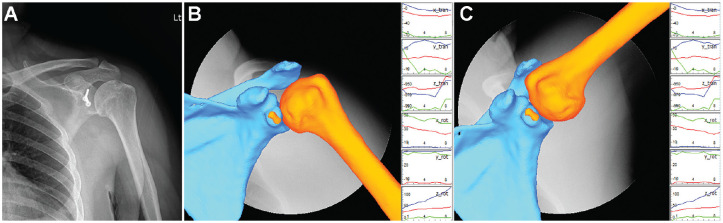
The study included 10 patients (age range, 20-52 years) who underwent the modified Latarjet procedure between June 2016 and November 2021. Computed tomography and fluoroscopy were conducted on both shoulder joints of all patients, and 3-dimensional models were reconstructed. The 3-dimensional coordinates were encoded on the reconstructed models, and shoulder kinematics were analyzed through a 3-dimensional-2-dimensional model-image registration technique. Scapular rotation parameters (scapular upward rotation, posterior tilt, external rotation, and scapulohumeral rhythm) were compared between the Latarjet and the nonsurgical contralateral sides during humeral abduction, as was anteroposterior (AP) translation relative to the glenoid center during active humeral external rotation.
The Latarjet side displayed significantly higher values of scapular upward rotation at higher degrees of humeral elevation (130°, 140°, and 150°) compared with the nonsurgical side ( = .027). Posterior tilt, external rotation, and scapulohumeral rhythm were not significantly different between sides. AP translation at maximal humeral rotation was not significantly different between sides (Latarjet, -0.06 ± 5.73 mm vs nonsurgical, 5.33 ± 1.60 mm; = .28). Interestingly, on the Latarjet side, AP translation increased until 40° of humeral rotation (4.27 ± 4.64 mm) but began to decrease from 50° of humeral rotation.
The Latarjet side demonstrated significant changes in scapular upward rotation during higher degrees of humeral elevation compared with the contralateral shoulder. Posterior movement of the humeral head at >50° of humeral rotation could be the desired effect of anterior stabilization; however, researchers should evaluate long-term complications such as osteoarthritis.
Analysis of shoulder kinematics after the Latarjet procedure could provide information regarding long-term outcomes and whether the procedure would affect the daily activities of patients.
研究人员一直试图了解拉塔热手术的潜在机制;然而,其对肩部运动学的影响尚未得到充分研究。
目的/假设:目的是分析拉塔热手术后的肩部运动学。假设该手术过程中喙突的非解剖学转移会影响正常的肩部运动学。
对照实验室研究。
该研究纳入了10例在2016年6月至2021年11月期间接受改良拉塔热手术的患者(年龄范围20 - 52岁)。对所有患者的双侧肩关节进行计算机断层扫描和荧光透视,并重建三维模型。在重建模型上编码三维坐标,并通过三维 - 二维模型 - 图像配准技术分析肩部运动学。比较拉塔热手术侧和非手术对侧在肱骨外展过程中的肩胛旋转参数(肩胛上旋、后倾、外旋和肩肱节律),以及在主动肱骨外旋过程中相对于关节盂中心的前后(AP)平移。
与非手术侧相比,拉塔热手术侧在肱骨抬高较高角度(130°、140°和150°)时肩胛上旋值显著更高(P = 0.027)。两侧之间的后倾、外旋和肩肱节律无显著差异。在最大肱骨旋转时两侧的AP平移无显著差异(拉塔热手术侧,-0.06 ±
5.73 mm vs非手术侧,5.33 ± 1.60 mm;P = 0.28)。有趣的是,在拉塔热手术侧,AP平移在肱骨旋转至40°时增加(4.27 ± 4.64 mm),但在肱骨旋转50°时开始下降。
与对侧肩部相比,拉塔热手术侧在肱骨抬高较高角度时肩胛上旋有显著变化。肱骨旋转>50°时肱骨头的后移可能是前方稳定的预期效果;然而,研究人员应评估骨关节炎等长期并发症。
分析拉塔热手术后的肩部运动学可以提供有关长期结果以及该手术是否会影响患者日常活动的信息。