Turri Fiorella, Jones Andrew, Constanty Lauriane, Ranjbar Setareh, Drexl Konstantin, Miano Giorgia, Lepage Caroline, Plessen Kerstin Jessica, Urben Sébastien
Division of Child and Adolescent Psychiatry Department of Psychiatry Lausanne University Hospital (CHUV) Lausanne Switzerland.
School of Psychology Liverpool John Moores University Liverpool UK.
JCPP Adv. 2023 Sep 30;4(1):e12200. doi: 10.1002/jcv2.12200. eCollection 2024 Mar.
This study aimed to better understand the temporal interrelationships among self-control, response inhibition, and anger (i.e., momentary state and rumination) on both the within- and between-person levels in male adolescents.
We applied temporal network analyses among 62 male adolescents with a wide range of behavioral difficulties. Self-control, momentary anger, and anger rumination were mapped by self-report measures, whereas we measured response inhibition through an ambulatory Go/No-go task (two measures a day-morning and afternoon-over a 9-day period).
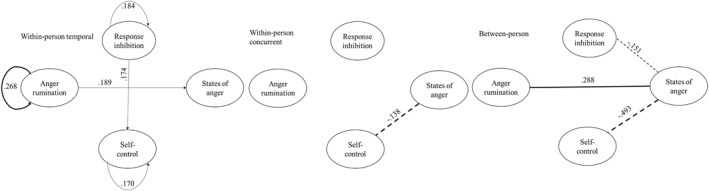
Temporal network analysis, at the within-person level, revealed that morning measures of response inhibition, anger rumination, and self-control were related to the corresponding measure in the afternoon. More efficient response inhibition in the morning was associated with higher self-control in the afternoon. Higher anger rumination in the morning led to higher momentary anger in the afternoon. In a concurrent within-person network, higher momentary anger was reciprocally associated with lower self-control. At the between-person level, higher momentary anger was correlated to higher anger rumination, lower response inhibition, and lower self-control.
This study provides insight into the dynamic interactions among self-control, response inhibition, and anger (momentary state and rumination) in male adolescents, advancing the understanding of self-regulatory control functioning.
本研究旨在更好地理解男性青少年在个体内部和个体之间层面上,自我控制、反应抑制和愤怒(即瞬时状态和沉思)之间的时间相互关系。
我们对62名有广泛行为困难的男性青少年进行了时间网络分析。自我控制、瞬时愤怒和愤怒沉思通过自我报告测量来确定,而我们通过动态的“去/不去”任务(在9天时间里,每天上午和下午各测量一次)来测量反应抑制。
在个体内部层面的时间网络分析显示,上午的反应抑制、愤怒沉思和自我控制测量结果与下午的相应测量结果相关。上午更有效的反应抑制与下午更高的自我控制相关。上午更高的愤怒沉思会导致下午更高的瞬时愤怒。在同时进行的个体内部网络中,更高的瞬时愤怒与更低的自我控制相互关联。在个体之间层面,更高的瞬时愤怒与更高的愤怒沉思、更低的反应抑制和更低的自我控制相关。
本研究为男性青少年自我控制、反应抑制和愤怒(瞬时状态和沉思)之间的动态相互作用提供了见解,推进了对自我调节控制功能的理解。