Alnaim Nusaybah, Al Ghadeer Hussain A, Al-Bunyan Abdulhameed A, Almulhem Abdulmohsen, Alsaleh Yassin, AlHelal Manal, Almugaizel Ishaq, Alhashim Zahra, Alhamrani Ahmed M, Al Bosrour Zinab A
Endocrinology and Diabetes, Maternity and Children Hospital, Al Ahsa, SAU.
Pediatrics, Maternity and Children Hospital, Al Ahsa, SAU.
Cureus. 2024 Feb 13;16(2):e54123. doi: 10.7759/cureus.54123. eCollection 2024 Feb.
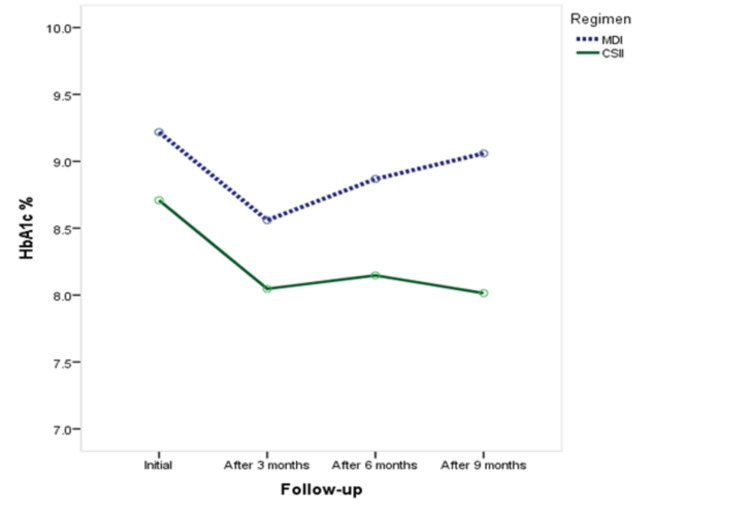
Background Advances in pump technology and the availability of insulin analogs, as well as the results of the Diabetes Control and Complications Trial (DCCT), which established the benefit of improved glycemic control, have all contributed to the increased use of insulin pump therapy in recent years, particularly in children. Purpose This research aims to compare the impact of insulin delivery method, i.e., continuous subcutaneous insulin infusion (CSII) or multiple daily injections (MDI) on glycemic control and the rate of diabetic ketoacidosis (DKA) among children with type 1 diabetes mellitus in Al Ahsa, Saudi Arabia. Methods A retrospective cohort study was carried out in a diabetic center in Al Ahsa, Saudi Arabia, over 24 months (2020-2022) among children with type I diabetes mellitus (age group 1-14 years). Results In total, 351 patients with diabetes were induced, with 316 (90%) on MDI and 35 (10%) on CSII. After six months of diagnosis, precisely 38 (12%) of patients with diabetes on the MDI regimen experienced DKA, compared to 4 (11.4%) of those on the CSII regimen, with no statistically significant difference (P=0.918). At six months and nine months of follow-up, the average hemoglobin A1c (HbA1c) was considerably higher in diabetic patients on MDI (8.9 ± 1.7% vs. 8.2 ± 1.5% and 9.1 ± 1.6% vs. 8.0 ± 1.3%, respectively, with a significant p-value ≤0.05). Conclusion In this study, we found that patients on the MDI regimen had considerably higher HbA1c levels than patients on the CSII regimen, but there was no statistically significant difference in DKA rates between them. This is a short-term follow-up study, and we recommend that patients be followed for a longer period of time for further accurate outcomes.
泵技术的进步、胰岛素类似物的可得性,以及糖尿病控制与并发症试验(DCCT)的结果(该试验证实了改善血糖控制的益处),都促使近年来胰岛素泵疗法的使用有所增加,尤其是在儿童中。
本研究旨在比较胰岛素给药方式,即持续皮下胰岛素输注(CSII)或多次皮下注射(MDI)对沙特阿拉伯艾哈萨1型糖尿病儿童血糖控制及糖尿病酮症酸中毒(DKA)发生率的影响。
在沙特阿拉伯艾哈萨的一个糖尿病中心进行了一项回顾性队列研究,研究对象为1型糖尿病儿童(年龄1 - 14岁),为期24个月(2020 - 2022年)。
共纳入351例糖尿病患者,其中316例(90%)采用MDI治疗,35例(10%)采用CSII治疗。诊断6个月后,MDI治疗方案的糖尿病患者中有38例(12%)发生DKA,而CSII治疗方案的患者中有4例(11.4%)发生DKA,差异无统计学意义(P = 0.918)。在随访6个月和9个月时,MDI治疗的糖尿病患者平均糖化血红蛋白(HbA1c)水平显著更高(分别为8.9±1.7%对8.2±1.5%以及9.1±1.6%对8.0±1.3%,p值≤0.05,差异有统计学意义)。
在本研究中,我们发现采用MDI治疗方案的患者HbA1c水平显著高于采用CSII治疗方案的患者,但两者之间的DKA发生率无统计学显著差异。这是一项短期随访研究,我们建议对患者进行更长时间的随访以获得更准确的结果。