Department of Preventive Medicine, Faculty of Medicine, Saga University Nabeshima, Saga, Japan.
Department of Social and Environmental Medicine, Faculty of Medicine, Saga University Nabeshima, Saga, Japan.
Front Public Health. 2024 Feb 29;12:1348170. doi: 10.3389/fpubh.2024.1348170. eCollection 2024.
Addresing vaccine hesitancy is considered an important goal in management of the COVID-19 pandemic. We sought to understand what factors influenced people, especially those initially hesitant, to receive two or more vaccine doses within a year of the vaccine's release.
We conducted longitudinal Web-based observational studies of 3,870 individuals. The surveys were conducted at four different time points: January 2021, June 2021, September 2021, and December 2021. In the baseline survey (January 2021), we assessed vaccination intention (i.e., "strongly agree" or "agree" [acceptance], "neutral" [not sure], and "disagree" or "strongly disagree" [hesitance]), and assumptions about coronavirus disease (COVID-19), COVID-19 vaccine, COVID-19-related health preventive behavior, and COVID-19 vaccine reliability. In subsequent surveys (December 2021), we assessed vaccination completion (i.e., ≥2 vaccinations). To investigate the relationship between predictors of COVID-19 vaccination completion, a multivariable logistic regression model was applied. Adjusted odds ratios (AORs) and 95% confidence intervals (CIs) were calculated while adjusting for gender, age, marital status, presence of children, household income category, and presence of diseases under treatment. In a stratified analysis, predictors were determined based on vaccination intention.
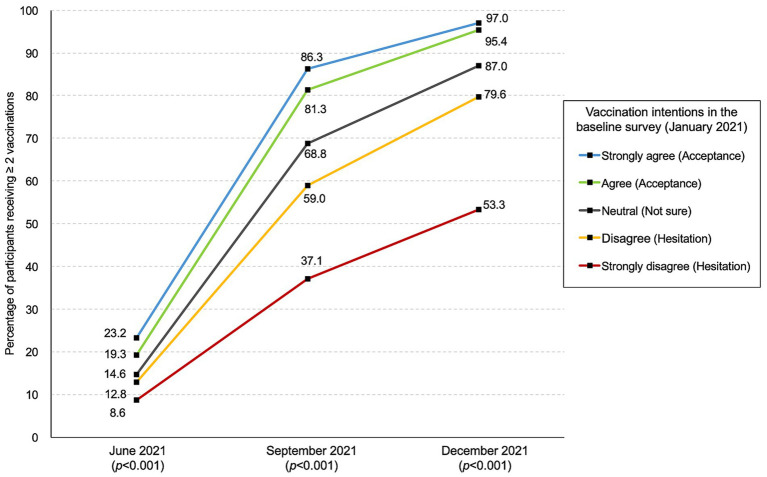
Approximately 96, 87, and 72% of those who demonstrated acceptance, were not sure, or hesitated had been vaccinated after 1 year, respectively. Overall, significant factors associated with COVID-19 vaccine compliance included the influence of others close to the index participant (social norms) (AOR, 1.80; 95% CI, 1.56-2.08; < 0.001), vaccine confidence (AOR, 1.39; 95% CI, 1.18-1.64; < 0.001) and structural constraints (no time, inconvenient location of medical institutions, and other related factors) (AOR, 0.80; 95% CI, 0.70-0.91; = 0.001). In the group of individuals classified as hesitant, significant factors associated with COVID-19 vaccine compliance included social norms (AOR, 2.43; 95% CI, 1.83-3.22; < 0.001), confidence (AOR, 1.44; 95% CI, 1.10-1.88; = 0.008), and knowledge (AOR, 0.69; 95% CI, 0.53-0.88; = 0.003).
We found that dissemination of accurate information about vaccines and a reduction in structural barriers to the extent possible enhanced vaccination rates. Once the need for vaccination becomes widespread, it becomes a social norm, and further improvements in these rates can then be anticipated. Our findings may help enhance vaccine uptake in the future.
解决疫苗犹豫被认为是管理 COVID-19 大流行的重要目标。我们试图了解是什么因素影响了人们,特别是那些最初犹豫不决的人,在疫苗推出后的一年内接受两剂或更多剂疫苗。
我们对 3870 名个体进行了纵向基于网络的观察性研究。这些调查在四个不同的时间点进行:2021 年 1 月、2021 年 6 月、2021 年 9 月和 2021 年 12 月。在基线调查(2021 年 1 月)中,我们评估了接种意愿(即“强烈同意”或“同意”[接受]、“中立”[不确定]和“不同意”或“强烈不同意”[犹豫]),以及对冠状病毒病(COVID-19)、COVID-19 疫苗、与 COVID-19 相关的健康预防行为和 COVID-19 疫苗可靠性的假设。在随后的调查(2021 年 12 月)中,我们评估了疫苗接种完成情况(即≥2 剂)。为了研究 COVID-19 疫苗接种完成情况的预测因素之间的关系,应用了多变量逻辑回归模型。在调整性别、年龄、婚姻状况、是否有子女、家庭收入类别和正在接受治疗的疾病后,计算了调整后的优势比(AOR)和 95%置信区间(CI)。在分层分析中,根据接种意愿确定了预测因素。
大约 96%、87%和 72%的接受者、不确定者和犹豫者在 1 年后分别接种了疫苗。总体而言,与 COVID-19 疫苗依从性相关的显著因素包括与指数参与者密切相关的其他人的影响(社会规范)(AOR,1.80;95%CI,1.56-2.08;<0.001)、疫苗信心(AOR,1.39;95%CI,1.18-1.64;<0.001)和结构约束(无时间、医疗机构位置不便和其他相关因素)(AOR,0.80;95%CI,0.70-0.91;=0.001)。在被归类为犹豫的个体组中,与 COVID-19 疫苗接种依从性相关的显著因素包括社会规范(AOR,2.43;95%CI,1.83-3.22;<0.001)、信心(AOR,1.44;95%CI,1.10-1.88;=0.008)和知识(AOR,0.69;95%CI,0.53-0.88;=0.003)。
我们发现,传播有关疫苗的准确信息和尽可能减少结构障碍有助于提高疫苗接种率。一旦接种疫苗的需求变得普遍,它就成为一种社会规范,预计这些比率将进一步提高。我们的研究结果可能有助于未来提高疫苗接种率。