Department of Pediatrics, BC Children's Hospital Research Institute and University of British Columbia, Vancouver, British Columbia, Canada.
Department of Pediatrics, The Hospital for Sick Children and University of Toronto, Toronto, Ontario, Canada.
JAMA Netw Open. 2024 Mar 4;7(3):e242551. doi: 10.1001/jamanetworkopen.2024.2551.
Early-life exposure to painful procedures has been associated with altered brain maturation and neurodevelopmental outcomes in preterm infants, although sex-specific differences are largely unknown.
To examine sex-specific associations among early-life pain exposure, alterations in neonatal structural connectivity, and 18-month neurodevelopment in preterm infants.
DESIGN, SETTING, AND PARTICIPANTS: This prospective cohort study recruited 193 very preterm infants from April 1, 2015, to April 1, 2019, across 2 tertiary neonatal intensive care units in Toronto, Canada. Structural connectivity data were available for 150 infants; neurodevelopmental outcomes were available for 123 infants. Data were analyzed from January 1, 2022, to December 31, 2023.
Pain was quantified in the initial weeks after birth as the total number of invasive procedures.
Infants underwent early-life and/or term-equivalent-age magnetic resonance imaging with diffusion tensor imaging to quantify structural connectivity using graph theory measures and regional connection strength. Eighteen-month neurodevelopmental outcomes were assessed with the Bayley Scales of Infant and Toddler Development, Third Edition. Stratifying by sex, generalized estimating equations were used to assess whether pain exposure modified the maturation of structural connectivity using an interaction term (early-life pain exposure × postmenstrual age [PMA] at scan). Generalized estimating equations were used to assess associations between structural connectivity and neurodevelopmental outcomes, adjusting for extreme prematurity and maternal education.
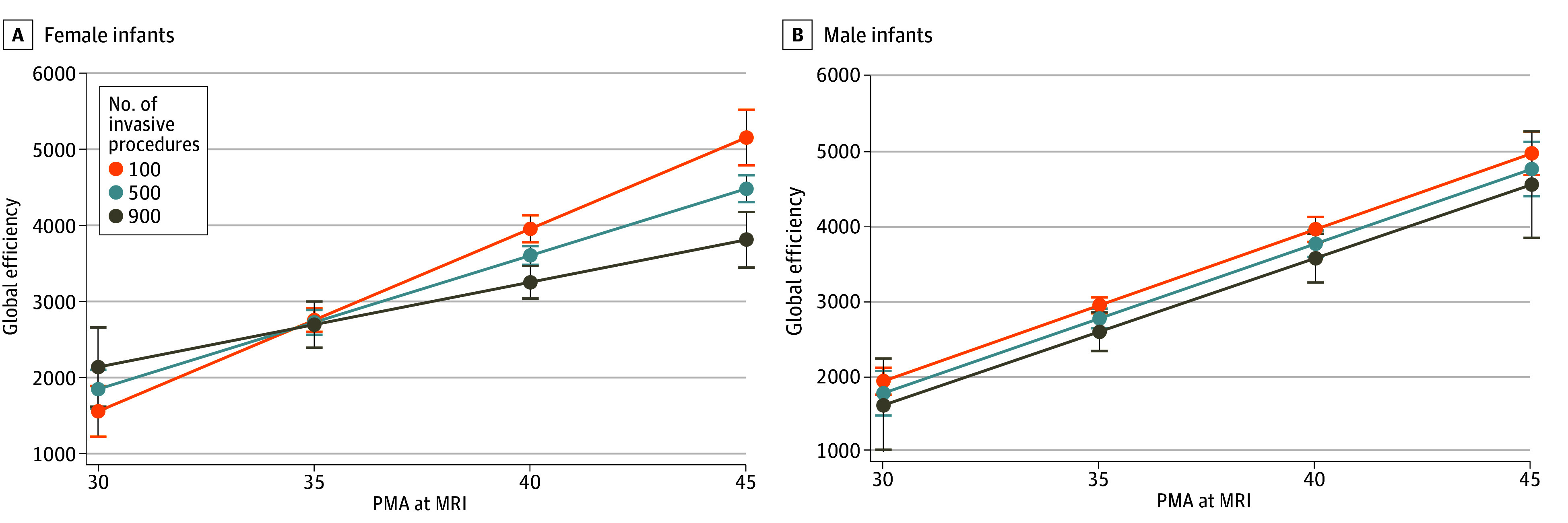
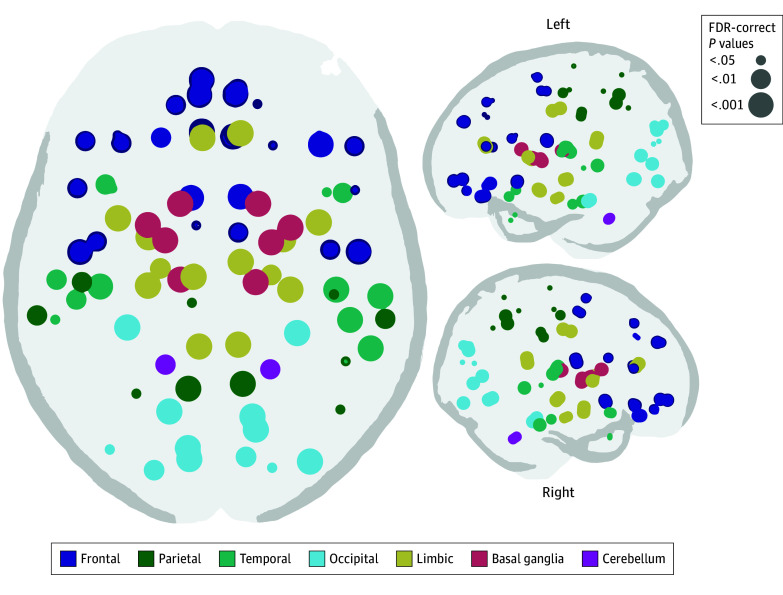
A total of 150 infants (80 [53%] male; median [IQR] gestational age at birth, 27.1 [25.4-29.0] weeks) with structural connectivity data were analyzed. Sex-specific associations were found between early-life pain and neonatal brain connectivity in female infants only, with greater early-life pain exposure associated with slower maturation in global efficiency (pain × PMA at scan interaction P = .002) and local efficiency (pain × PMA at scan interaction P = .005). In the full cohort, greater pain exposure was associated with lower global efficiency (coefficient, -0.46; 95% CI, -0.78, to -0.15; P = .004) and local efficiency (coefficient, -0.57; 95% CI, -1.04 to -0.10; P = .02) and regional connection strength. Local efficiency (coefficient, 0.003; 95% CI, 0.001-0.004; P = .005) and regional connection strength in the striatum were associated with cognitive outcomes.
In this cohort study of very preterm infants, greater exposure to early-life pain was associated with altered maturation of neonatal structural connectivity, particularly in female infants. Alterations in structural connectivity were associated with neurodevelopmental outcomes, with potential regional specificities.
早期生命中经历痛苦的程序与早产儿大脑成熟和神经发育结果的改变有关,尽管性别特异性差异在很大程度上尚不清楚。
研究早产儿生命早期疼痛暴露、新生儿结构连接改变与 18 个月神经发育之间的性别特异性关联。
设计、地点和参与者:这是一项前瞻性队列研究,于 2015 年 4 月 1 日至 2019 年 4 月 1 日期间在加拿大多伦多的 2 个三级新生儿重症监护病房招募了 193 名非常早产儿。150 名婴儿可提供结构连接数据;123 名婴儿可提供神经发育结果数据。数据分析于 2022 年 1 月 1 日至 2023 年 12 月 31 日进行。
在出生后的最初几周内,疼痛以侵入性程序的总数来量化。
婴儿接受了生命早期和/或胎龄相等时的磁共振成像检查,使用弥散张量成像来使用图论指标和区域连接强度来量化结构连接。使用贝利婴幼儿发育量表第三版评估 18 个月的神经发育结果。通过性别分层,广义估计方程用于评估疼痛暴露是否通过交互项(生命早期疼痛暴露×扫描时的孕周)改变了结构连接的成熟度。广义估计方程用于评估结构连接与神经发育结果之间的关联,同时调整了极早产儿和母亲教育程度的极端情况。
对 150 名婴儿(80 名[53%]为男性;中位[IQR]出生时的胎龄,27.1[25.4-29.0]周)进行了结构连接数据分析。仅在女性婴儿中发现了生命早期疼痛与新生儿大脑连接之间的性别特异性关联,与生命早期疼痛暴露更多相关的是全局效率(疼痛×扫描时的 PMA 交互作用 P=0.002)和局部效率(疼痛×扫描时的 PMA 交互作用 P=0.005)的成熟速度较慢。在全队列中,更多的疼痛暴露与更低的全局效率(系数,-0.46;95%置信区间,-0.78,至-0.15;P=0.004)和局部效率(系数,-0.57;95%置信区间,-1.04 至-0.10;P=0.02)和区域连接强度相关。局部效率(系数,0.003;95%置信区间,0.001-0.004;P=0.005)和纹状体的区域连接强度与认知结果相关。
在这项对非常早产儿的队列研究中,与生命早期疼痛暴露更多相关的是新生儿结构连接的成熟改变,特别是在女性婴儿中。结构连接的改变与神经发育结果相关,具有潜在的区域特异性。