Institute of Bioengineering, Research Center of Biotechnology of the Russian Academy of Sciences, Leninsky Prosp, bld. 33‑2, Moscow, Russia, 119071.
Winogradsky Institute of Microbiology, Research Center of Biotechnology of the Russian Academy of Sciences, Leninsky Prosp, bld. 33‑2, Moscow, Russia, 119071.
Sci Rep. 2024 Mar 15;14(1):6349. doi: 10.1038/s41598-024-56870-0.
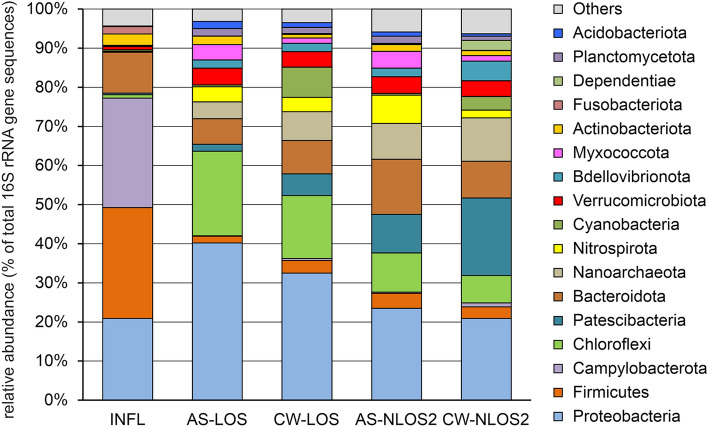
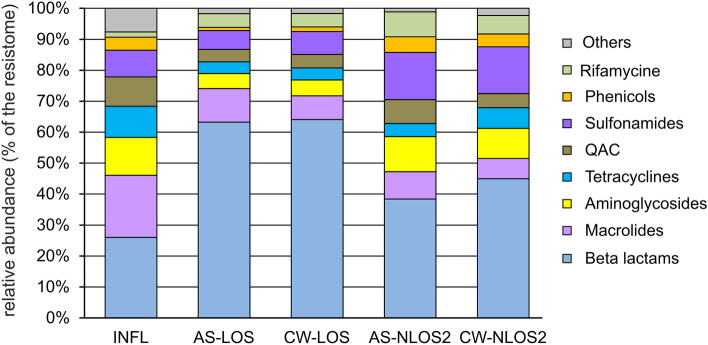
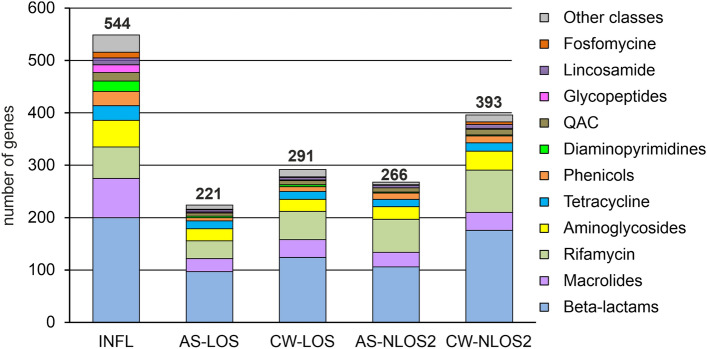
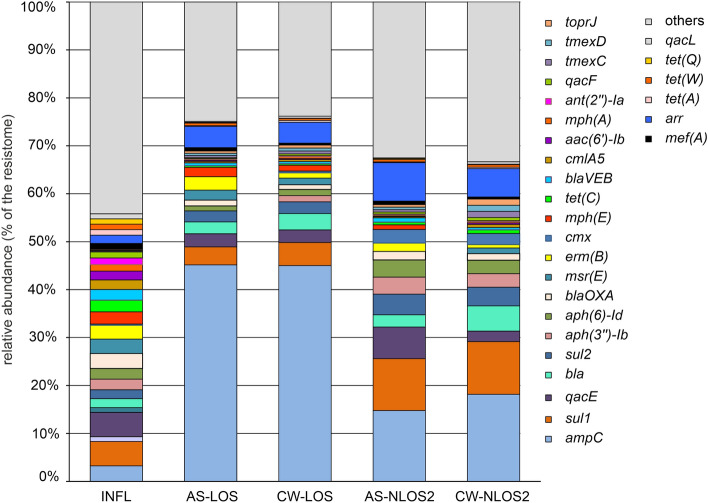
Wastewater treatment plants (WWTPs) are considered to be hotspots for the spread of antibiotic resistance genes (ARGs). We performed a metagenomic analysis of the raw wastewater, activated sludge and treated wastewater from two large WWTPs responsible for the treatment of urban wastewater in Moscow, Russia. In untreated wastewater, several hundred ARGs that could confer resistance to most commonly used classes of antibiotics were found. WWTPs employed a nitrification/denitrification or an anaerobic/anoxic/oxic process and enabled efficient removal of organic matter, nitrogen and phosphorus, as well as fecal microbiota. The resistome constituted about 0.05% of the whole metagenome, and after water treatment its share decreased by 3-4 times. The resistomes were dominated by ARGs encoding resistance to beta-lactams, macrolides, aminoglycosides, tetracyclines, quaternary ammonium compounds, and sulfonamides. ARGs for macrolides and tetracyclines were removed more efficiently than beta-lactamases, especially ampC, the most abundant ARG in the treated effluent. The removal efficiency of particular ARGs was impacted by the treatment technology. Metagenome-assembled genomes of multidrug-resistant strains were assembled both for the influent and the treated effluent. Ccomparison of resistomes from WWTPs in Moscow and around the world suggested that the abundance and content of ARGs depend on social, economic, medical, and environmental factors.
污水处理厂(WWTP)被认为是抗生素耐药基因(ARGs)传播的热点。我们对俄罗斯莫斯科两个负责处理城市废水的大型 WWTP 的原废水、活性污泥和处理后的废水进行了宏基因组分析。在未经处理的废水中,发现了数百种可赋予对大多数常用抗生素类药物抗性的 ARGs。WWTP 采用硝化/反硝化或厌氧/缺氧/好氧工艺,能够有效去除有机物、氮和磷以及粪便微生物群。抗性组约占整个宏基因组的 0.05%,经过水处理后,其份额减少了 3-4 倍。抗性组主要由编码对β-内酰胺类、大环内酯类、氨基糖苷类、四环素类、季铵化合物和磺胺类药物的耐药性的 ARGs 组成。与β-内酰胺酶相比,大环内酯类和四环素类的 ARGs 去除效率更高,尤其是在处理后的废水中含量最丰富的 ARG ampC。特定 ARGs 的去除效率受到处理技术的影响。多药耐药菌株的宏基因组组装基因组既来自进水也来自处理后的废水。来自莫斯科和世界各地 WWTP 的抗性组的比较表明,ARGs 的丰度和含量取决于社会、经济、医疗和环境因素。