Department of Environmental Science, Zhejiang University, Hangzhou 310058, China; Zhejiang Provincial Key Laboratory of Organic Pollution Process and Control, Hangzhou 310058, China.
Department of Civil and Environmental Engineering, National University of Singapore, Singapore 117576, Singapore; NUS Environmental Research Institute, National University of Singapore, Singapore 117411, Singapore.
Sci Total Environ. 2023 Aug 20;887:163781. doi: 10.1016/j.scitotenv.2023.163781. Epub 2023 May 4.
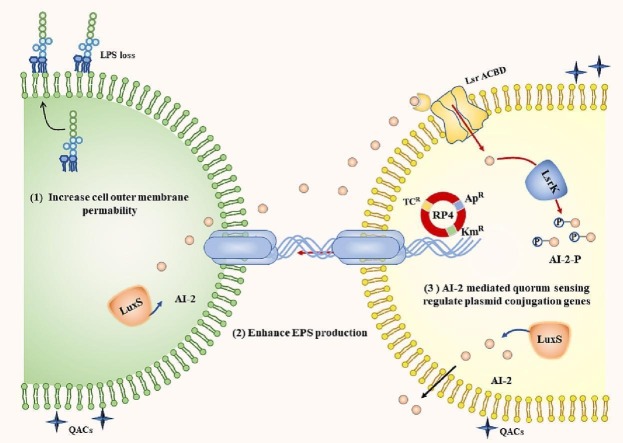
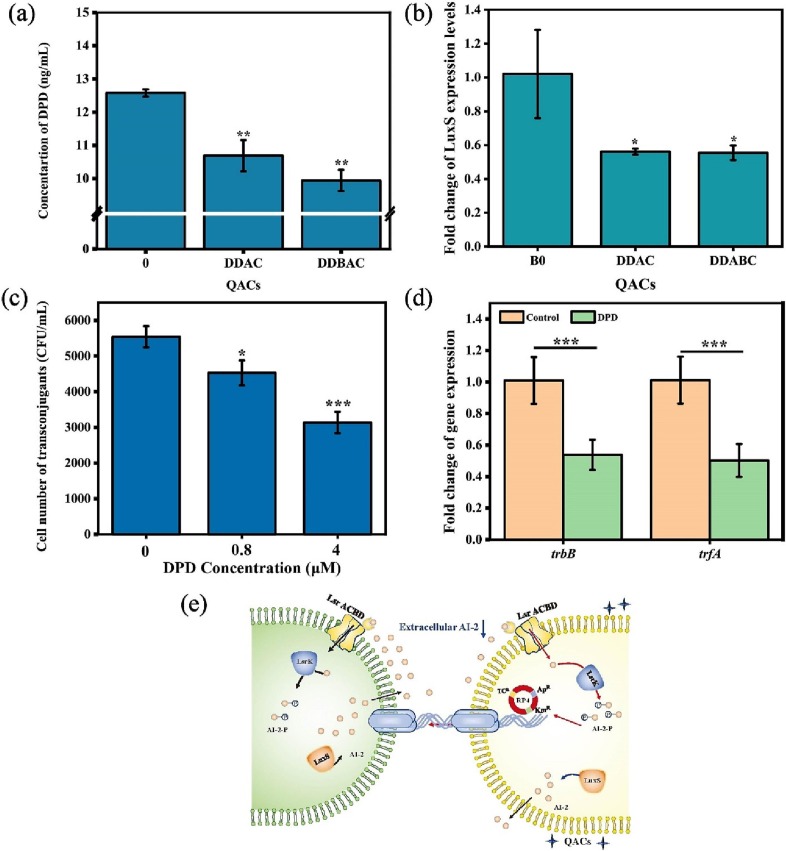
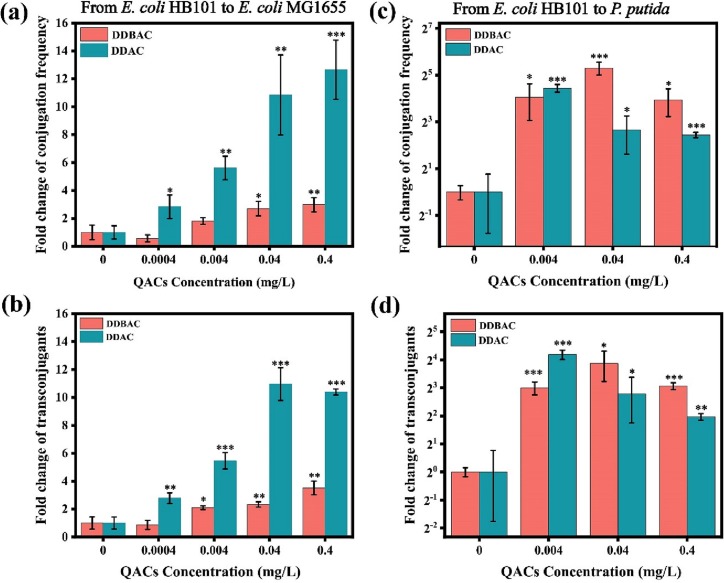
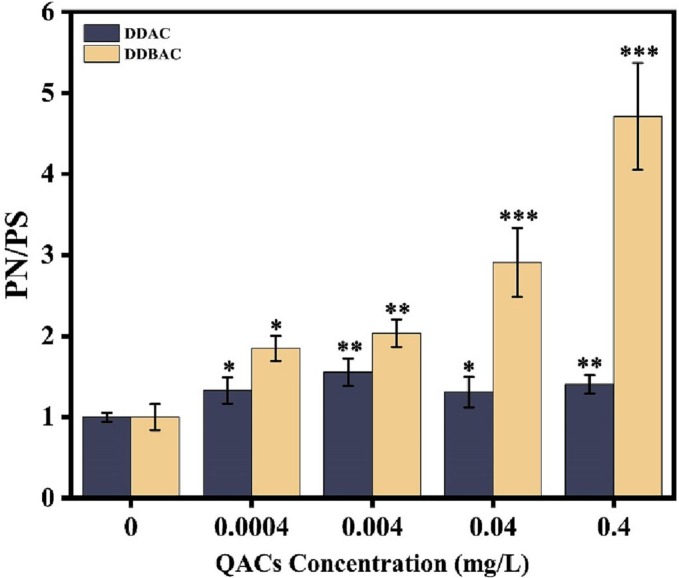
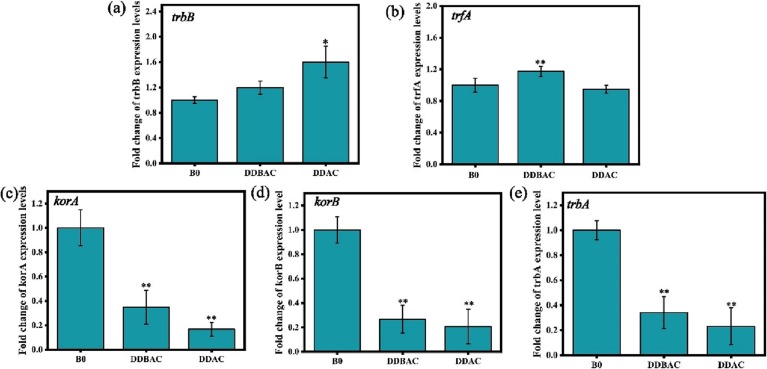
During the pandemic of COVID-19, the amounts of quaternary ammonium compounds (QACs) used to inactivate the virus in public facilities, hospitals and households increased, which raised concerns about the evolution and transmission of antimicrobial resistance (AMR). Although QACs may play an important role in the propagation of antibiotic resistance gene (ARGs), the potential contribution and mechanism remains unclear. Here, the results showed that benzyl dodecyl dimethyl ammonium chloride (DDBAC) and didecyl dimethyl ammonium chloride (DDAC) significantly promoted plasmid RP4-mediated ARGs transfer within and across genera at environmental relevant concentrations (0.0004-0.4 mg/L). Low concentrations of QACs did not contribute to the permeability of the cell plasma membrane, but significantly increased the permeability of the cell outer membrane due to the decrease in content of lipopolysaccharides. QACs altered the composition and content of extracellular polymeric substances (EPS) and were positively correlated with the conjugation frequency. Furthermore, transcriptional expression levels of genes encode for mating pairing formation (trbB), DNA replication and translocation (trfA), and global regulators (korA, korB, trbA) are regulated by QACs. And we demonstrate for the first time that QACs decreased the concentration of extracellular AI-2 signals, which was verified to be involved in regulating conjugative transfer genes (trbB, trfA). Collectively, our findings underscore the risk of increased disinfectant concentrations of QACs on the ARGs transfer and provide new mechanisms of plasmid conjugation.
在 COVID-19 大流行期间,用于公共设施、医院和家庭消毒的季铵盐化合物(QACs)的用量增加,这引起了人们对抗微生物药物耐药性(AMR)传播和进化的担忧。虽然 QACs 可能在抗生素耐药基因(ARGs)的传播中发挥重要作用,但潜在的贡献和机制尚不清楚。本研究结果表明,在环境相关浓度(0.0004-0.4 mg/L)下,苯扎氯铵(DDBAC)和十二烷基二甲基氯化铵(DDAC)显著促进了质粒 RP4 在种内和种间的抗生素耐药基因转移。低浓度的 QACs 不会导致细胞质膜通透性增加,但由于脂多糖含量降低,显著增加了细胞外膜的通透性。QACs 改变了细胞外多聚物(EPS)的组成和含量,并与接合频率呈正相关。此外,编码配对形成(trbB)、DNA 复制和转移(trfA)以及全局调控因子(korA、korB、trbA)的基因转录表达水平受到 QACs 的调控。并且我们首次证明,QACs 降低了细胞外 AI-2 信号的浓度,这被证明参与了调节接合转移基因(trbB、trfA)。综上所述,我们的研究结果强调了增加 QACs 消毒剂浓度对抗生素耐药基因转移的风险,并提供了质粒接合的新机制。