Department of Mechanical Engineering, Columbia University, New York, NY 10027.
Tel Aviv University.
J Biomech Eng. 2024 Jul 1;146(7). doi: 10.1115/1.4065109.
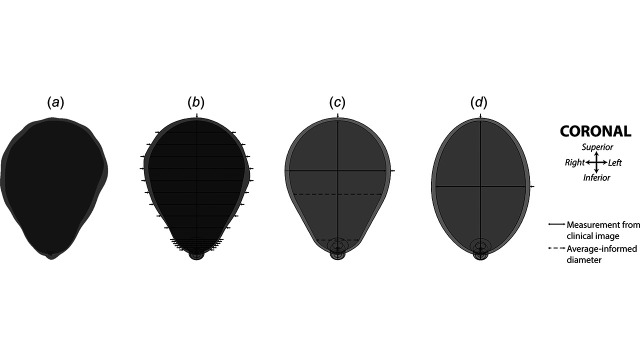
Birthing mechanics are poorly understood, though many injuries during childbirth are mechanical, like fetal and maternal tissue damage. Several biomechanical simulation models of parturition have been proposed to investigate birth, but many do not include the uterus. Additionally, most solid models rely on segmenting anatomical structures from clinical images to generate patient geometry, which can be time-consuming. This work presents two new parametric solid modeling methods for generating patient-specific, at-term uterine three-dimensional geometry. Building from an established method of modeling the sagittal uterine shape, this work improves the uterine coronal shape, especially where the fetal head joins the lower uterine wall. Solid models of the uterus and cervix were built from five at-term patients' magnetic resonance imaging (MRI) sets. Using anatomy measurements from MRI-segmented models, two parametric models were created-one that employs an averaged coronal uterine shape and one with multiple axial measurements of the coronal uterus. Through finite element analysis, the two new parametric methods were compared to the MRI-segmented high-fidelity method and a previously published elliptical low-fidelity method. A clear improvement in the at-term uterine shape was found using the two new parametric methods, and agreement in principal Lagrange strain directions was observed across all modeling methods. These methods provide an effective and efficient way to generate three-dimensional solid models of patient-specific maternal uterine anatomy, advancing possibilities for future research in computational birthing biomechanics.
分娩力学的理解还很不完善,尽管许多分娩过程中的损伤都是机械性的,比如胎儿和产妇组织损伤。已经提出了几种分娩的生物力学模拟模型来研究分娩,但许多模型都不包括子宫。此外,大多数实体模型依赖于从临床图像中分割解剖结构来生成患者几何形状,这可能很耗时。这项工作提出了两种新的参数化实体建模方法,用于生成特定于患者的足月子宫三维几何形状。这项工作基于一种现有的建模矢状子宫形状的方法,改进了子宫冠状形状,特别是在胎儿头部与下子宫壁相接的地方。使用来自 MRI 分割模型的解剖测量值,创建了两个参数化模型:一个使用平均冠状子宫形状,另一个使用多个冠状子宫的轴向测量值。通过有限元分析,将这两种新的参数化方法与 MRI 分割的高保真方法和以前发表的椭圆低保真方法进行了比较。使用这两种新的参数化方法发现了足月子宫形状的明显改善,并且在所有建模方法中都观察到了主拉格朗日应变方向的一致性。这些方法为生成特定于患者的母体子宫解剖学的三维实体模型提供了一种有效且高效的方法,为计算分娩生物力学的未来研究提供了更多可能。