Department of Population Health Sciences, Geisinger Clinic, Danville, PA 17822, United States.
Department of Genomic Health, Geisinger, Danville, PA 17822, United States.
J Am Med Inform Assoc. 2024 May 20;31(6):1247-1257. doi: 10.1093/jamia/ocae053.
Genomic kidney conditions often have a long lag between onset of symptoms and diagnosis. To design a real time genetic diagnosis process that meets the needs of nephrologists, we need to understand the current state, barriers, and facilitators nephrologists and other clinicians who treat kidney conditions experience, and identify areas of opportunity for improvement and innovation.
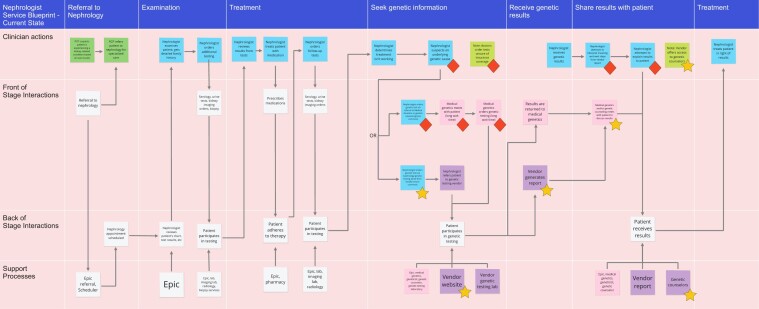
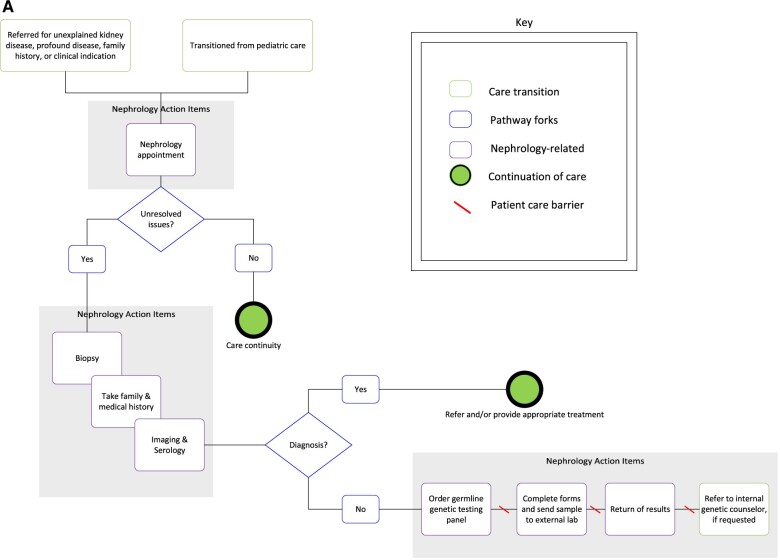
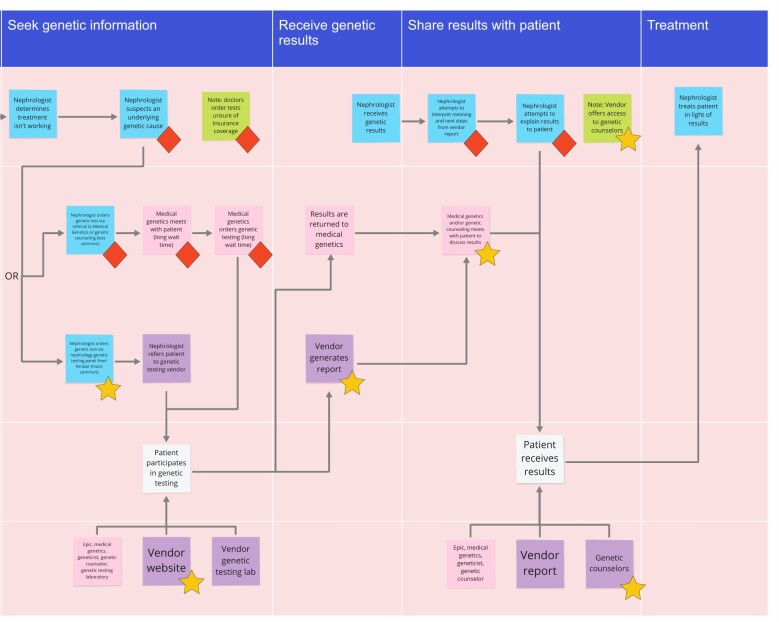
Qualitative in-depth interviews were conducted with nephrologists and internists from 7 health systems. Rapid analysis identified themes in the interviews. These were used to develop service blueprints and process maps depicting the current state of genetic diagnosis of kidney disease.
Themes from the interviews included the importance of trustworthy resources, guidance on how to order tests, and clarity on what to do with results. Barriers included lack of knowledge, lack of access, and complexity surrounding the case and disease. Facilitators included good user experience, straightforward diagnoses, and support from colleagues.
The current state of diagnosis of kidney diseases with genetic etiology is suboptimal, with information gaps, complexity of genetic testing processes, and heterogeneity of disease impeding efficiency and leading to poor outcomes. This study highlights opportunities for improvement and innovation to address these barriers and empower nephrologists and other clinicians who treat kidney conditions to access and use real time genetic information.
基因肾脏疾病通常在症状出现和诊断之间存在很长的时间滞后。为了设计一个满足肾病学家需求的实时基因诊断流程,我们需要了解肾病学家和其他治疗肾脏疾病的临床医生目前的状况、障碍和促进因素,并确定改进和创新的机会领域。
对来自 7 个医疗系统的肾病学家和内科医生进行了定性深入访谈。快速分析确定了访谈中的主题。这些主题被用来开发服务蓝图和流程图,描绘当前肾脏疾病基因诊断的现状。
访谈的主题包括值得信赖的资源的重要性、关于如何进行测试的指导,以及对结果如何处理的明确性。障碍包括缺乏知识、缺乏获取途径,以及病例和疾病的复杂性。促进因素包括良好的用户体验、直接的诊断,以及同事的支持。
目前,具有遗传病因的肾脏疾病的诊断状况并不理想,存在信息差距、基因检测过程的复杂性以及疾病的异质性,这阻碍了效率,并导致不良结果。本研究强调了改进和创新的机会,以解决这些障碍,并使治疗肾脏疾病的肾病学家和其他临床医生能够获得和使用实时基因信息。