Shaalan Mohamed, El Zaher El Zaher H, Farag Ossama M, Abdallatif Ahmad G, Sallam Ahmed M
Trauma and Orthopaedics, Worcester Royal Hospital, Worcester, GBR.
Orthopaedic Surgery, Ain Shams University, Cairo, EGY.
Cureus. 2024 Feb 17;16(2):e54358. doi: 10.7759/cureus.54358. eCollection 2024 Feb.
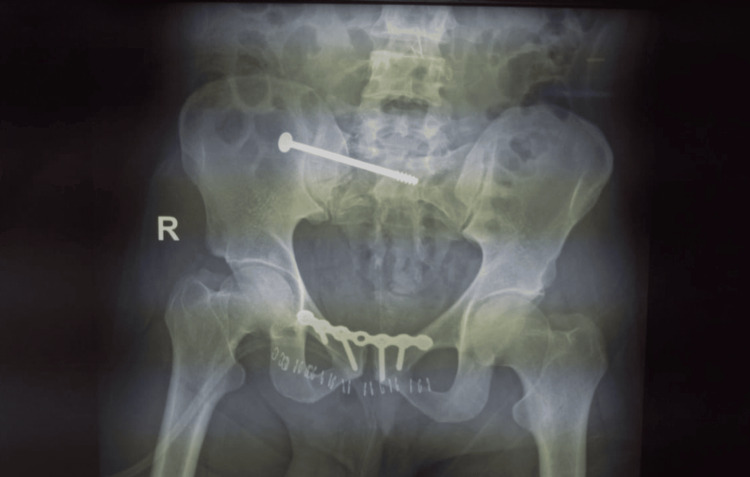
Unstable sacral fractures with pelvic fractures are challenging to both surgeons and patients, particularly in the immediate post-injury phase and later when definitive fixation is undertaken. Percutaneous iliosacral screw fixation is widely regarded as the gold standard treatment for unstable sacral fractures without spinopelvic dissociation. Closed reduction and percutaneous fixation using iliosacral screws for sacral fractures provide early stabilisation without the need for extensive surgical exposure, thereby mitigating major complications associated with open surgical procedures. A new technique for stabilising unstable sacral fractures is the minimally invasive ilioilial fixator, also called a transiliac internal fixator (TIIF), which has gained more attention for its ability to address challenges associated with sacroiliac screw fixation. The objective of this study is to compare the functional, radiological, and surgical outcomes between the percutaneous iliosacral screw and the ilioilial fixator.
A total of 51 patients with sacral fracture injuries sustained between August 2019 and November 2021 were included in this study, with 25 patients in Group A and 26 patients in Group B. Patient randomization was done using computer-generated randomization facilitated by Random Allocation Software (Mahmood Saghaei, Isfahan, Iran). All patients underwent the chosen intervention within 10 days of the trauma. Patients had follow-up at two weeks, six weeks, and 12 months post-treatment. The results of fixation were evaluated radiologically based on the Matta and Tornetta grading system and clinically using the Majeed pelvic scoring system. Complications were detected in both groups during follow-up visits.
The study found no statistically significant differences between the two patient groups in terms of final clinical assessment (p=0.79), radiological assessment (p=0.78), or the need for another operation (p=1.0). Moreover, there were no statistically significant differences between the groups with respect to complication rates (p=0.63) or the time of union (p=0.14). No differences were noted in terms of intraoperative blood loss (p=0.93) or operative time (p=0.34) but for longer incision length in the ilioilial fixator group (p<0.001) and an increased risk of intraoperative radiation exposure in the iliosacral screw group (p<00.1).
Although the iliosacral screw is considered a gold standard for unstable sacral fracture, a TIIF is a good alternative with a very satisfactory outcome.
Although the iliosacral screw still remains the gold standard for the management of sacral fractures, the ilioilial fixator emerges as a good alternative with comparable functional and radiological outcomes.

伴有骨盆骨折的不稳定骶骨骨折对外科医生和患者来说都是一项挑战,尤其是在受伤后的急性期以及后期进行确定性固定时。经皮髂骶螺钉固定被广泛认为是治疗无脊柱骨盆分离的不稳定骶骨骨折的金标准。对于骶骨骨折,采用髂骶螺钉进行闭合复位和经皮固定可实现早期稳定,无需广泛的手术暴露,从而减少了与开放手术相关的主要并发症。一种用于稳定不稳定骶骨骨折的新技术是微创髂髂固定器,也称为经髂内固定器(TIIF),它因能够应对与骶髂螺钉固定相关的挑战而受到更多关注。本研究的目的是比较经皮髂骶螺钉与髂髂固定器在功能、影像学和手术效果方面的差异。
本研究共纳入了2019年8月至2021年11月期间发生骶骨骨折的51例患者,A组25例,B组26例。使用随机分配软件(伊朗伊斯法罕的Mahmood Saghaei)辅助计算机生成随机数进行患者随机分组。所有患者均在创伤后10天内接受了所选的干预措施。患者在治疗后2周、6周和12个月进行随访。根据Matta和Tornetta分级系统对固定结果进行影像学评估,并使用Majeed骨盆评分系统进行临床评估。在随访期间对两组患者的并发症进行了检测。
研究发现,两组患者在最终临床评估(p = 0.79)、影像学评估(p = 0.78)或再次手术需求(p = 1.0)方面均无统计学显著差异。此外,两组在并发症发生率(p = 0.63)或骨折愈合时间(p = 0.14)方面也无统计学显著差异。在术中失血量(p = 0.93)或手术时间(p = 0.34)方面未观察到差异,但髂髂固定器组的切口长度更长(p < 0.001),且髂骶螺钉组术中辐射暴露风险增加(p < 0.1)。
尽管髂骶螺钉被认为是不稳定骶骨骨折的金标准,但TIIF是一种很好的替代方法,效果非常令人满意。
尽管髂骶螺钉仍然是骶骨骨折治疗的金标准,但髂髂固定器作为一种具有可比功能和影像学结果的良好替代方法而出现。