
首次加用抗癫痫药物的癫痫患者的治疗依从性、治疗模式及医疗保健利用情况:一项全国性队列研究。
Treatment compliance, treatment patterns, and healthcare utilization in epilepsy patients with first add-on antiepileptic drugs: A nationwide cohort study.
作者信息
Kim Min Young, Kim Jung-Ae, Lee Youngeun, Lee Sang Kun
机构信息
Medical, Eisai Korea Inc, 6 Bongeunsa-ro 86-gil, Gangnam-gu, Seoul, Republic of Korea.
Real World Insights, IQVIA Korea, 173 Toegye-ro, Jung-gu, Seoul, Republic of Korea.
出版信息
Heliyon. 2024 Mar 7;10(6):e27770. doi: 10.1016/j.heliyon.2024.e27770. eCollection 2024 Mar 30.
OBJECTIVE
This study aimed to assess the treatment compliance, patterns, healthcare resource utilization (HCRU), and costs of anti-epilepsy drugs (AEDs) as the first add-on therapy in patients with epilepsy.
METHODS
We conducted a retrospective population-based cohort study using Korean National Health Insurance claims data from 2016 to 2020. Patients with epilepsy who newly received AED add-on therapy were identified and followed for up to 12 months to evaluate persistence, adherence, treatment patterns, HCRU, and costs.
RESULTS
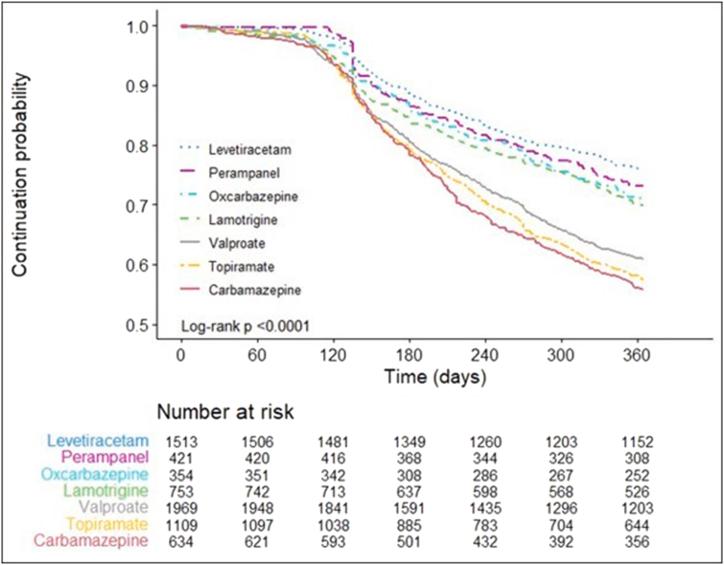
Among 6,746 patients who initiated AED add-on therapy, 65.5% were persistent on their index AED add-on from the index date until the end of the follow-up period, and the mean persistent time on the index add-on was 307.3 ± 92.3 days. A total of 76.8% patients were adherent, with a medication possession ratio (MPR) ≥80%, and the mean MPR was 88.9 ± 25.4%. Persistence and adherence to the index AED add-on were relatively higher among patients prescribed lamotrigine, levetiracetam, oxcarbazepine, and perampanel than those prescribed carbamazepine, topiramate, or valproate. A total of 41.0% of the patients changed their index AED add-on during the follow-up period. The carbamazepine, topiramate, and valproate groups had higher rates of change than the other AED groups. HCRU and costs tended to be lower in the lamotrigine, levetiracetam, oxcarbazepine, and perampanel groups. Furthermore, perampanel showed the lowest HCRU and costs for all-cause cases as well as the lowest length of stay and outpatient visits for epilepsy-related cases.
CONCLUSION
In this population-based study, the use of lamotrigine, levetiracetam, oxcarbazepine, or perampanel as the first add-on therapy in patients with epilepsy contributed to better treatment compliance and lower HCRU and costs than that of carbamazepine, topiramate, or valproate.
目的
本研究旨在评估抗癫痫药物(AEDs)作为癫痫患者首次添加治疗的治疗依从性、模式、医疗资源利用(HCRU)及成本。
方法
我们利用2016年至2020年韩国国民健康保险理赔数据进行了一项基于人群的回顾性队列研究。确定新接受AED添加治疗的癫痫患者,并随访长达12个月,以评估持续性、依从性、治疗模式、HCRU及成本。
结果
在6746例开始AED添加治疗的患者中,65.5%从索引日期至随访期结束一直持续使用其索引AED添加药物,索引添加药物的平均持续时间为307.3±92.3天。共有76.8%的患者依从性良好,药物持有率(MPR)≥80%,平均MPR为88.9±25.4%。与服用卡马西平、托吡酯或丙戊酸盐的患者相比,服用拉莫三嗪、左乙拉西坦、奥卡西平及吡仑帕奈的患者对索引AED添加药物的持续性和依从性相对更高。共有41.0%的患者在随访期间更换了索引AED添加药物。卡马西平、托吡酯和丙戊酸盐组的更换率高于其他AED组。拉莫三嗪、左乙拉西坦、奥卡西平及吡仑帕奈组的HCRU和成本往往较低。此外,吡仑帕奈在全因病例中的HCRU和成本最低,在癫痫相关病例中的住院时间和门诊就诊次数也最低。
结论
在这项基于人群的研究中,与卡马西平、托吡酯或丙戊酸盐相比,使用拉莫三嗪、左乙拉西坦、奥卡西平或吡仑帕奈作为癫痫患者的首次添加治疗有助于提高治疗依从性,并降低HCRU和成本。

 Zotero 插件