
功能化磁性脂肪酶/Cu(PO)杂化纳米花:合成、表征及酶活性评估
Functionalized magnetic lipase/Cu(PO) hybrid nanoflower: Synthesis, characterization, and enzymatic evaluation.
作者信息
Anboo Shamini, Lau Sie Yon, Kansedo Jibrail, Yap Pow-Seng, Hadibarata Tony, Kamaruddin Azlina Harun
机构信息
Department of Chemical Engineering, Faculty of Engineering and Science, Curtin University Malaysia, CDT 250, 98009, Miri, Sarawak, Malaysia.
Department of Civil Engineering, Xi'an Jiaotong-Liverpool University, Suzhou, 215123, China.
出版信息
Heliyon. 2024 Mar 4;10(6):e27348. doi: 10.1016/j.heliyon.2024.e27348. eCollection 2024 Mar 30.
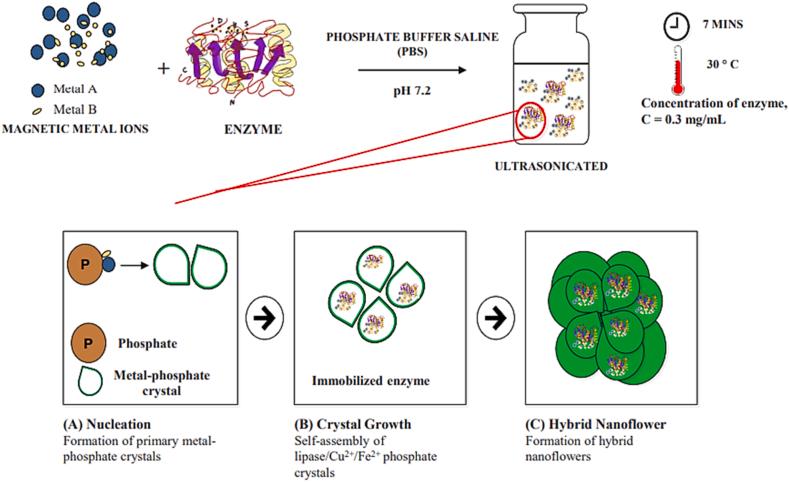
This paper reports the synthesis of magnetic lipase/Cu(PO) hybrid nanoflowers via a rapid ultrasonication method. The enzyme immobilization and nanoflower growth mechanism can be described as the (a) Fe, Cu, and phosphate "binding", (b) metal phosphate crystals formation, (c) formation and growth of metal phosphate crystals to form plate-like structures, and (d) self-assembly of plate structures that forms a flower-like structure. Some factors contributing to the morphology of the hybrid nanoflowers structure includes the time and concentration of lipase were studied. The effect of temperature, pH, and duration on the enzyme immobilization yield were also studied. In addition, the strong magnetic property (9.73 emu g) of the nanoflowers resulted in higher retrievability and reusability after repeated usage. Furthermore, the catalytic activity of lipase/Cu(PO) hybrid nanoflowers was investigated and the ideal conditions were determined whereby, the maximum activity was calculated to be 1511 ± 44 U g, showing a catalytic enhancement of 89% in comparison to free lipase. The reusability study showed that, after 5 cycles, the magnetic lipase/Cu(PO) nanoflowers successfully retained 60% of its initial activity. From the results obtained, it is worth noting that, the magnetic lipase/Cu(PO) hybrid nanoflowers are highly efficient in industrial biocatalytic applications.
本文报道了通过快速超声法合成磁性脂肪酶/Cu(PO)杂化纳米花。酶固定化和纳米花生长机制可描述为:(a)铁、铜和磷酸盐“结合”;(b)金属磷酸盐晶体形成;(c)金属磷酸盐晶体形成并生长以形成板状结构;(d)板状结构自组装形成花状结构。研究了一些影响杂化纳米花结构形态的因素,包括脂肪酶的时间和浓度。还研究了温度、pH值和持续时间对酶固定化产率的影响。此外,纳米花的强磁性(9.73 emu g)使其在重复使用后具有更高的可回收性和再利用性。此外,研究了脂肪酶/Cu(PO)杂化纳米花的催化活性并确定了理想条件,据此计算出最大活性为1511±44 U g,与游离脂肪酶相比催化活性提高了89%。可重复使用性研究表明,经过5个循环后,磁性脂肪酶/Cu(PO)纳米花成功保留了其初始活性的60%。从获得的结果值得注意的是,磁性脂肪酶/Cu(PO)杂化纳米花在工业生物催化应用中具有高效性。




 Zotero 插件