Montefiore Medical Center, Albert Einstein College of Medicine, Bronx, NY, USA.
Department of Ophthalmology & Visual Sciences, Yale School of Medicine, New Haven, Conn, USA.
BMC Ophthalmol. 2024 Mar 19;24(1):125. doi: 10.1186/s12886-024-03392-y.
Few ocular trauma studies have addressed mortality outcomes. We sought to determine characteristics of mortality-related ocular trauma admissions and compared them with non-fatal injuries.
A retrospective study was conducted using de-identified data of patients admitted with major trauma from the National Trauma Data Bank (2008-2014). Patients with ocular injury were identified using ICD- 9CM codes. Demographics, intention and mechanism, types of ocular and head injuries, and injury severity were documented. Mortality was determined using post-admission disposition. Statistical analysis using student t-test, chi-square, and odds ratios (OR) calculations were performed with STATA-17 software. Significance was set at P < 0.05.
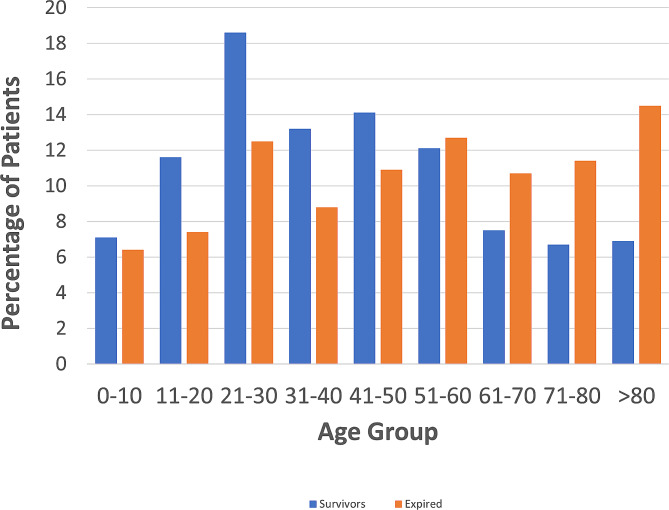
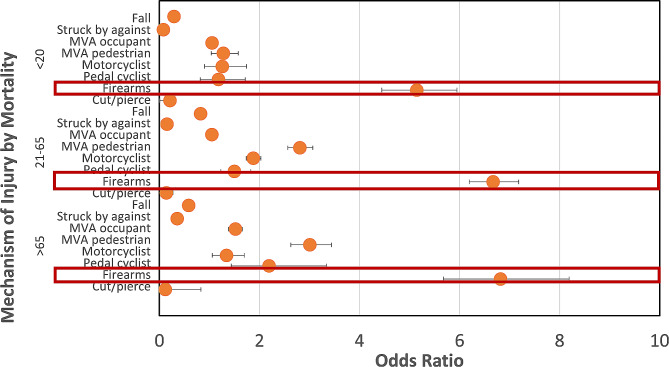
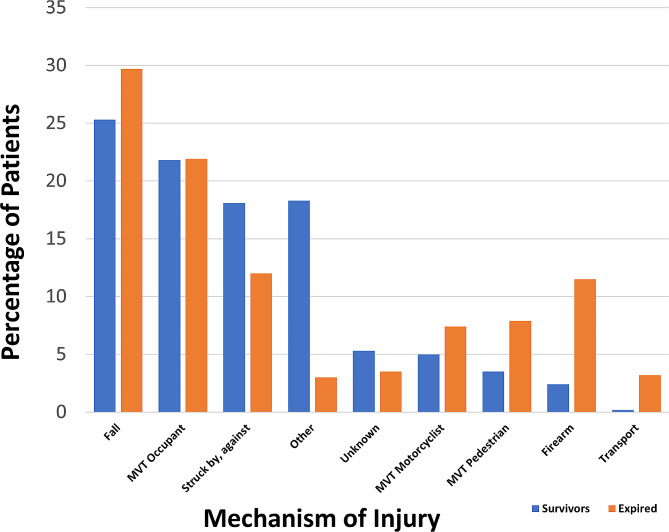
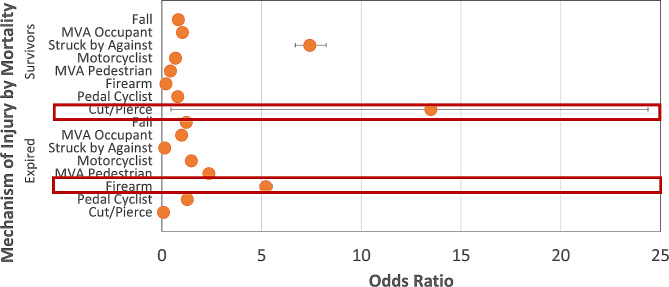
Of 316,485 patients admitted with ocular trauma, 12,233 (3.86%) were mortality related. Expired patients were older than survivors: mean (SD) of 50.1(25.5) vs. 41.5(22.8) years. White (OR = 1.32; P < 0.001), ≥ 65years old (OR = 2.25; P < 0.001), and male (OR = 1.05; P = 0.029) patients were most likely to expire than their counterparts. Common mechanisms of injury in survivors were falls (25.3%), motor vehicle traffic-occupant, MVTO (21.8%) and struck by/against (18.1%) and for fatal injuries, falls (29.7%), MVTO (21.9%) and firearms (11.5%). Traumatic brain injury (TBI) was documented in 88.2% of mortality-related admissions. Very severe injury severity scores (ISS > 24) (OR = 19.19; P < 0.001) and severe Glasgow Coma Score (GCS < 8) (OR = 19.22; P < 0.001) were most associated with mortality than survival. Firearms were most associated with very severe ISS (OR = 3.73; P < 0.001), severe GCS (OR = 4.68; P < 0.001) and mortality (OR = 5.21; P < 0.001) than other mechanisms. Patients with cut/pierce injuries had the greatest odds of survival (OR = 13.48; P < 0.001). Optic nerve/visual pathways injuries (3.1%) had the highest association with very severe ISS (OR = 2.51; P < 0.001), severe GCS (OR = 3.64; P < 0.001) and mortality (OR = 2.58; P < 0.001) than other ocular injuries. Black patients with very severe ISS (OR = 32.14; P < 0.001) and severe GCS (OR = 31.89; P < 0.001) were more likely to expire than other race/ethnicities with similar injury severity.
Mortality-related admissions were older, male, and mostly of White race than ocular trauma admissions of survivors. Firearms were the deadliest mechanism. TBI was commonly associated and patients with optic nerve/pathway injuries, very severe ISS and severe GCS had higher mortality rates. Characteristics and demographic variations identified in this study may be useful in developing focused measures aimed at preventing trauma-related deaths.
很少有眼部创伤研究涉及死亡率结果。我们旨在确定与非致命性损伤相关的与死亡率相关的眼部创伤入院的特征,并将其与非致命性损伤进行比较。
使用国家创伤数据银行(2008-2014 年)的患者主要创伤入院的匿名数据进行回顾性研究。使用 ICD-9CM 代码识别眼部损伤患者。记录人口统计学、意图和机制、眼部和头部损伤类型以及损伤严重程度。通过入院后处置确定死亡率。使用 STATA-17 软件进行学生 t 检验、卡方检验和比值比(OR)计算的统计分析。设 P < 0.05 为有统计学意义。
在 316485 名接受眼部创伤治疗的患者中,有 12233 例(3.86%)与死亡率相关。死亡患者比幸存者年龄更大:平均(标准差)分别为 50.1(25.5)岁和 41.5(22.8)岁。白人(OR=1.32;P<0.001)、年龄≥65 岁(OR=2.25;P<0.001)和男性(OR=1.05;P=0.029)患者比同龄人更有可能死亡。幸存者常见的损伤机制是跌倒(25.3%)、机动车交通乘员(MVTO)(21.8%)和撞击/碰撞(18.1%),而致命损伤机制是跌倒(29.7%)、MVTO(21.9%)和枪支(11.5%)。88.2%的与死亡率相关的入院患者有创伤性脑损伤(TBI)。非常严重的损伤严重程度评分(ISS>24)(OR=19.19;P<0.001)和严重的格拉斯哥昏迷评分(GCS<8)(OR=19.22;P<0.001)与死亡率最相关,而不是生存率。枪支与非常严重的 ISS(OR=3.73;P<0.001)、严重的 GCS(OR=4.68;P<0.001)和死亡率(OR=5.21;P<0.001)最相关,而其他机制则与这些指标相关性较差。切割/刺穿损伤的患者有最大的生存机会(OR=13.48;P<0.001)。视神经/视觉通路损伤(3.1%)与非常严重的 ISS(OR=2.51;P<0.001)、严重的 GCS(OR=3.64;P<0.001)和死亡率(OR=2.58;P<0.001)的相关性最高,而与其他眼部损伤的相关性较低。非常严重的 ISS(OR=32.14;P<0.001)和严重的 GCS(OR=31.89;P<0.001)的黑人患者比其他种族/族裔的患者更有可能死亡,尽管他们的损伤严重程度相似。
与幸存者的眼部创伤入院相比,与死亡率相关的入院患者年龄更大、男性更多,且大多为白人。枪支是最致命的机制。TBI 通常与患者有关,视神经/通路损伤、非常严重的 ISS 和严重的 GCS 的患者死亡率更高。本研究中确定的特征和人口统计学差异可能有助于制定有针对性的措施,以预防与创伤相关的死亡。