Department of Public Health, University of Helsinki, POB 41, Helsinki, FI-00014, Finland.
Department of Intensive Care Medicine, Amsterdam University Medical Centers, location VUmc, Amsterdam, The Netherlands.
BMC Pulm Med. 2024 Mar 19;24(1):140. doi: 10.1186/s12890-024-02941-x.
In the early literature, unintentional vitamin C deficiency in humans was associated with heart failure. Experimental vitamin C deficiency in guinea pigs caused enlargement of the heart. The purpose of this study was to collect and analyze case reports on vitamin C and pulmonary hypertension.
We searched Pubmed and Scopus for case studies in which vitamin C deficiency was considered to be the cause of pulmonary hypertension. We selected reports in which pulmonary hypertension was diagnosed by echocardiography or catheterization, for any age, sex, or dosage of vitamin C. We extracted quantitative data for our analysis. We used the mean pulmonary artery pressure (mPAP) as the outcome of primary interest.
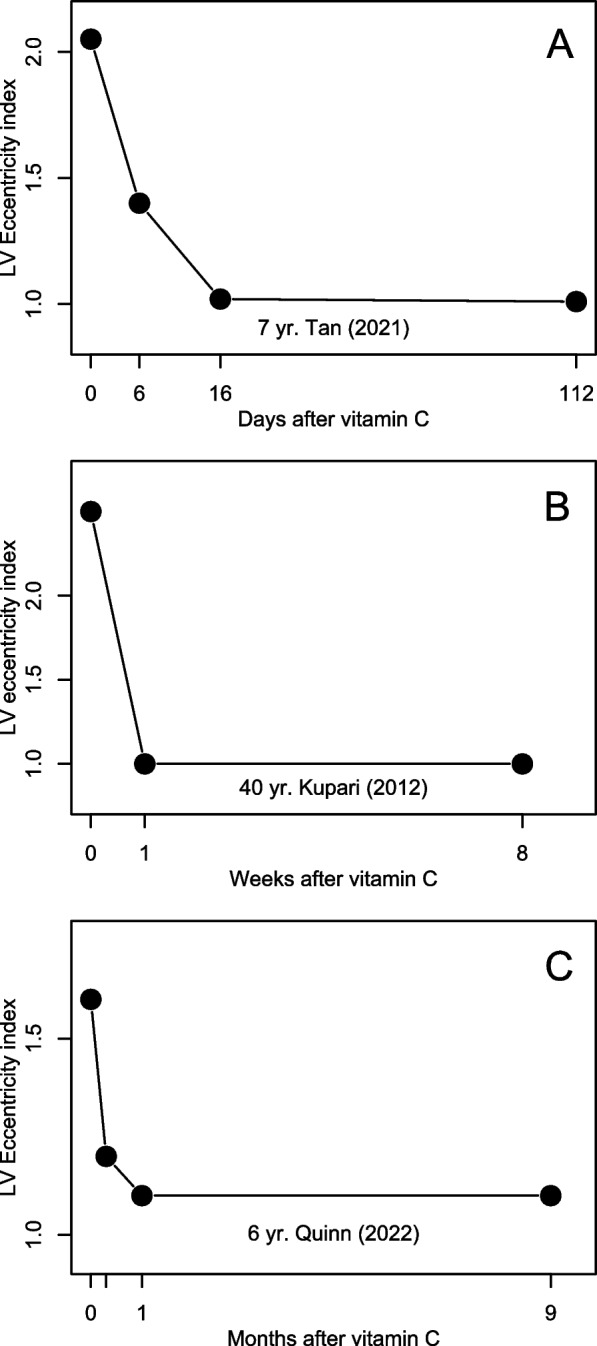
We identified 32 case reports, 21 of which were published in the last 5 years. Dyspnea was reported in 69%, edema in 53% and fatigue in 28% of the patients. Vitamin C plasma levels, measured in 27 cases, were undetectable in 24 and very low in 3 cases. Diet was poor in 30 cases and 17 cases had neuropsychiatric disorders. Right ventricular enlargement was reported in 24 cases. During periods of vitamin C deficiency, the median mPAP was 48 mmHg (range 29-77 mmHg; N = 28). After the start of vitamin C administration, the median mPAP was 20 mmHg (range 12-33 mmHg; N = 18). For the latter 18 cases, mPAP was 2.4-fold (median) higher during vitamin C deficiency. Pulmonary vascular resistance (PVR) during vitamin C deficiency was reported for 9 cases, ranging from 4.1 to 41 Wood units. PVR was 9-fold (median; N = 5) higher during vitamin C deficiency than during vitamin C administration. In 8 cases, there was direct evidence that the cases were pulmonary artery hypertension (PAH). Probably the majority of the remaining cases were also PAH.
The cases analyzed in our study indicate that pulmonary hypertension can be one explanation for the reported heart failure of scurvy patients in the early literature. It would seem sensible to measure plasma vitamin C levels of patients with PH and examine the effects of vitamin C administration.
在早期文献中,人类非故意的维生素 C 缺乏与心力衰竭有关。豚鼠实验性维生素 C 缺乏可导致心脏扩大。本研究的目的是收集和分析维生素 C 与肺动脉高压相关的病例报告。
我们在 Pubmed 和 Scopus 上检索了维生素 C 缺乏被认为是肺动脉高压病因的病例研究。我们选择了通过超声心动图或导管检查诊断为肺动脉高压的报告,不论年龄、性别或维生素 C 剂量。我们提取了分析所需的定量数据。我们使用平均肺动脉压(mPAP)作为主要研究结果。
我们确定了 32 份病例报告,其中 21 份发表于过去 5 年。69%的患者报告有呼吸困难,53%的患者有水肿,28%的患者有疲劳。27 例患者的维生素 C 血浆水平,24 例无法检测到,3 例非常低。30 例饮食不良,17 例有神经精神障碍。24 例患者右心室增大。在维生素 C 缺乏期间,中位数 mPAP 为 48mmHg(范围 29-77mmHg;N=28)。开始维生素 C 治疗后,中位数 mPAP 为 20mmHg(范围 12-33mmHg;N=18)。对于后 18 例,维生素 C 缺乏时 mPAP 高 2.4 倍(中位数;N=5)。9 例报告了维生素 C 缺乏时的肺血管阻力(PVR),范围为 4.1 至 41 伍德单位。维生素 C 缺乏时 PVR 高 9 倍(中位数;N=5)。8 例有直接证据表明这些病例为肺动脉高压(PAH)。其余病例可能也大多为 PAH。
我们研究中分析的病例表明,肺动脉高压可能是早期文献中报道的坏血病患者心力衰竭的一个解释。测量 PH 患者的血浆维生素 C 水平并检查维生素 C 治疗的效果似乎是明智的。