Siemieniak Steven, Greiving Tanner, Shepard Nola, Rall Jason, Nowadly Craig
Department of Emergency Medicine, Brooke Army Medical Center, Fort Sam Houston, TX, USA.
59th Medical Wing / Science and Technology, Lackland Air Force Base, TX, USA.
Resusc Plus. 2024 Mar 13;18:100603. doi: 10.1016/j.resplu.2024.100603. eCollection 2024 Jun.
Resuscitative endovascular balloon occlusion of the aorta (REBOA) has emerged as an adjunct to CPR for nontraumatic cardiac arrest (NTCA). This translational study investigated the impact of varying low-flow duration (15- vs 30-mins) on REBOA's hemodynamic performance and ability to achieve return of spontaneous circulation (ROSC) in a porcine model.
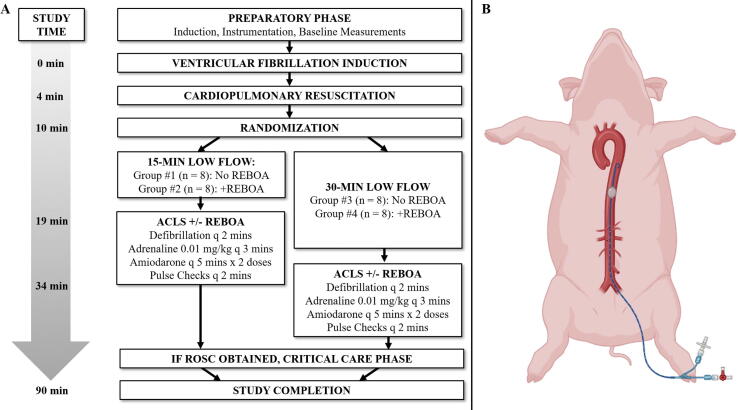
Thirty-two pigs were anesthetized and placed into ventricular fibrillation. All animals received a 4-min no-flow period before CPR was initiated. Animals were randomized into four groups: 15- vs 30-minutes of CPR; REBOA vs. no-REBOA. After completion of 15- or 30-minute low-flow, ACLS was initiated and REBOA was inflated in experimental animals.
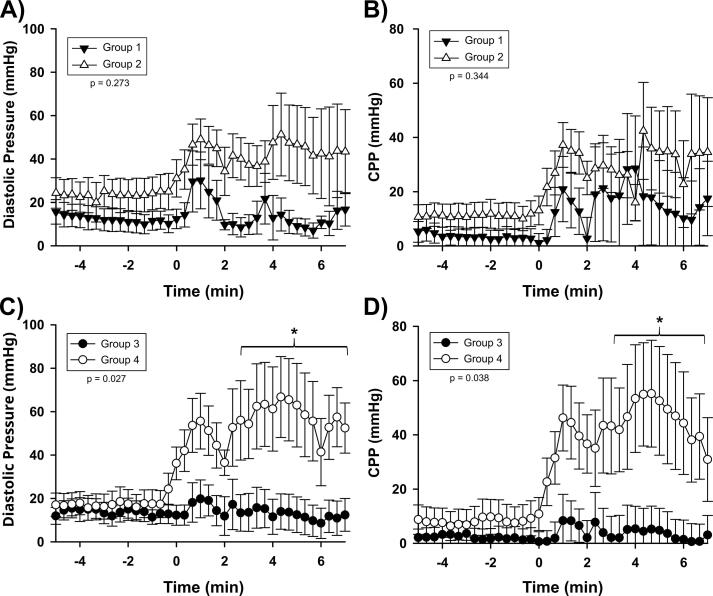
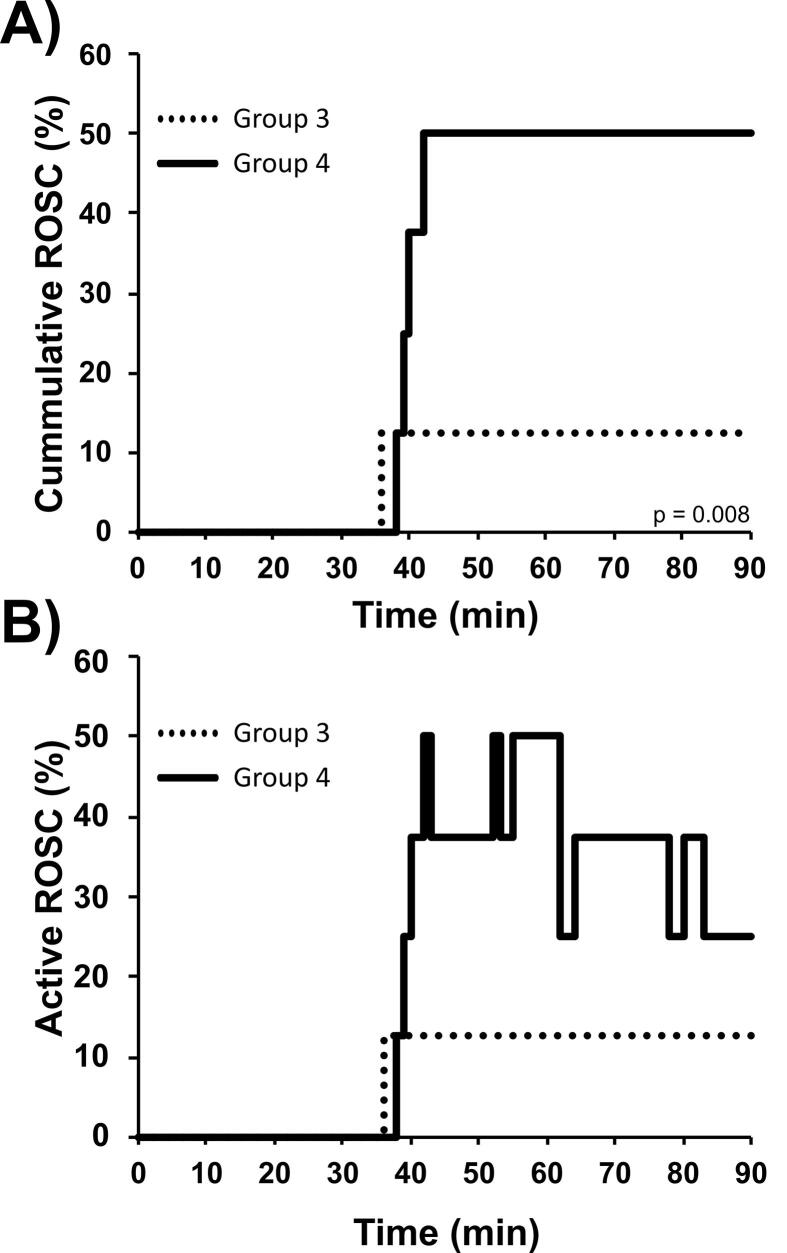
In the 15-mins groups, there were no differences in the rates of ROSC between REBOA (4/8, 50%) and control (4/8, 50%; = 0.99). However, in the 30-min groups, the REBOA animals had a significantly higher rate of ROSC (6/8, 75%) compared to control (1/8, 12.5%; = 0.04). In the 7-mins after REBOA deployment in the 30-min animals there was a statistically significant difference in coronary perfusion pressure (REBOA 42.1 mmHg, control 3.6 mmHg, = 0.038). Importantly, 5/6 animals that obtained ROSC in the 30-min group with REBOA re-arrested at least once, with 3/6 maintaining ROSC until study completion.
In our porcine model of NTCA, REBOA preferentially improved hemodynamics and ROSC after a 30-mins period of low-flow CPR. REBOA may be a viable strategy to improve ROSC after prolonged downtime, however, more hemodynamic support will be required to maintain ROSC.
复苏性血管内主动脉球囊阻断术(REBOA)已成为非创伤性心脏骤停(NTCA)心肺复苏(CPR)的辅助手段。本转化研究在猪模型中探讨了不同低流量持续时间(15分钟与30分钟)对REBOA血流动力学性能及实现自主循环恢复(ROSC)能力的影响。
32头猪麻醉后诱发室颤。所有动物在开始CPR前有4分钟无血流期。动物被随机分为四组:15分钟与30分钟CPR;REBOA组与非REBOA组。在15或30分钟低流量期结束后,启动高级心血管生命支持(ACLS),并对实验动物充气阻断主动脉。
在15分钟组中,REBOA组(4/8,50%)与对照组(4/8,50%;P = 0.99)的ROSC率无差异。然而,在30分钟组中,与对照组(1/8,12.5%;P = 0.04)相比,REBOA组动物的ROSC率显著更高(6/8,75%)。在30分钟组动物中,阻断主动脉后7分钟内,冠状动脉灌注压有统计学显著差异(REBOA组42.1 mmHg,对照组3.6 mmHg,P = 0.038)。重要的是,30分钟组中通过REBOA实现ROSC的5/6动物至少再次骤停一次,其中3/6维持ROSC直至研究结束。
在我们的NTCA猪模型中,在30分钟低流量CPR后,REBOA优先改善了血流动力学和ROSC。REBOA可能是延长停搏时间后改善ROSC的可行策略,然而,需要更多的血流动力学支持来维持ROSC。