Yuen Man-Fung, Fung Scott, Ma Xiaoli, Nguyen Tuan T, Hassanein Tarek, Hann Hie-Won, Elkhashab Magdy, Nahass Ronald G, Park James S, Jacobson Ira M, Ayoub Walid S, Han Steven-Huy, Gane Edward J, Zomorodi Katie, Yan Ran, Ma Julie, Knox Steven J, Stamm Luisa M, Bonacini Maurizio, Weilert Frank, Ramji Alnoor, Bennett Michael, Ravendhran Natarajan, Chan Sing, Dieterich Douglas T, Kwo Paul Yien, Schiff Eugene R, Bae Ho S, Lalezari Jacob, Agarwal Kosh, Sulkowski Mark S
Department of Medicine and State Key Laboratory of Liver Research, School of Clinical Medicine, Queen Mary Hospital, The University of Hong Kong, Hong Kong.
Department of Medicine, Division of Gastroenterology and Hepatology, University of Toronto, Toronto, Canada.
JHEP Rep. 2024 Jan 18;6(4):100999. doi: 10.1016/j.jhepr.2023.100999. eCollection 2024 Apr.
BACKGROUND & AIMS: The investigational first-generation core inhibitor vebicorvir (VBR) demonstrated safety and antiviral activity over 24 weeks in two phase IIa studies in patients with chronic HBV infection. In this long-term extension study, patients received open-label VBR with nucleos(t)ide reverse transcriptase inhibitors (NrtIs).
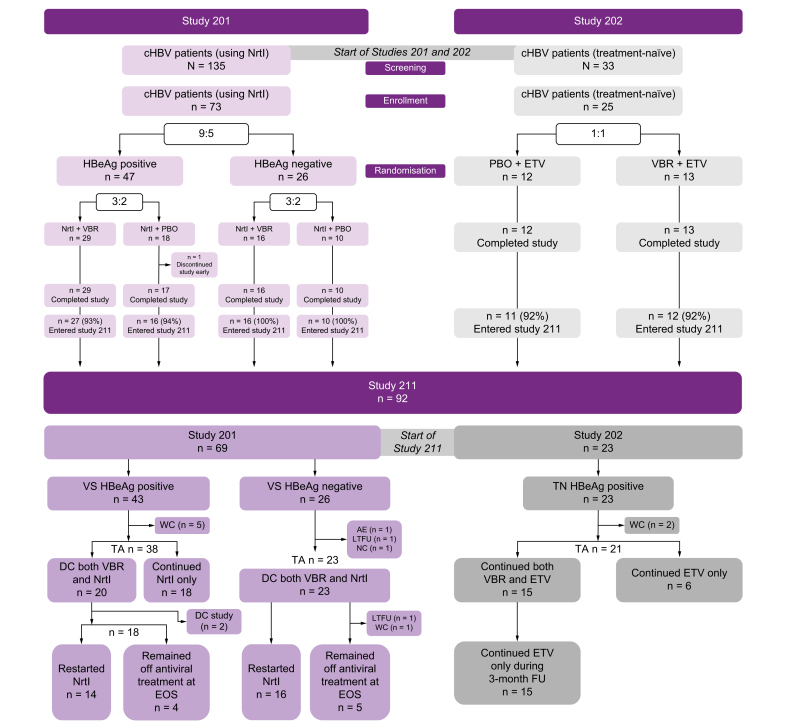
Patients in this study (NCT03780543) previously received VBR + NrtI or placebo + NrtI in parent studies 201 (NCT03576066) or 202 (NCT03577171). After receiving VBR + NrtI for ≥52 weeks, stopping criteria (based on the treatment history and hepatitis B e antigen status in the parent studies) were applied, and patients either discontinued both VBR + NrtI, discontinued VBR only, or continued both VBR + NrtI. The primary efficacy endpoint was the proportion of patients with HBV DNA <20 IU/ml at 24 weeks off treatment.
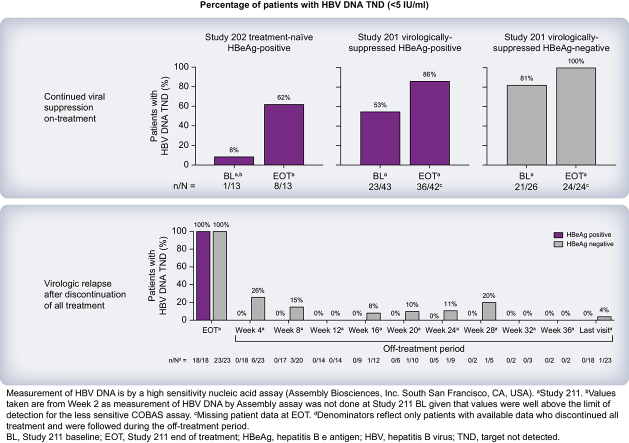
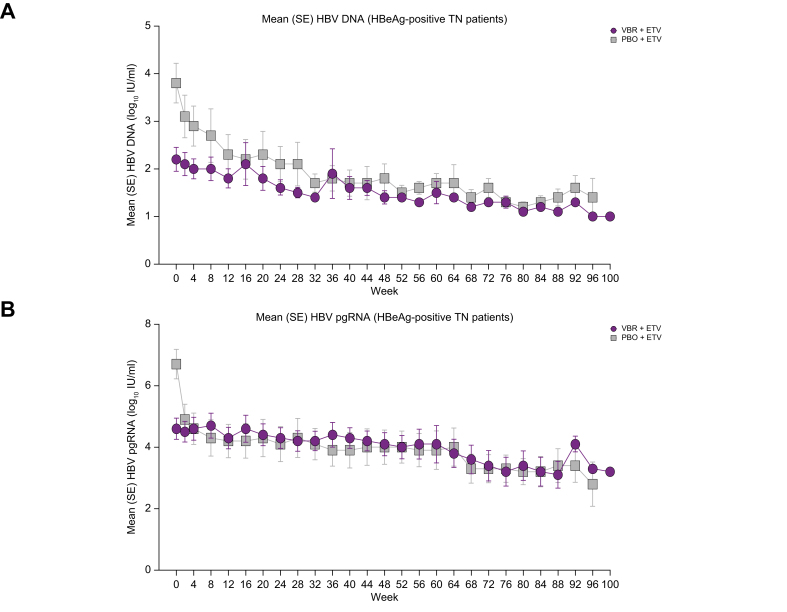
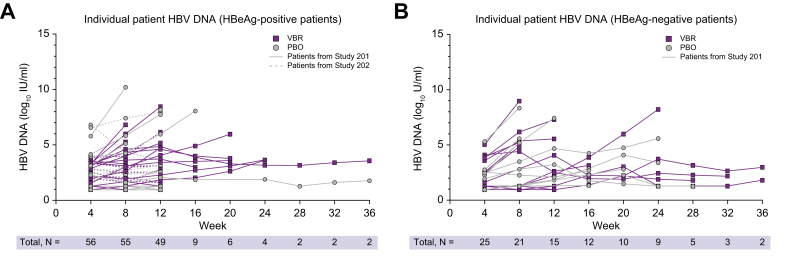
Ninety-two patients entered the extension study and received VBR + NrtI. Long-term VBR + NrtI treatment led to continued suppression of HBV nucleic acids and, to a lesser extent, HBV antigens. Forty-three patients met criteria to discontinue VBR + NrtI, with no patients achieving the primary endpoint; the majority of virologic rebound occurred ≥4 weeks off treatment. Treatment was generally well tolerated, with few discontinuations due to adverse events (AEs). There were no deaths. Most AEs and laboratory abnormalities were related to elevations in alanine aminotransferase and occurred during the off-treatment or NrtI-restart phases. No drug-drug interactions between VBR + NrtI and no cases of treatment-emergent resistance among patients who adhered to treatment were observed.
Long-term VBR + NrtI was safe and resulted in continued reductions in HBV nucleic acids following completion of the 24-week parent studies. Following treatment discontinuation, virologic relapse was observed in all patients. This first-generation core inhibitor administered with NrtI for at least 52 weeks was not sufficient for HBV cure.
NCT03780543.
Approved treatments for chronic hepatitis B virus infection (cHBV) suppress viral replication, but viral rebound is almost always observed after treatment discontinuation, highlighting an unmet need for improved therapies with finite treatment duration producing greater therapeutic responses that can be sustained off treatment. First-generation core inhibitors, such as vebicorvir, have mechanisms of action orthogonal to standard-of-care therapies that deeply suppress HBV viral replication during treatment; however, to date, durable virologic responses have not been observed after treatment discontinuation. The results reported here will help researchers with the design and interpretation of future studies investigating core inhibitors as possible components of finite treatment regimens for patients with cHBV. It is possible that next-generation core inhibitors with enhanced potency may produce deeper and more durable antiviral activity than first-generation agents, including vebicorvir.
在两项针对慢性HBV感染患者的IIa期研究中,研究性第一代核心抑制剂韦比科韦(VBR)在24周内显示出安全性和抗病毒活性。在这项长期扩展研究中,患者接受了开放标签的VBR联合核苷(酸)逆转录酶抑制剂(NrtIs)治疗。
本研究(NCT03780543)中的患者先前在201号(NCT03576066)或202号(NCT03577171)母体研究中接受了VBR + NrtI或安慰剂 + NrtI治疗。在接受VBR + NrtI治疗≥52周后,应用停药标准(基于母体研究中的治疗史和乙肝e抗原状态),患者要么停用VBR + NrtI两者,要么仅停用VBR,要么继续使用VBR + NrtI两者。主要疗效终点是停药24周时HBV DNA<20 IU/ml的患者比例。
92例患者进入扩展研究并接受VBR + NrtI治疗。长期VBR + NrtI治疗导致HBV核酸持续受到抑制,对HBV抗原的抑制作用较小。43例患者符合停用VBR + NrtI的标准,无患者达到主要终点;大多数病毒学反弹发生在停药≥4周后。治疗总体耐受性良好,因不良事件(AE)停药的情况很少。无死亡病例。大多数AE和实验室异常与丙氨酸氨基转移酶升高有关,且发生在停药期或NrtI重新开始治疗阶段。未观察到VBR + NrtI之间的药物相互作用,坚持治疗的患者中也未出现治疗中出现的耐药病例。
长期VBR + NrtI治疗是安全的,并在24周的母体研究完成后使HBV核酸持续减少。停药后,所有患者均出现病毒学复发。这种与NrtI联合使用至少52周的第一代核心抑制剂不足以治愈HBV。
NCT03780543。
慢性乙型肝炎病毒感染(cHBV)的获批治疗方法可抑制病毒复制,但停药后几乎总会出现病毒反弹,这突出表明需要改进治疗方法,以实现有限疗程的更好治疗反应,并在停药后仍能维持疗效。第一代核心抑制剂,如韦比科韦,其作用机制与标准治疗方法不同,在治疗期间能深度抑制HBV病毒复制;然而到目前为止,停药后尚未观察到持久病毒学反应。此处报告的结果将有助于研究人员设计和解释未来研究,这些研究将核心抑制剂作为cHBV患者有限治疗方案的可能组成部分进行研究。有可能下一代效力更强的核心抑制剂会比包括韦比科韦在内的第一代药物产生更深且更持久的抗病毒活性。