Division of Urology, Department of Surgery, Faculty of Medicine, SH Ho Urology Centre, The Chinese University of Hong Kong, Hong Kong SAR, China.
Int Urol Nephrol. 2024 Sep;56(9):2923-2928. doi: 10.1007/s11255-024-04028-2. Epub 2024 Mar 21.
The study aimed at investigating prostate cancer patients' choice of androgen deprivation treatment (ADT) and possible factors that would affect their preferences of ADT.
This was a single-centre cross-sectional study investigating the usage and preferences of ADT. Consecutives prostate cancer patients who were receiving injectable luteinizing hormone-releasing hormone (LHRH) agonist or antagonist were recruited from the prostate cancer clinic in a tertiary academic hospital. Patients who received bilateral orchidectomy or those who could not consent to the study were excluded. Disease characteristics, treatment information and patient background were documented. The survey collected information related to their change in ADT regimen, preferences on drug usage (routes and frequency of administration) and their reasons. A hypothetical set of three drug formularies was designed. Questions regarding patient preference and the contributing reasons raised in the format of questionnaire.
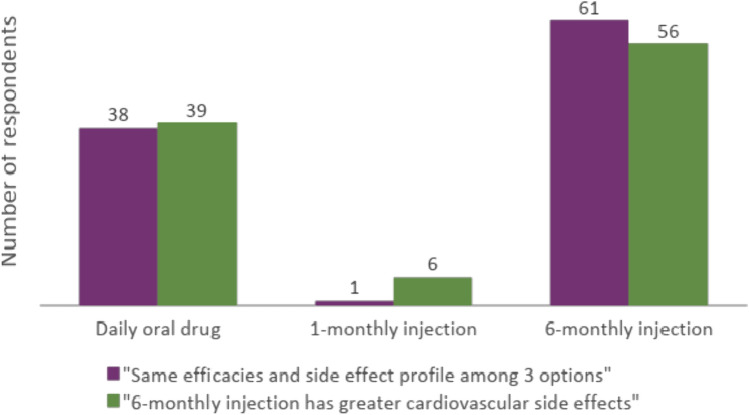
100 patients completed the survey. Most patients started with more frequent injections (3-monthly, 54%; 1-monthly, 38%) and switched to 6-monthly injections (89%) at the time of the survey. Primary reasons for the change were healthcare opinion (72%) and less frequent treatment (51%). Three options of ADT (oral daily, 1-monthly and 6-monthly injection) with the same efficacies and side effect profile were offered: 61% preferred 6-monthly injection, 1% preferred 1-monthly injection and 38% preferred oral regimen. When patients were informed of lower cardiovascular side effects in 1-monthly injection or daily oral drug, patients' preference was 56% (6-monthly), 6% (1-monthly), and 39% (oral). Patients with polypharmacy (more than 5 regular medications) were more inclined to choose injections (p = 0.025). Patient age, educational background, employment status, marriage status and disease status were not found to be statistically significant contributing factors to patient preference.
6-monthly ADT injection was the preferred ADT despite greater cardiovascular risks. Among 1-monthly or daily oral LHRH antagonist, more patients prefer oral option. Convenience factor was highly valued.
本研究旨在调查前列腺癌患者选择去势治疗(ADT)的情况,以及可能影响他们对 ADT 偏好的因素。
这是一项单中心横断面研究,调查 ADT 的使用情况和偏好。连续入组来自一家三级学术医院前列腺癌诊所正在接受注射促黄体激素释放激素(LHRH)激动剂或拮抗剂治疗的前列腺癌患者。排除接受双侧睾丸切除术或无法同意参与研究的患者。记录疾病特征、治疗信息和患者背景。该调查收集了与 ADT 方案改变、药物使用偏好(给药途径和频率)及其原因相关的信息。设计了一套假设的三种药物处方。采用问卷调查的形式提出了关于患者偏好及其相关原因的问题。
100 例患者完成了调查。大多数患者开始时接受更频繁的注射(3 个月,54%;1 个月,38%),在调查时转为 6 个月注射(89%)。改变的主要原因是医疗保健意见(72%)和治疗频率降低(51%)。提供了三种具有相同疗效和副作用特征的 ADT(口服每日、每月 1 次和每 6 个月 1 次注射):61%的患者更喜欢 6 个月注射,1%的患者更喜欢每月 1 次注射,38%的患者更喜欢口服方案。当患者被告知每月 1 次注射或每日口服药物的心血管副作用较低时,患者的偏好分别为 56%(6 个月)、6%(每月 1 次)和 39%(口服)。同时服用多种药物(超过 5 种常规药物)的患者更倾向于选择注射(p=0.025)。患者年龄、教育背景、就业状况、婚姻状况和疾病状况均未被发现是影响患者偏好的统计学显著因素。
尽管心血管风险较高,但 6 个月 ADT 注射仍是首选 ADT。在每月 1 次或每日口服 LHRH 拮抗剂中,更多患者更喜欢口服方案。便利性因素受到高度重视。