Research Department of Primary Care and Population Health, Centre for Ageing and Population Studies, UCL, London.
Department of Neurology, Institute of Neurology, UCL, London.
Br J Gen Pract. 2024 Jun 27;74(744):e482-e488. doi: 10.3399/BJGP.2023.0423. Print 2024 Jul.
A history of anxiety is more common in people with Parkinson's disease (PD). The prospective risk of PD in those newly presenting with anxiety and factors that increase the risk of PD in patients with anxiety have not been investigated.
To investigate the incidence of PD in people with anxiety aged ≥50 years and clinical features associated with later diagnosis of PD in people with anxiety.
A retrospective cohort study using UK primary care data between 2008 and 2018, assessing patients with new-onset anxiety aged ≥50 years.
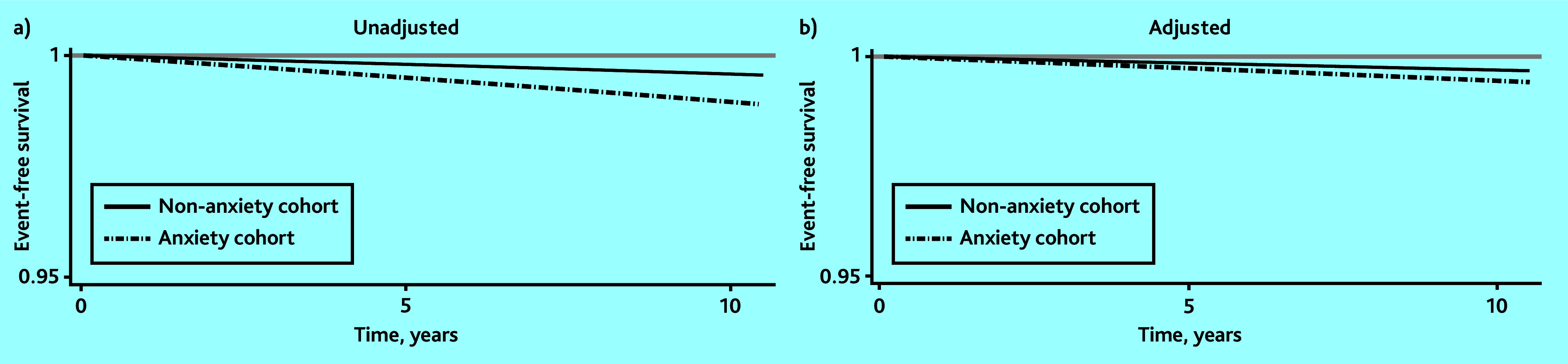
Weibull survival regression models were fitted and hazard ratios (HRs) for modelling time-to-PD was estimated in those with and without anxiety, and when determining the risk of developing PD in those with anxiety. Results were adjusted for sociodemographic and lifestyle factors, and relevant physical and mental health conditions.
The risk of PD increased two-fold compared with the non-anxiety group after adjustment for age, sex, social deprivation, lifestyle factors, severe mental illness, head trauma, and dementia (HR 2.1, 95% confidence interval = 1.9 to 2.4). In those with anxiety, the presence of depression, hypotension, tremor, rigidity, balance impairment, constipation, sleep disturbance, fatigue, and cognitive impairment were associated with an increased risk of developing PD.
The risk of developing PD was at least doubled in people with anxiety compared with those without. The clinical features of those who developed PD can help identify patients presenting with anxiety who are in the prodromal phase of PD.
焦虑症在帕金森病(PD)患者中更为常见。那些新出现焦虑症的人患 PD 的前瞻性风险以及增加焦虑症患者患 PD 风险的因素尚未得到调查。
调查≥50 岁新出现焦虑症患者中 PD 的发病率以及与焦虑症患者随后诊断为 PD 相关的临床特征。
这是一项回顾性队列研究,使用 2008 年至 2018 年英国初级保健数据,评估≥50 岁新出现焦虑症的患者。
使用 Weibull 生存回归模型,对有和无焦虑症的患者进行建模时间至 PD 的风险比(HR)估计,并确定焦虑症患者发生 PD 的风险。结果调整了社会人口统计学和生活方式因素以及相关的身心健康状况。
与非焦虑组相比,调整年龄、性别、社会剥夺、生活方式因素、严重精神疾病、头部创伤和痴呆后,PD 的风险增加了两倍(HR 2.1,95%置信区间= 1.9 至 2.4)。在有焦虑症的患者中,抑郁、低血压、震颤、僵硬、平衡障碍、便秘、睡眠障碍、疲劳和认知障碍的存在与发生 PD 的风险增加相关。
与无焦虑症的患者相比,有焦虑症的患者发生 PD 的风险至少增加了一倍。出现 PD 的患者的临床特征有助于识别处于 PD 前驱期的出现焦虑症的患者。