Department of Anatomy and Developmental Biology, Monash University, Clayton, VIC, Australia.
Mogrify Limited, Cambridge, England, UK.
Sci Rep. 2024 Mar 21;14(1):6749. doi: 10.1038/s41598-024-57242-4.
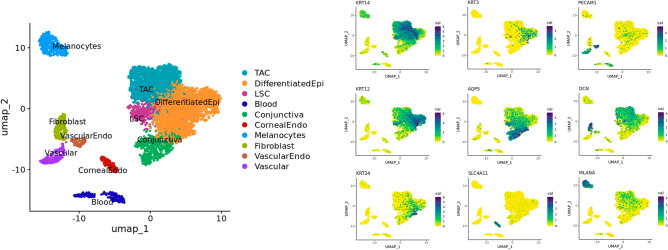
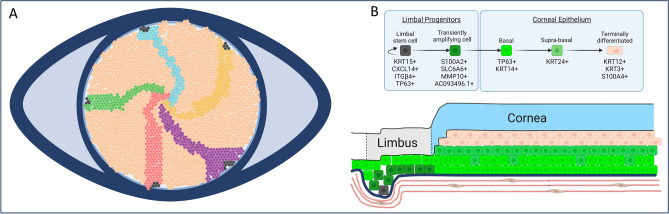
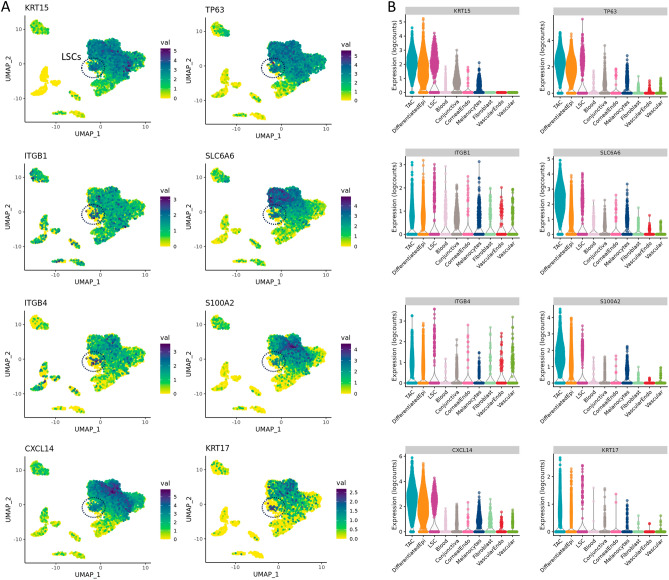
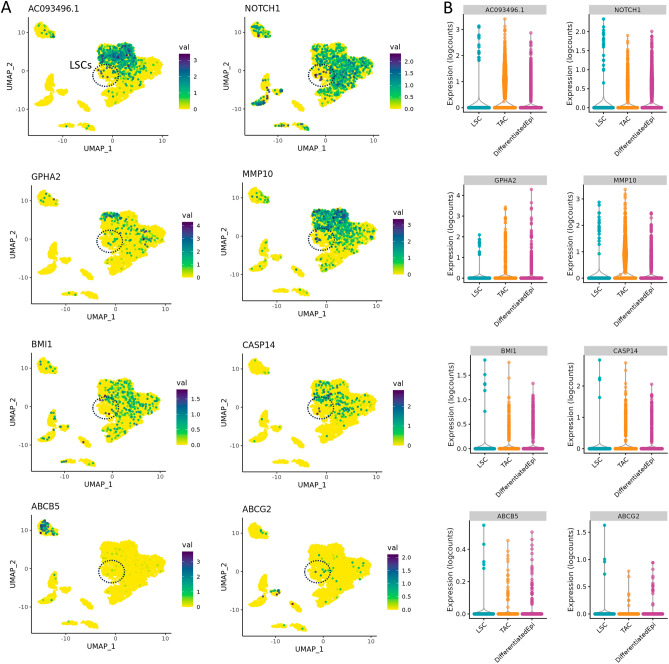
The corneal epithelium acts as a barrier to pathogens entering the eye; corneal epithelial cells are continuously renewed by uni-potent, quiescent limbal stem cells (LSCs) located at the limbus, where the cornea transitions to conjunctiva. There has yet to be a consensus on LSC markers and their transcriptome profile is not fully understood, which may be due to using cadaveric tissue without an intact stem cell niche for transcriptomics. In this study, we addressed this problem by using single nuclei RNA sequencing (snRNAseq) on healthy human limbal tissue that was immediately snap-frozen after excision from patients undergoing cataract surgery. We identified the quiescent LSCs as a sub-population of corneal epithelial cells with a low level of total transcript counts. Moreover, TP63, KRT15, CXCL14, and ITGβ4 were found to be highly expressed in LSCs and transiently amplifying cells (TACs), which constitute the corneal epithelial progenitor populations at the limbus. The surface markers SLC6A6 and ITGβ4 could be used to enrich human corneal epithelial cell progenitors, which were also found to specifically express the putative limbal progenitor cell markers MMP10 and AC093496.1.
角膜上皮作为病原体进入眼睛的屏障; 位于角膜缘的单潜能静止的角膜缘干细胞 (LSCs) 不断更新角膜上皮细胞,角膜缘是角膜向结膜过渡的地方。目前还没有关于 LSC 标志物的共识,其转录组谱也不完全清楚,这可能是由于使用没有完整干细胞龛的尸体组织进行转录组学研究。在这项研究中,我们通过对从接受白内障手术的患者中切除后立即冷冻的健康人角膜缘组织进行单细胞 RNA 测序 (snRNAseq) 来解决这个问题。我们发现,静止的 LSCs 是角膜上皮细胞的一个亚群,其总转录物计数水平较低。此外,TP63、KRT15、CXCL14 和 ITGβ4 在 LSCs 和瞬时扩增细胞 (TAC) 中高度表达,它们构成了角膜缘的角膜上皮祖细胞群体。表面标志物 SLC6A6 和 ITGβ4 可用于富集人角膜上皮细胞祖细胞,也发现其特异性表达假定的角膜缘祖细胞标志物 MMP10 和 AC093496.1。