Hatem Okba, Kaçar Ömer Furkan, Kaçar Hüsna Kaya, Szentpéteri József L, Marosvölgyi Tamás, Szabó Éva
Doctoral School of Health Sciences, Faculty of Health Sciences, University of Pécs, Pécs, Hungary.
Department of Biochemistry and Medical Chemistry, Medical School, University of Pécs, Pécs, Hungary.
Front Nutr. 2024 Mar 7;11:1379772. doi: 10.3389/fnut.2024.1379772. eCollection 2024.
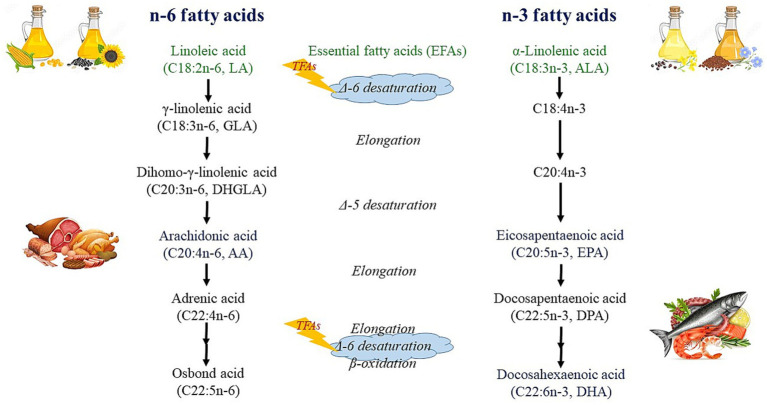
It is well known that long chain polyunsaturated fatty acids (LCPUFAs) play an important role in neurodevelopment in the perinatal life. The most important source of these fatty acids is the diet, however, they can also be formed in the human body from their shorter chain precursors, the essential fatty acids. Since the WHO recommends exclusive breastfeeding for the first six months after birth, the exclusive source of these fatty acids for breastfed infants is human milk, which can be influenced by the mother's diet. Unsaturated fatty acids can have either cis or configuration double bond in their chain with distinct physiological effects. Cis isomeric unsaturated fatty acids have several beneficial effects, while isomers are mostly detrimental, because of their similar structure to saturated fatty acids. fatty acids (TFAs) can be further subdivided into industrial (iTFA) and ruminant-derived fatty acids (rTFA). However, the physiological effects of these two TFA subgroups may differ. In adults, dietary intake of iTFA has been linked to atherosclerosis, insulin resistance, obesity, chronic inflammation, and increased development of certain cancers, among other diseases. However, iTFAs can have a negative impact on health not only in adulthood but in childhood too. Results from previous studies have shown that iTFAs have a significant negative effect on LCPUFA levels in the blood of newborns and infants. In addition, iTFAs can affect the growth and development of infants, and animal studies suggest that they might even have lasting negative effects later in life. Since the only source of TFAs in the human body is the diet, the TFA content of breast milk may determine the TFA supply of breastfed infants and thus affect the levels of LCPUFAs important for neurodevelopment and the health of infants. In this review, we aim to provide an overview of the TFA content in human milk available in the literature and their potential effects on infant health and development.
众所周知,长链多不饱和脂肪酸(LCPUFAs)在围产期神经发育中起着重要作用。这些脂肪酸最重要的来源是饮食,然而,它们也可以在人体内由其较短链的前体——必需脂肪酸形成。由于世界卫生组织建议出生后前六个月进行纯母乳喂养,母乳喂养婴儿这些脂肪酸的唯一来源是母乳,而母乳会受到母亲饮食的影响。不饱和脂肪酸在其链中可以有顺式或反式构型的双键,具有不同的生理效应。顺式异构不饱和脂肪酸有多种有益作用,而反式异构体大多有害,因为它们的结构与饱和脂肪酸相似。反式脂肪酸(TFAs)可进一步细分为工业来源反式脂肪酸(iTFA)和反刍动物来源反式脂肪酸(rTFA)。然而,这两个反式脂肪酸亚组的生理效应可能不同。在成年人中,饮食中摄入iTFA与动脉粥样硬化、胰岛素抵抗、肥胖、慢性炎症以及某些癌症的发病率增加等多种疾病有关。然而,iTFAs不仅在成年期,在儿童期也会对健康产生负面影响。先前研究结果表明,iTFAs对新生儿和婴儿血液中LCPUFA水平有显著负面影响。此外,iTFAs会影响婴儿的生长发育,动物研究表明,它们甚至可能在以后的生活中产生持久的负面影响。由于人体中反式脂肪酸的唯一来源是饮食,母乳中的反式脂肪酸含量可能决定母乳喂养婴儿的反式脂肪酸供应,从而影响对神经发育和婴儿健康至关重要的LCPUFAs水平。在本综述中,我们旨在概述文献中报道的母乳中反式脂肪酸含量及其对婴儿健康和发育的潜在影响。