Department of Genetics and Genome Biology, University of Leicester, University Road, Leicester, UK.
Institute for Evolution and Biodiversity, University of Muenster, Huefferstrabe, Muenster, Germany.
BMC Genomics. 2024 Mar 22;25(1):305. doi: 10.1186/s12864-024-10211-7.
The ageing process is a multifaceted phenomenon marked by the gradual deterioration of cellular and organismal functions, accompanied by an elevated susceptibility to diseases. The intricate interplay between genetic and environmental factors complicates research, particularly in complex mammalian models. In this context, simple invertebrate organisms have been pivotal, but the current models lack detectable DNA methylation limiting the exploration of this critical epigenetic ageing mechanism. This study introduces Nasonia vitripennis, the jewel wasp, as an innovative invertebrate model for investigating the epigenetics of ageing. Leveraging its advantages as a model organism and possessing a functional DNA methylation system, Nasonia emerges as a valuable addition to ageing research.
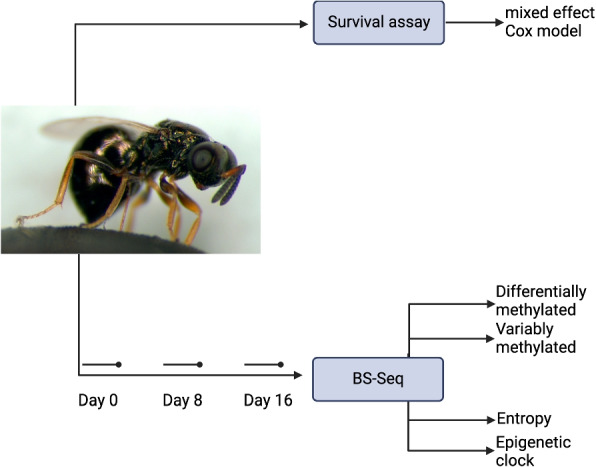
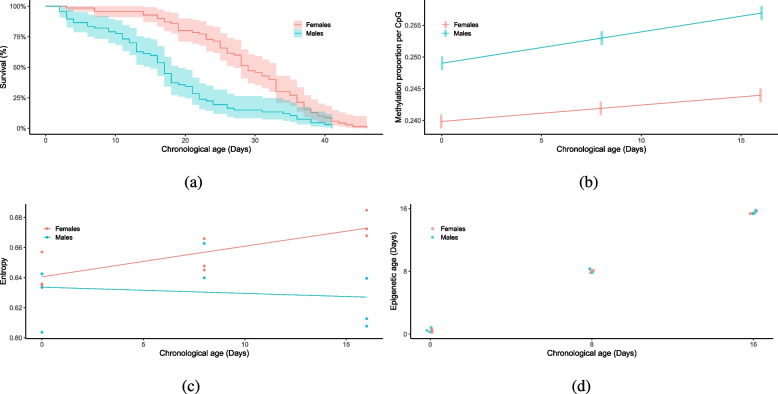
Whole-genome bisulfite sequencing unveiled dynamic alterations in DNA methylation, with differentially methylated CpGs between distinct time points in both male and female wasps. These changes were associated with numerous genes, enriching for functions related to telomere maintenance, histone methylation, and mRNA catabolic processes. Additionally, other CpGs were found to be variably methylated at each timepoint. Sex-specific effects on epigenetic entropy were observed, indicating differential patterns in the loss of epigenetic stability over time. Constructing an epigenetic clock containing 19 CpGs revealed a robust correlation between epigenetic age and chronological age.
Nasonia vitripennis emerges as a promising model for investigating the epigenetics of ageing, shedding light on the intricate dynamics of DNA methylation and their implications for age-related processes. This research not only expands the repertoire of ageing models but also opens avenues for deeper exploration of epigenetic mechanisms in the context of ageing.
衰老过程是一个多方面的现象,其特征是细胞和机体功能逐渐恶化,并伴随着疾病易感性的增加。遗传和环境因素的复杂相互作用使得研究变得复杂,特别是在复杂的哺乳动物模型中。在这种情况下,简单的无脊椎动物已经成为关键,但当前的模型缺乏可检测的 DNA 甲基化,限制了对这一关键表观遗传衰老机制的探索。本研究引入了丽蝇蛹金小蜂(Nasonia vitripennis),作为一种研究衰老表观遗传学的新型无脊椎动物模型。利用其作为模式生物的优势和功能性 DNA 甲基化系统,丽蝇蛹金小蜂成为衰老研究的宝贵补充。
全基因组亚硫酸氢盐测序揭示了 DNA 甲基化的动态变化,在雄性和雌性蜂蛹的不同时间点之间存在差异甲基化的 CpG。这些变化与许多基因相关,丰富了与端粒维持、组蛋白甲基化和 mRNA 分解代谢过程相关的功能。此外,还发现其他 CpG 在每个时间点都存在可变甲基化。观察到了性别特异性对表观遗传熵的影响,表明在随着时间的推移,表观遗传稳定性丧失的模式存在差异。构建一个包含 19 个 CpG 的表观遗传时钟显示,表观遗传年龄与实际年龄之间存在很强的相关性。
丽蝇蛹金小蜂作为研究衰老表观遗传学的有前途的模型,揭示了 DNA 甲基化的复杂动态及其对与年龄相关过程的影响。这项研究不仅扩展了衰老模型的范围,还为在衰老背景下深入探索表观遗传机制开辟了途径。