Department of Surgical Sciences, Anesthesiology and Intensive Care, Uppsala University, Akademiska Sjukhuset, Ingång 70, 75 185, Uppsala, Sweden.
Department of Medical Cell Biology, Unit for Integrative Physiology, Uppsala University, Uppsala, Sweden.
Crit Care. 2024 Mar 24;28(1):98. doi: 10.1186/s13054-024-04881-8.
Sepsis is a condition where the immune response to infection becomes dysregulated and life-threatening. It is not known whether lifestyle factors influence the risk of sepsis. The aim of the present study is to investigate the association between physical activity and the risk of acquiring and dying in infection or sepsis.
The population-based Swedish Mammography Cohort and Cohort of Swedish Men sent participants lifestyle questionnaires in 1997 and have subsequently followed participants in national Swedish registers, including the National Patient Register, the Swedish Intensive Care Registry and the Cause of Death Register. The risk of contracting infection and sepsis, the risk of intensive care unit admission and the risk of death were estimated using multivariable Cox regression.
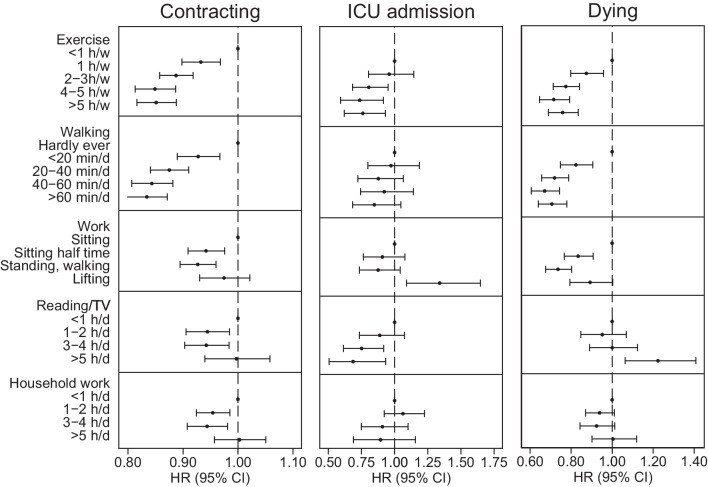
Among 64,850 cohort participants, 26,124 individuals suffered at least one episode of infection or sepsis and 4708 individuals died of infection or sepsis during the study period. In adjusted analyses, compared to exercising less than one hour per week, stated exercise one hour per week was associated with lower risk of contracting infection or sepsis, hazard ratio (HR) 0.93 (95% confidence interval (CI) 0.90-0.97), and lower risk of dying in infection or sepsis, HR 0.87 (95% CI 0.80-0.96). Further exercise was associated with even lower risk, and similar patterns were observed for walking. The population-attributable risks of contracting and dying in infection or sepsis for not exercising were 2.6% and 4.5%, respectively.
Exercise and walking demonstrate inverse dose-response associations with both the risk of contracting and dying in infection and sepsis, presenting possible preventative interventions for this critical condition.
败血症是一种由于感染导致的免疫反应失调而危及生命的病症。目前尚不清楚生活方式因素是否会影响败血症的发病风险。本研究旨在调查身体活动与感染和败血症发病及死亡风险之间的关系。
基于人群的瑞典乳腺普查队列和瑞典男性队列在 1997 年向参与者发送了生活方式调查问卷,并随后通过国家瑞典登记处对参与者进行了随访,包括国家患者登记处、瑞典重症监护登记处和死因登记处。采用多变量 Cox 回归估计了感染和败血症发病风险、入住重症监护病房风险和死亡风险。
在 64850 名队列参与者中,26124 人至少发生过一次感染或败血症,4708 人在研究期间死于感染或败血症。在调整后的分析中,与每周运动不足 1 小时相比,每周运动 1 小时与感染或败血症发病风险降低相关,风险比(HR)为 0.93(95%置信区间(CI)为 0.90-0.97),并且感染或败血症死亡风险降低,HR 为 0.87(95% CI 为 0.80-0.96)。进一步的运动与更低的风险相关,步行也呈现出类似的模式。不运动导致感染和败血症发病和死亡的人群归因风险分别为 2.6%和 4.5%。
运动和步行与感染和败血症的发病和死亡风险呈负相关,提示这一关键疾病存在可能的预防干预措施。