Babaita Abdulfatai Olamilekan, Kako Mayumi, Teramoto Chie, Okamoto Miho, Hayashi Yoko, Ohshimo Shinichiro, Sadamori Takuma, Hattori Minoru, Moriyama Michiko
Graduate School of Biomedical and Health Sciences, Program of Health Sciences, Hiroshima University, Hiroshima, Japan.
Division of Nursing Science, Graduate School of Biomedical and Health Sciences, Hiroshima University, Kasumi 1-2-3 Minami-ku, Hiroshima, 734-8553, Japan.
BMC Nurs. 2024 Mar 25;23(1):199. doi: 10.1186/s12912-024-01866-4.
The practical sessions during skills laboratory simulation or clinical simulation are cores of nursing education. For this, different modalities have been devised to facilitate psychomotor skills learning. One of the commonly used educational material or instructional method to supplement skills learning across various disciplines is video-based teaching method. The opportunities of traditional two-dimensional video might be limitless and maximized with 360º virtual reality (VR) video, which offers immersive experience. This study incorporates 360º VR video into skills laboratory training as an alternative approach to face-to-face procedure demonstration.
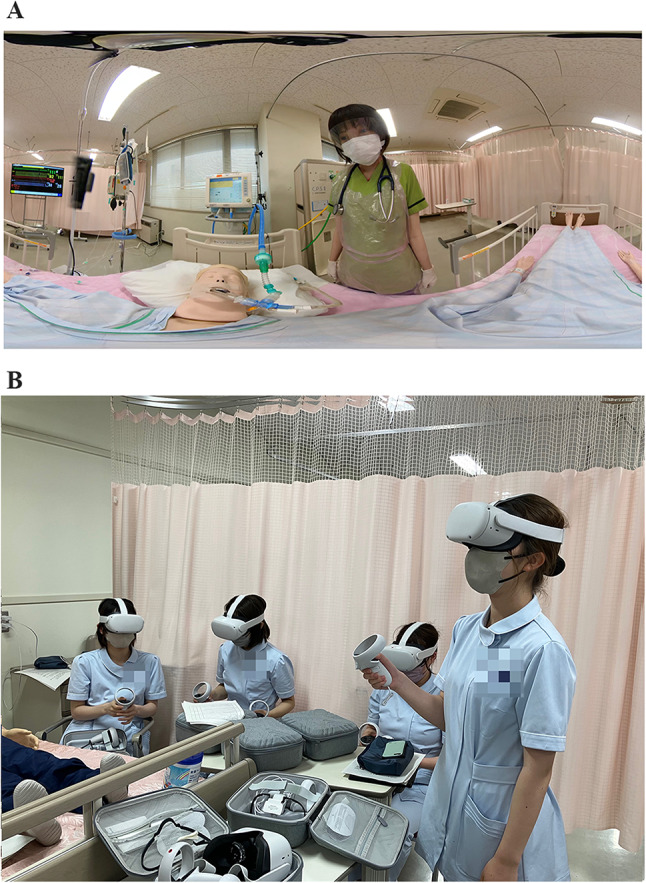
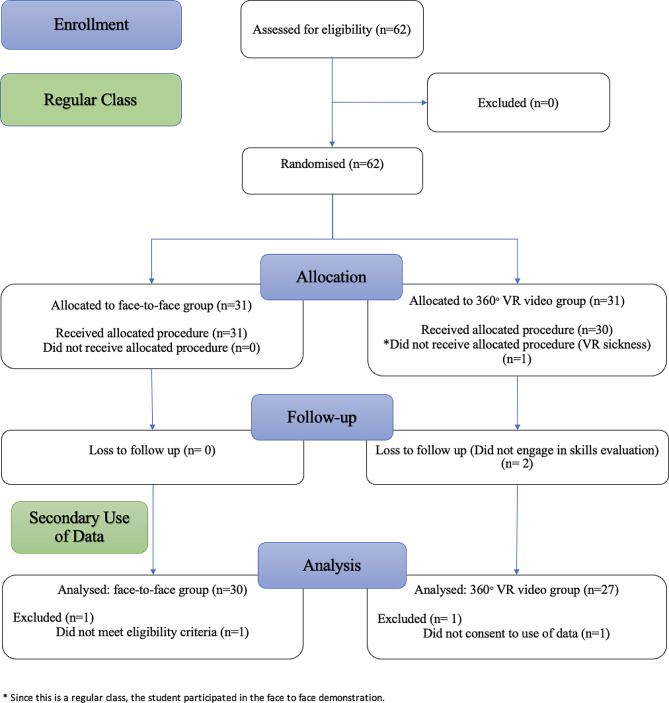
An open-label, parallel (1:1), randomized controlled trial study was conducted among third-year undergraduate nursing students at Hiroshima University, Japan. The nursing students were block-randomized into 360º VR video and face-to-face demonstration group. After a 3-hour theoretical class of patient management on ventilator and closed-suction principles of mechanically ventilated patients in an Intensive Care Unit focused class, the 360º VR group watched the 360º VR video of closed tracheal suction (including oral) using the head-mounted display of Meta Quest 2 individually, while the face-to-face group attended the instructor's demonstration. A week after the skills laboratory, the students' psychomotor skills, knowledge, satisfaction, confidence were evaluated; the 360º VR video group's perception was explored; Wilcoxon rank-sum test was used to compare the two groups.
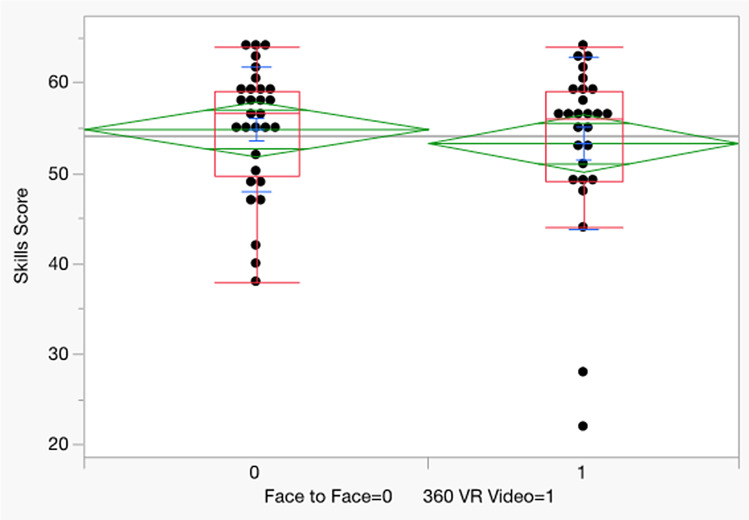
A total of 57 students were analyzed; 27 students in the 360º VR video group and 30 students in face-to-face group. There were no statistically significant differences between both groups in skills, knowledge, and confidence. However, the face-to-face group had higher satisfaction level than the 360º VR group; this difference was statistically significant. In the 360º VR video group, 62% agreed that VR makes learning more interesting; more than half of students (62.5%) experienced VR sickness symptoms, and "feeling of drunk" is the highest. The students appreciated the ready to use, immersiveness, and realism; however, symptoms and discomfort, burdensomeness, and production limitations were improvements recommended.
Although face-to-face demonstration is the established method of teaching psychomotor skills to nursing students, the use of 360º VR video could achieve similar learning effect as an alternative approach.
技能实验室模拟或临床模拟中的实践课程是护理教育的核心。为此,人们设计了不同的模式来促进运动技能学习。在各个学科中,常用的补充技能学习的教学材料或教学方法之一是基于视频的教学方法。传统二维视频的机会可能是无限的,而360º虚拟现实(VR)视频提供沉浸式体验,能将其机会最大化。本研究将360ºVR视频纳入技能实验室培训,作为面对面操作演示的替代方法。
在日本广岛大学的三年级本科护理学生中进行了一项开放标签、平行(1:1)随机对照试验研究。护理学生被整群随机分为360ºVR视频组和面对面演示组。在重症监护病房聚焦课程中,进行了为期3小时的关于呼吸机患者管理和机械通气患者密闭吸痰原理的理论课程后,360ºVR组学生各自使用Meta Quest 2头戴式显示器观看密闭气管吸痰(包括口腔吸痰)的360ºVR视频,而面对面组学生观看教师演示。在技能实验室课程一周后,对学生的运动技能、知识、满意度、信心进行评估;探索360ºVR视频组学生的看法;使用Wilcoxon秩和检验比较两组。
共分析了57名学生;360ºVR视频组27名学生,面对面组30名学生。两组在技能、知识和信心方面无统计学显著差异。然而,面对面组的满意度高于360ºVR组;这一差异具有统计学意义。在360ºVR视频组中,62%的学生同意VR使学习更有趣;超过一半的学生(62.5%)出现VR晕动症状,其中“醉酒感”最为常见。学生们赞赏其易于使用、沉浸感和真实感;然而,建议改进症状和不适、繁琐程度以及制作限制等方面。
虽然面对面演示是向护理学生教授运动技能的既定方法,但使用360ºVR视频作为替代方法可取得类似的学习效果。