CAMS Key Laboratory of Translational Research on Lung Cancer, State Key Laboratory of Molecular Oncology, Department of Medical Oncology, National Cancer Center/National Clinical Research Center for Cancer/Cancer Hospital, Chinese Academy of Medical Sciences, Peking Union Medical College, Beijing, China.
CAS Key Laboratory of Mental Health, Institute of Psychology, Chinese Academy of Sciences, Beijing, China.
Thorac Cancer. 2024 May;15(13):1041-1049. doi: 10.1111/1759-7714.15287. Epub 2024 Mar 24.
The psychological well-being of lung cancer patients is critical in-patient care but frequently overlooked.
This study, employing a cross-sectional, questionnaire-based design, aimed to elucidate the prevalence of depressive and anxiety symptoms among lung cancer patients and identify associated risk factors. Participants' demographic, medical history, disease stage, and pathology were systematically collected. Psychological assessment was conducted using the general anxiety disorder-7 (GAD-7), patient health questionnaire-9 (PHQ-9), and hospital anxiety and depression scale (HADS). Statistical analyses were performed using SPSS software (version 25.0).
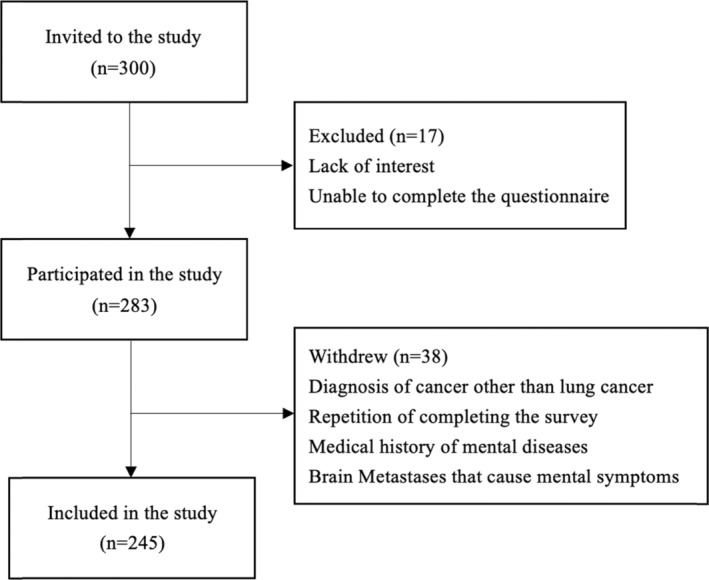
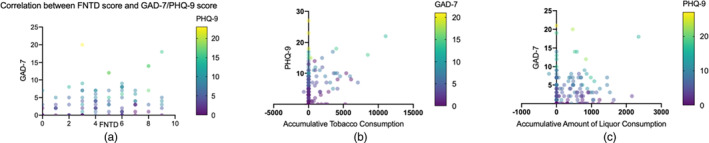
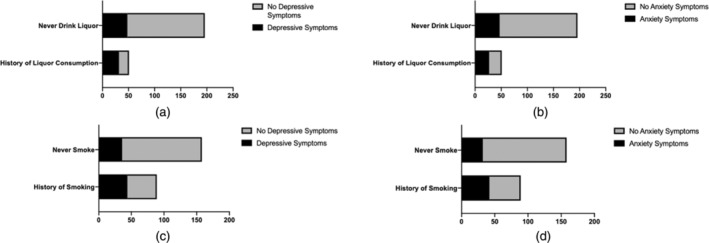
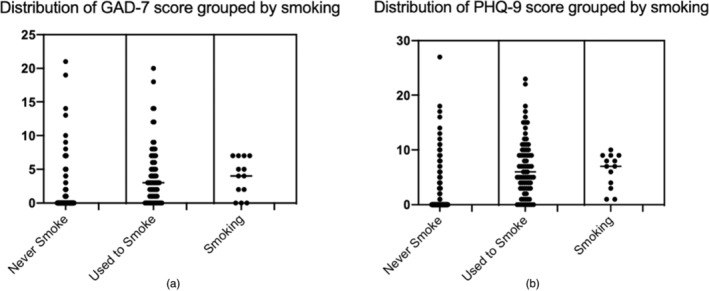
Out of 294 distributed questionnaires, 247 lung cancer patients were included in the final analysis, with an average completion time of 9.08 min. Notably, 32.4% exhibited depressive symptoms, while 30% displayed signs of anxiety. A significant correlation was found between both depressive and anxiety symptoms and a history of tobacco and alcohol consumption. Specifically, increased nicotine dependence and greater cumulative tobacco use were linked to higher rates of depressive symptoms, whereas cumulative alcohol consumption was associated with increased risks of anxiety symptoms.
The study affirms the feasibility of GAD-7, PHQ-9, and HADS as screening tools for depressive and anxiety symptoms in lung cancer patients. It further highlights tobacco and alcohol consumption as significant risk factors for poor psychological health in this population.
肺癌患者的心理健康是患者护理中的关键,但常常被忽视。
本研究采用横断面问卷调查设计,旨在阐明肺癌患者抑郁和焦虑症状的患病率,并确定相关的风险因素。系统收集参与者的人口统计学、病史、疾病分期和病理信息。使用广泛性焦虑障碍 7 项量表(GAD-7)、患者健康问卷 9 项量表(PHQ-9)和医院焦虑抑郁量表(HADS)进行心理评估。使用 SPSS 软件(版本 25.0)进行统计分析。
在发放的 294 份问卷中,247 例肺癌患者纳入最终分析,平均完成时间为 9.08 分钟。值得注意的是,32.4%的患者表现出抑郁症状,30%的患者表现出焦虑症状。抑郁和焦虑症状与吸烟和饮酒史之间存在显著相关性。具体而言,尼古丁依赖程度增加和累计吸烟量增加与抑郁症状发生率升高相关,而累计饮酒量与焦虑症状风险增加相关。
本研究证实 GAD-7、PHQ-9 和 HADS 可作为肺癌患者抑郁和焦虑症状的筛查工具。此外,研究还强调了吸烟和饮酒是该人群心理健康不良的重要风险因素。