Conde Esther, Hernandez Susana, Rodriguez Carrillo Jose Luis, Martinez Rebeca, Alonso Marta, Curto Daniel, Jimenez Beatriz, Caminoa Alejandra, Benito Amparo, Garrido Pilar, Clave Sergi, Arriola Edurne, Esteban-Rodriguez Isabel, De Castro Javier, Sansano Irene, Felip Enriqueta, Rojo Federico, Dómine Manuel, Abdulkader Ihab, Garcia-Gonzalez Jorge, Teixido Cristina, Reguart Noemi, Compañ Desamparados, Insa Amelia, Mancheño Nuria, Palanca Sarai, Juan-Vidal Oscar, Baixeras Nuria, Nadal Ernest, Cebollero Maria, Calles Antonio, Martin Paloma, Salas Clara, Provencio Mariano, Aranda Ignacio, Massuti Bartomeu, Lopez-Vilaro Laura, Majem Margarita, Paz-Ares Luis, Lopez-Rios Fernando
Hospital Universitario 12 de Octubre, Madrid, Spain.
Universidad Complutense, Madrid, Spain.
JTO Clin Res Rep. 2024 Feb 20;5(4):100653. doi: 10.1016/j.jtocrr.2024.100653. eCollection 2024 Apr.
inhibitors with impressive overall response rates are now available for patients with NSCLC, yet the identification of fusions remains a difficult challenge. Most guidelines encourage the upfront use of next-generation sequencing (NGS), or alternatively, fluorescence in situ hybridization (FISH) or reverse transcriptase-polymerase chain reaction (RT-PCR) when NGS is not possible or available. Taken together, the suboptimal performance of single-analyte assays to detect fusions, although consistent with the notion of encouraging universal NGS, is currently widening some of the clinical practice gaps in the implementation of predictive biomarkers in patients with advanced NSCLC.
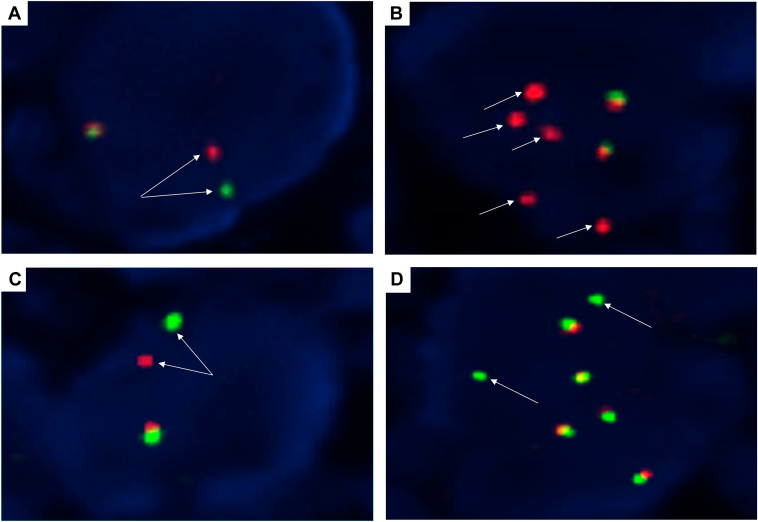
This situation prompted us to evaluate several assays in a large multicenter cohort of fusion-positive NSCLC (n = 38) to obtain real-world data. In addition to RNA-based NGS (the criterion standard method), all positive specimens underwent break-apart FISH with two different assays and were also tested by an RT-PCR assay.
The most common partners were (78.9%), followed by (15.8%). The two NGS-positive but FISH-negative samples contained a fusion. The three fusions not identified with RT-PCR were , and . All three false-negative RT-PCR cases were FISH-positive, exhibited a typical break-apart pattern, and contained a very high number of positive tumor cells with both FISH assays. Signet ring cells, psammoma bodies, and pleomorphic features were frequently observed (in 34.2%, 39.5%, and 39.5% of tumors, respectively).
In-depth knowledge of the advantages and disadvantages of the different testing methodologies could help clinical and molecular tumor boards implement and maintain sensible algorithms for the rapid and effective detection of fusions in patients with NSCLC. The likelihood of false-negative results with both FISH and RT-PCR reinforces the need for upfront NGS in patients with NSCLC.
对于非小细胞肺癌(NSCLC)患者,目前已有总体缓解率令人瞩目的抑制剂,但融合基因的鉴定仍然是一项艰巨的挑战。大多数指南鼓励在一线使用下一代测序(NGS),或者在无法进行或没有NGS时,使用荧光原位杂交(FISH)或逆转录聚合酶链反应(RT-PCR)。尽管鼓励普遍使用NGS,但单分析物检测在检测融合基因方面的性能欠佳,这目前正在扩大晚期NSCLC患者预测性生物标志物实施中的一些临床实践差距。
这种情况促使我们在一个大型多中心融合基因阳性NSCLC队列(n = 38)中评估几种检测方法,以获得真实世界的数据。除了基于RNA的NGS(标准标准方法)外,所有阳性标本均采用两种不同的检测方法进行分裂FISH检测,并通过RT-PCR检测。
最常见的融合伴侣是(78.9%),其次是(15.8%)。两个NGS阳性但FISH阴性的样本含有融合基因。RT-PCR未鉴定出的三个融合基因是、和。所有三个RT-PCR假阴性病例均为FISH阳性,呈现典型的分裂模式,并且两种FISH检测均显示阳性肿瘤细胞数量非常高。经常观察到印戒细胞、砂粒体和多形性特征(分别在34.2%、39.5%和39.5%的肿瘤中)。
深入了解不同检测方法的优缺点有助于临床和分子肿瘤委员会实施和维持合理的算法,以便快速有效地检测NSCLC患者的融合基因。FISH和RT-PCR出现假阴性结果的可能性增加了NSCLC患者一线使用NGS的必要性。