Hartmann Jessica C, Madlener Sarah J, van der Linde Christian, Ončák Milan, Beyer Martin K
Universität Innsbruck, Institut für Ionenphysik und Angewandte Physik, Technikerstraße 25, 6020 Innsbruck, Austria.
Phys Chem Chem Phys. 2024 Apr 3;26(14):10904-10918. doi: 10.1039/d4cp00357h.
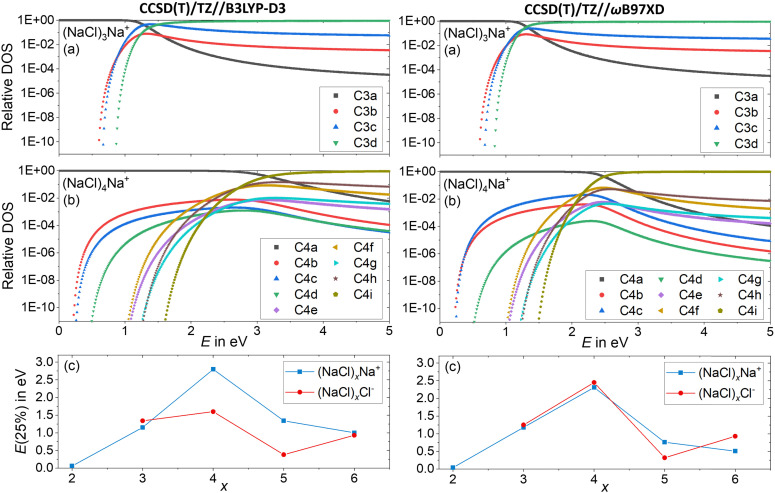
As one of the main components of sea salt aerosols, sodium chloride is involved in numerous atmospheric processes. Gas-phase clusters are ideal models to study fundamental physical and chemical properties of sodium chloride, which are significantly affected by the cluster size. Of particular interest are magic cluster sizes, which exhibit high intensities in mass spectra. In order to understand the origin of these magic cluster sizes, quantum chemical calculations at the CCSD(T)//DFT level are performed, yielding structures and binding energies of neutral (NaCl), anionic (NaCl)Cl and cationic (NaCl)Na clusters up to = 8. Our calculations show that the clusters can easily isomerize, enabling dissociation into the lowest-energy isomers of the fragments. Energetics can explain the special stability of (NaCl)Cl, but (NaCl)Na actually offers low-lying dissociation channels, despite being a magic cluster size. Collision-induced dissociation experiments reveal that the loss of neutral clusters (NaCl), = 2, 4, is in most cases more favorable than the loss of NaCl or the atomic ion, sodium chloride clusters actually fragment the cleavage of the entire cluster, not by evaporating small cluster building blocks. This is rationalized by the calculated high stability of even-numbered neutral clusters (NaCl), especially = 2, 4. Analysis of the density of states and rate constants calculated with a modified Rice-Ramsperger-Kassel-Marcus (RRKM) equation called AWATAR - considering all energetically accessible isomers of reactants and fragments - shows that entropic effects are responsible for the magic cluster character of (NaCl)Na. In particular, low-lying vibrational modes provide a high density of states of the near-planar cluster. Together with the small contribution of an atomic ion to the sum of states in a loose transition state for dissociation, this leads to a very small unimolecular rate constant for dissociation into (NaCl) and Na, which is the lowest energy fragmentation pathway. Thus, entropic effects may override energetics for certain magic cluster sizes.
作为海盐气溶胶的主要成分之一,氯化钠参与了众多大气过程。气相团簇是研究氯化钠基本物理和化学性质的理想模型,这些性质会受到团簇大小的显著影响。特别令人感兴趣的是幻数团簇大小,它们在质谱中表现出高强度。为了理解这些幻数团簇大小的起源,我们在CCSD(T)//DFT水平上进行了量子化学计算,得到了中性(NaCl)、阴离子(NaCl)Cl和阳离子(NaCl)Na团簇(直至N = 8)的结构和结合能。我们的计算表明,这些团簇很容易异构化,能够解离成碎片的最低能量异构体。能量学可以解释(NaCl)Cl的特殊稳定性,但(NaCl)Na实际上提供了低能解离通道,尽管它是一个幻数团簇大小。碰撞诱导解离实验表明,中性团簇(NaCl)(N = 2、4)的损失在大多数情况下比NaCl或原子离子的损失更有利,氯化钠团簇实际上是通过整个团簇的裂解而碎片化,而不是通过蒸发小的团簇构建块。这可以通过计算得出的偶数中性团簇(NaCl)(特别是N = 2、4)的高稳定性来解释。对使用称为AWATAR的改进Rice-Ramsperger-Kassel-Marcus (RRKM)方程计算的态密度和速率常数的分析——考虑反应物和碎片的所有能量上可及的异构体——表明熵效应是(NaCl)Na幻数团簇特征的原因。特别是,低能振动模式为近平面团簇提供了高的态密度。再加上原子离子在松散解离过渡态中对态总和的贡献很小,这导致解离成(NaCl)和Na的单分子速率常数非常小,而这是最低能量的碎片化途径。因此,对于某些幻数团簇大小,熵效应可能会超过能量学效应。