Department of Plant Sciences, University of California, Davis, CA 95616, USA.
Whitebark Pine Ecosystem Foundation, Missoula, MT 59808, USA.
G3 (Bethesda). 2024 May 7;14(5). doi: 10.1093/g3journal/jkae061.
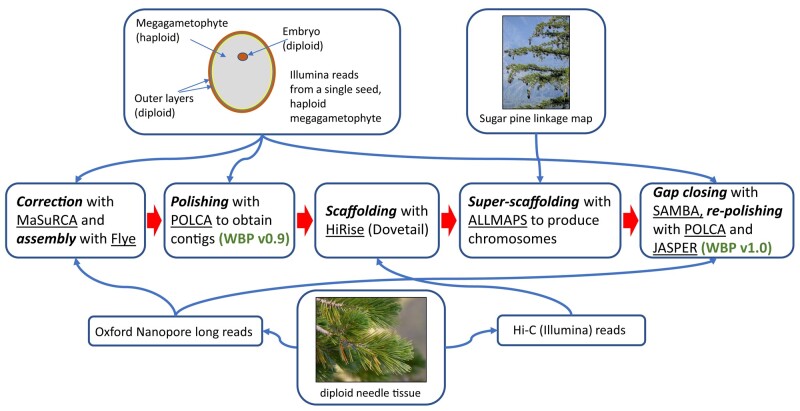
Whitebark pine (WBP, Pinus albicaulis) is a white pine of subalpine regions in the Western contiguous United States and Canada. WBP has become critically threatened throughout a significant part of its natural range due to mortality from the introduced fungal pathogen white pine blister rust (WPBR, Cronartium ribicola) and additional threats from mountain pine beetle (Dendroctonus ponderosae), wildfire, and maladaptation due to changing climate. Vast acreages of WBP have suffered nearly complete mortality. Genomic technologies can contribute to a faster, more cost-effective approach to the traditional practices of identifying disease-resistant, climate-adapted seed sources for restoration. With deep-coverage Illumina short reads of haploid megagametophyte tissue and Oxford Nanopore long reads of diploid needle tissue, followed by a hybrid, multistep assembly approach, we produced a final assembly containing 27.6 Gb of sequence in 92,740 contigs (N50 537,007 bp) and 34,716 scaffolds (N50 2.0 Gb). Approximately 87.2% (24.0 Gb) of total sequence was placed on the 12 WBP chromosomes. Annotation yielded 25,362 protein-coding genes, and over 77% of the genome was characterized as repeats. WBP has demonstrated the greatest variation in resistance to WPBR among the North American white pines. Candidate genes for quantitative resistance include disease resistance genes known as nucleotide-binding leucine-rich repeat receptors (NLRs). A combination of protein domain alignments and direct genome scanning was employed to fully describe the 3 subclasses of NLRs. Our high-quality reference sequence and annotation provide a marked improvement in NLR identification compared to previous assessments that leveraged de novo-assembled transcriptomes.
白皮松(WBP,Pinus albicaulis)是美国西部和加拿大亚高山地区的一种白松。由于引入的真菌病原体白皮松疱锈病(WPBR,Cronartium ribicola)和山松甲虫(Dendroctonus ponderosae)、野火以及因气候变化导致的适应性不良等额外威胁,WBP 在其自然分布的很大一部分地区已受到严重威胁。大片的 WBP 几乎已经全部死亡。基因组技术可以为传统的鉴定具有抗病性、适应气候变化的种子资源以进行恢复的做法提供更快、更具成本效益的方法。我们使用 Illumina 高通量短读长的单体雌配子体组织和 Oxford Nanopore 长读长的二倍体针叶组织进行测序,然后采用混合、多步骤组装方法,最终组装得到一个包含 27.6 Gb 序列的基因组,由 92740 个 contigs(N50 为 537007 bp)和 34716 个 scaffolds(N50 为 2.0 Gb)组成。大约 87.2%(24.0 Gb)的总序列被定位到 12 条 WBP 染色体上。注释得到了 25362 个蛋白质编码基因,超过 77%的基因组被鉴定为重复序列。WBP 表现出对 WPBR 的最高抗性变异,在北美白松中最为明显。定量抗性的候选基因包括被称为核苷酸结合富含亮氨酸重复受体(NLRs)的抗病基因。我们采用了蛋白结构域比对和直接基因组扫描相结合的方法,对 3 类 NLR 进行了全面描述。与以前利用从头组装转录组进行的评估相比,我们的高质量参考序列和注释显著提高了 NLR 的鉴定能力。